



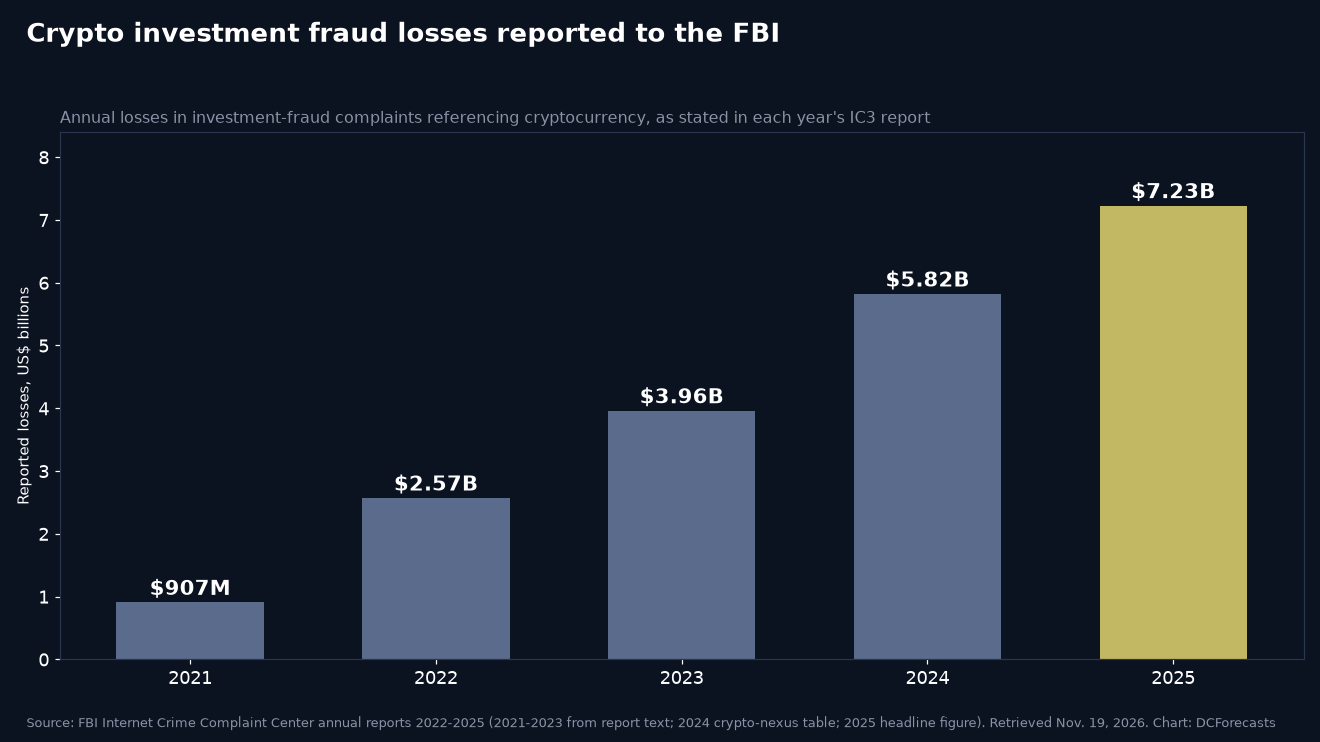
The U.S. Treasury opened another front against the overseas networks behind crypto investment scams on Nov. 19, sanctioning three men and two companies tied to scam compounds in Cambodia and on the Thai-Burmese border. The action lands as FBI data shows Americans reported $7.228 billion in crypto investment fraud losses in 2025, nearly eight times the 2021 total.
The targets are not crypto platforms but the people who lease, own and guard the buildings where trafficked workers run fake trading apps. Treasury Secretary Scott Bessent said the department “has aggressively targeted overseas scam compounds to protect Americans from fraud” and will keep using “all available tools” against them.
Who Treasury Sanctioned on Nov. 19
According to the Treasury press release, the Office of Foreign Assets Control (OFAC) designated:
- Zhao Hui, a Cambodian national who leased a scam center owned by the already sanctioned Prince Group and paid protection fees to its leader, Chen Zhi. Treasury says Zhao also owned a separate scam compound in Cambodia that mainly targeted Americans and Europeans, where he was directly involved in operations.
- Bei Fang Bo Lin Construction Decoration Co., Ltd. and ZHZ Investment Consulting Co., Ltd., two Cambodia-based firms where Zhao chairs the board.
- General Saw Shwe Wah, commander-in-chief of the Democratic Karen Benevolent Army (DKBA) since December 2025, who replaced General Saw Steel after OFAC designated him in November 2025.
- Colonel Saw A One, the DKBA commander overseeing security around Three Pagodas Pass in Karen State, where Treasury says new buildings for scam operations have been going up. He reportedly owns a plantation where scam operations take place.
Treasury describes the DKBA as an armed group that provides security for scam compounds, lets them operate and takes part in violence against trafficking victims held inside. All five designations fall under Executive Order 13694, as amended, and support Executive Order 14390 of March 6, 2026, which directs agencies to use every available tool against foreign networks that defraud Americans.
A Follow-Up to the Prince Group Crackdown
The new action builds on earlier moves against the same ecosystem. Earlier this month, DCForecasts reported on Treasury’s sanctions on 45 more Prince Group targets while 127,271 seized bitcoin awaited a final forfeiture decision. Zhao’s case shows investigators moving from headline names toward landlords and security providers.
Treasury said the Nov. 19 action was coordinated with the FBI’s New York Field Office, the Justice Department’s Scam Center Strike Force, the Drug Enforcement Administration, and the Homeland Security Task Force and National Coordination Center.
Crypto Investment Fraud Losses Nearly Eightfold Since 2021
The numbers explain the urgency. The FBI’s Internet Crime Complaint Center (IC3) says cryptocurrency investment fraud was the largest source of financial losses to Americans in 2025. According to the 2025 IC3 report, it drew 61,559 complaints and $7.228 billion in reported losses. Complaints rose 48% from 2024 and losses rose 25%.
Earlier reports show how quickly the problem grew. Crypto-linked investment fraud losses were $907 million in 2021, $2.57 billion in 2022 and $3.96 billion in 2023. The 2024 report’s crypto-nexus table puts investment losses at about $5.82 billion.
The FBI says these scams are mostly run by organized crime groups in Southeast Asia that use trafficking victims as forced labor. Contact often starts with a text, dating app or social media ad. Victims are shown fake profits on a fraudulent platform, offered “loans” to invest more, and finally hit with invented taxes and fees when they try to withdraw.

Older Americans Carry the Heaviest Losses
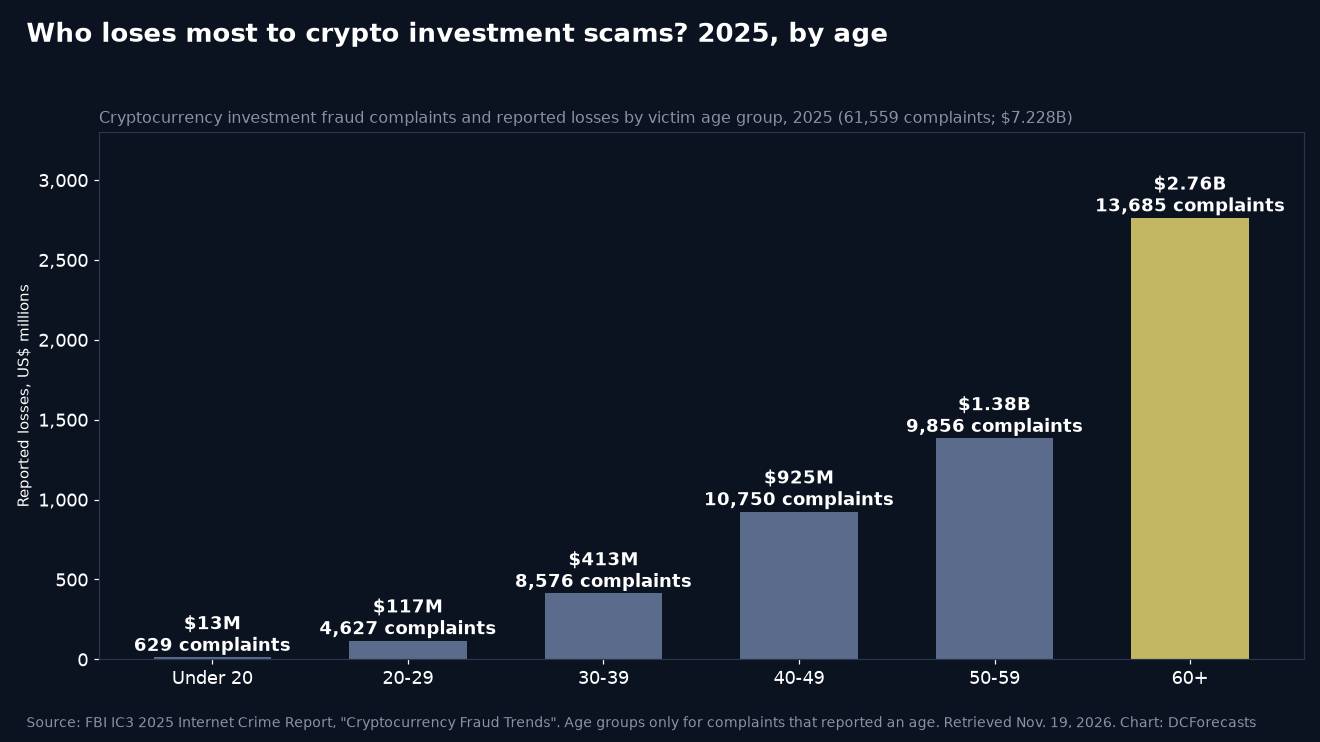
The age breakdown in the 2025 report is stark. Americans aged 60 and over filed 13,685 crypto investment fraud complaints and reported $2.76 billion in losses. That is more than people under 50 combined. People aged 50 to 59 lost another $1.38 billion.
There is some good news in the same report. The FBI’s Operation Level Up, launched in January 2024, contacted 3,780 crypto investment fraud victims in 2025, and 78% did not yet know they were being scammed. The FBI estimates those warnings saved victims $225.9 million last year, and the program has passed $500 million in savings since it began.
Why the Crackdown Matters for Bitcoin
None of this involves a flaw in Bitcoin. The scam compounds sell fake platforms and invented returns, and the coins are only the payment rail. Every bitcoin transfer is recorded on a public ledger, which helps investigators follow the money, as the 127,271 bitcoin seized in the Prince Group case showed.
Cutting off the landlords and armed guards behind these operations protects the new investors arriving through regulated channels. For buyers, the lessons are simple:
- Be wary of anyone who first reaches out by text, social media or dating app and then offers trading advice.
- Use only well-known, regulated platforms that you found yourself.
- Treat any demand for a “tax” or “fee” before a withdrawal as a red flag.
- Report suspected fraud to the FBI at ic3.gov.
DCForecasts has also covered how one pig-butchering scam cost a Massachusetts victim $1.89 million, most of it in fake withdrawal fees.
What Happens Next
Under the designations, any property of the five targets in the United States or held by U.S. persons is now blocked and must be reported to OFAC. Any entity they own 50% or more of, alone or together, is blocked too. U.S. persons are generally barred from dealing with them, and foreign banks that do so risk sanctions exposure.
Treasury has now reached past scam bosses to the armed groups that protect them, and the Scam Center Strike Force is still investigating compounds across Cambodia, Laos and Burma. More designations look likely. Each one makes fake trading apps harder to cash out, which helps the honest Bitcoin market.
DC Forecasts is a leader in many crypto news categories, striving for the highest journalistic standards and abiding by a strict set of editorial policies. If you are interested to offer your expertise or contribute to our news website, feel free to contact us at [email protected]












Discussion about this post