


Six U.S. senators from both parties want the Treasury Department to give state-supervised stablecoin issuers the same breathing room that federally supervised issuers would get under the GENIUS Act. Their concern is timing. Without a fix, state-licensed issuers could face disruption when the law’s core rules take effect. Many could simply pick a federal charter instead, which would undercut the choice Congress wrote into the law.
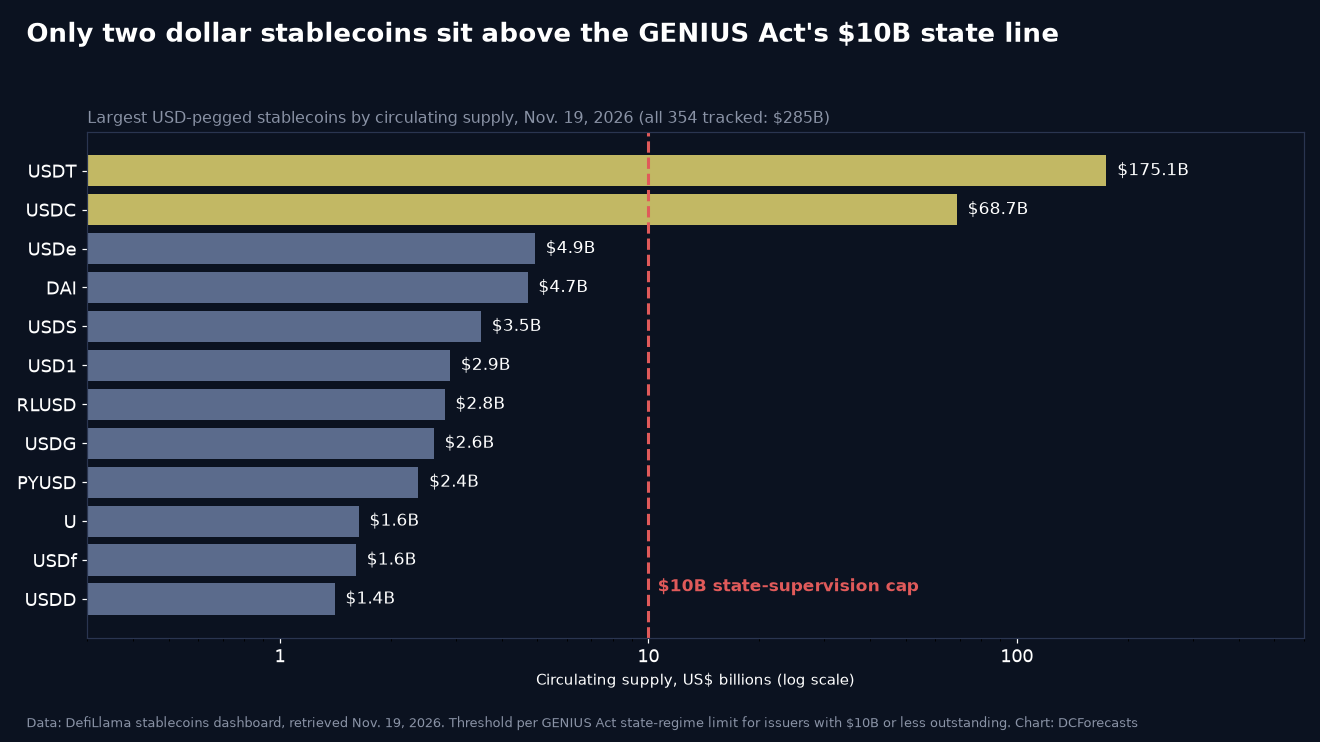
The request comes as the dollar stablecoin market sits at about $285 billion. Only two tokens are larger than the $10 billion line that decides whether an issuer can stay under state supervision.
What the Senators Asked Treasury to Do
According to a press release from Sen. Cynthia Lummis’s office on Nov. 18, the letter to Treasury Secretary Scott Bessent was led by Lummis (R-WY), who chairs the Senate Banking Committee’s digital assets subcommittee, and Sen. Kirsten Gillibrand (D-NY). It was co-signed by Sens. Angela Alsobrooks (D-MD), Kevin Cramer (R-ND), Pete Ricketts (R-NE) and Mark Warner (D-VA).
The senators want Treasury to grant a safe harbor from compliance with section 3 of the GENIUS Act to issuers in states that have certified their regimes as “substantially similar” to federal law. That protection would apply while the Stablecoin Certification Review Committee works through those certifications in 2027.
Treasury’s proposed rule already offers a similar safe harbor to issuers supervised by the Office of the Comptroller of the Currency (OCC). The senators say state issuers deserve the same treatment.
“For Treasury to finalize this proposal in a way that reflects Congressional intent, it must allow issuers to choose from state or federal charters, as contemplated by the GENIUS Act, without the risk of business disruption or uncertainty,” the senators wrote.
Why the $10 Billion Line Matters
The GENIUS Act, signed in July 2025, set up the first federal framework for payment stablecoins. It also kept a role for the states. Issuers with $10 billion or less in outstanding stablecoins may operate under a state regime, as long as that regime is “substantially similar” to the federal framework.
Lummis’s office notes that issuers in some states with existing digital asset rules, including Wyoming, do not have to move to federal supervision when they cross $10 billion. Congress also gave Wyoming, New York and Nebraska an expedited certification path under section 4(c)(7). In the senators’ view, that shows lawmakers expected those states to qualify from day one.
Wyoming has been building this framework for years. It created its Special Purpose Depository Institution charter in 2019, giving digital asset firms a fully reserved, state-regulated home long before Congress acted.

Almost Every Stablecoin Fits Under the State Cap
Market data shows how much the state route matters in practice. DefiLlama tracks 354 dollar-pegged stablecoins with a combined supply of about $285 billion as of Nov. 19.
Only two are above $10 billion: Tether’s USDT at about $175.1 billion and Circle’s USDC at about $68.7 billion. Together they account for roughly 86% of the market. The third-largest, Ethena’s USDe, is at about $4.9 billion, less than half the cap.
The other 352 tokens together hold about $41.2 billion. Every one of them is below the threshold, so in principle every one could operate under a qualifying state regime. That is why the safe harbor question matters. If state issuers face more uncertainty during the transition than federal ones, smaller and newer issuers may decide the federal path is the safer bet.
The senators put it directly. Without parity, issuers “may be incentivized to seek greater operational clarity under a federal license,” including through the OCC. They called that “the opposite of our intent in drafting this legislation.”
Not Everyone Thinks It Will Change Much
Some in the industry doubt the fix would shift behavior. Kevin Wysocki, head of policy at Anchorage Digital, replied to Lummis on X that issuers “are picking the federal path.” He said the $10 billion cap is a risk few want to take, even with exemptions available.
Federal charters are clearly in demand. DCForecasts recently reported that the OCC has tallied 28 bank charter approvals in two years, with dozens more in line. Big banks are also moving, as seen in the $270 million joint stablecoin project backed by Goldman, Citi and others.
What It Means for Bitcoin and Crypto Markets
Stablecoins are the main cash rail of crypto trading. Dollar tokens are how many investors move money between exchanges and into Bitcoin. A clear rulebook with real competition between state and federal charters supports a deeper, more resilient supply of those dollars.
Bipartisan pressure to protect that competition is a constructive sign. It suggests Washington wants the GENIUS Act to bring more regulated issuers into the market, not fewer. More trusted on-ramps make it easier for new buyers to reach Bitcoin. The stablecoin market has also been volatile lately, as DCForecasts noted when USDC supply slid 13% even as big institutions adopted it.
What Comes Next
Treasury is still working toward a final rule. The GENIUS Act’s main requirements take effect on Jan. 18, 2027, 18 months after the law was signed, unless final rules arrive sooner.
The senators asked Treasury to cover issuers in states expected to have qualifying frameworks by Jan. 18, 2028. Whether Treasury agrees will help decide if state charters remain a real alternative or fade into a mostly federal system. With Republicans and Democrats signing the same letter, the request carries weight as Treasury finalizes the rule.
DC Forecasts is a leader in many crypto news categories, striving for the highest journalistic standards and abiding by a strict set of editorial policies. If you are interested to offer your expertise or contribute to our news website, feel free to contact us at [email protected]











Discussion about this post