



HSBC’s Hong Kong dollar stablecoin has found its first job beyond payments. From Nov. 19, eligible customers can use HSBC RedCoin to buy units of a tokenized money market fund inside the bank’s Hong Kong mobile app, starting at 100 coins, or HK$100.
The units belong to a new tokenized class of HSBC Global Money Funds – Hong Kong Dollar, a fund whose trust deed dates to February 1991. The tokens live on Ethereum, one token for each fund unit.
The bank said the launch extends RedCoin from everyday payments into wealth management. It also marks one of the clearest cases yet of a major bank linking its own regulated stablecoin to its own tokenized investment product.
How the RedCoin Fund Purchase Works
Customers first activate a stablecoin wallet in the HSBC HK Mobile Banking App. They can then pay with RedCoin, ticker RCHKD, to subscribe to the new distribution class, labeled SD.
HSBC said RedCoin itself pays no interest. Any dividends from the fund are handled separately from the stablecoin. Under the fund’s October 2026 explanatory memorandum, the tokenized Class S units declare dividends daily and reinvest them the same business day, so holders receive new tokens rather than cash payouts.
HSBC’s securities services arm handles the tokenization of the new class. HSBC Digital Assets Custody holds both RedCoin and the tokenized units in safekeeping.
What the Fund Documents Reveal
The explanatory memorandum, which is authorized for distribution in Hong Kong only, sets out how tightly the tokens are controlled. Ethereum is named as the primary blockchain, though the document leaves room to add other public chains with comparable security later.
Ownership is recorded on chain, but only wallets that pass know-your-customer checks are whitelisted. Smart contracts enforce role-based access and an approval process for minting and burning tokens. The manager does not intend to allow peer-to-peer transfers or trading of the tokens on any secondary market.
Subscriptions and redemptions run only through eligible distributors. The fund itself does not hold any virtual assets, including stablecoins. RedCoin is simply the payment rail.

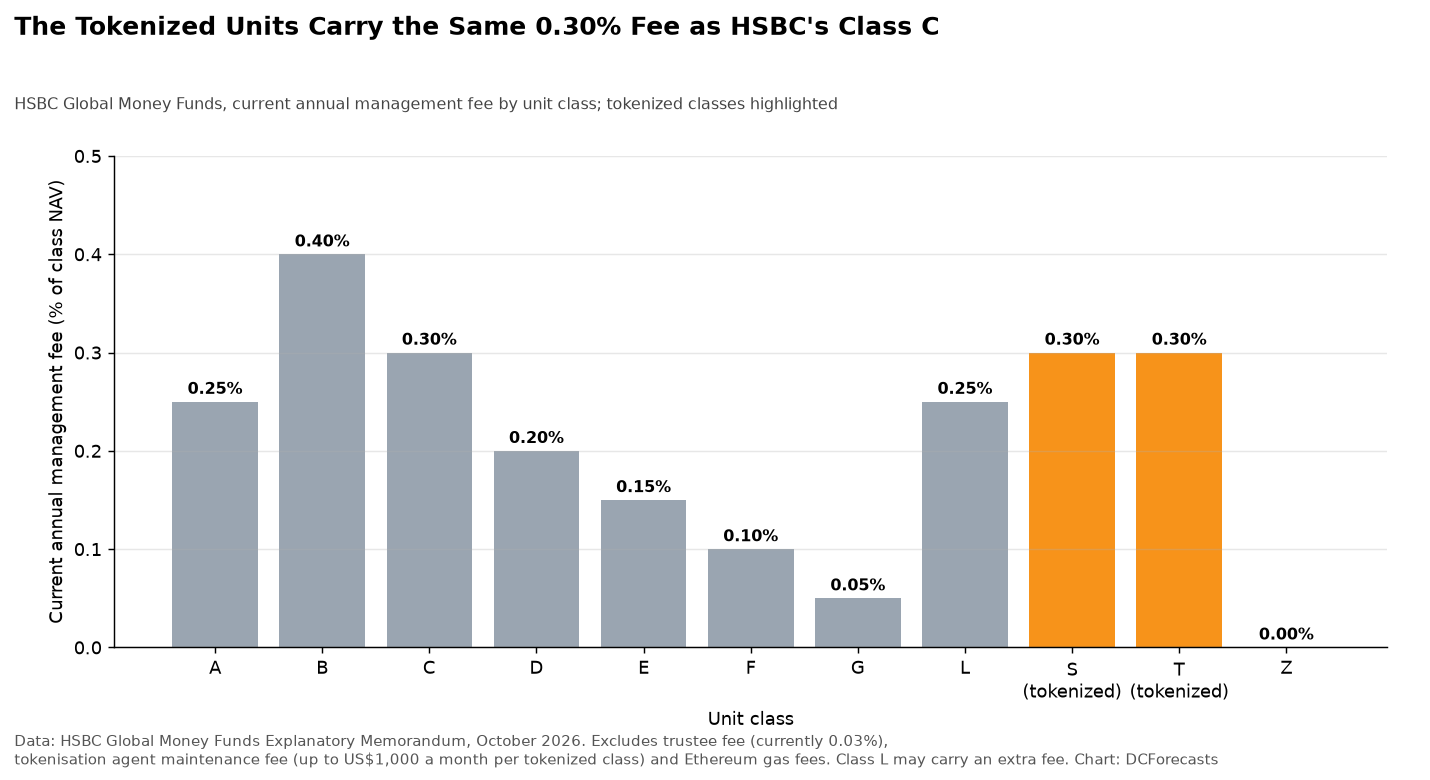
Costs look familiar. The tokenized Class S and Class T units carry a 0.30% annual management fee, the same as Class C and below Class B’s 0.40%. The trustee currently charges 0.03% a year.
Tokenization adds two new lines. The tokenization agent charges a maintenance fee of up to US$1,000 a month for each tokenized class, and Ethereum gas fees for minting and burning are borne by the tokenized units. The memorandum puts the median gas cost at US$0.10 to US$0.25 per transaction in 2026, while noting spikes as high as US$200 during the 2022 surge. The document also requires smart contract audits before launch and after every major code change.
From PayMe Payments to Wealth Products in Four Weeks
The fund launch comes less than a month after RedCoin went live. HSBC rolled out the coin on Oct. 23 through PayMe, where more than 3.3 million users could activate a wallet to pay friends and more than 100,000 merchants.
That launch followed the stablecoin issuer licence HSBC received from the Hong Kong Monetary Authority in April 2026, licence number FRS02. Hong Kong’s Stablecoins Ordinance was passed in May 2025, and its licensing regime for issuers took effect in August 2025.
At the October launch, HSBC said it would add stablecoin wallets to its main banking app and open tokenized investments to RedCoin later this year. Thursday’s launch delivers both.
Customers Pointed HSBC Toward Tokenized Investing
HSBC’s own research suggested demand. In a June survey of 1,060 Hong Kong customers aged 18 to 64, published on Sept. 30, 74% recognized at least one stablecoin use case. Digital asset trading and tokenized investments led the list at 57%.
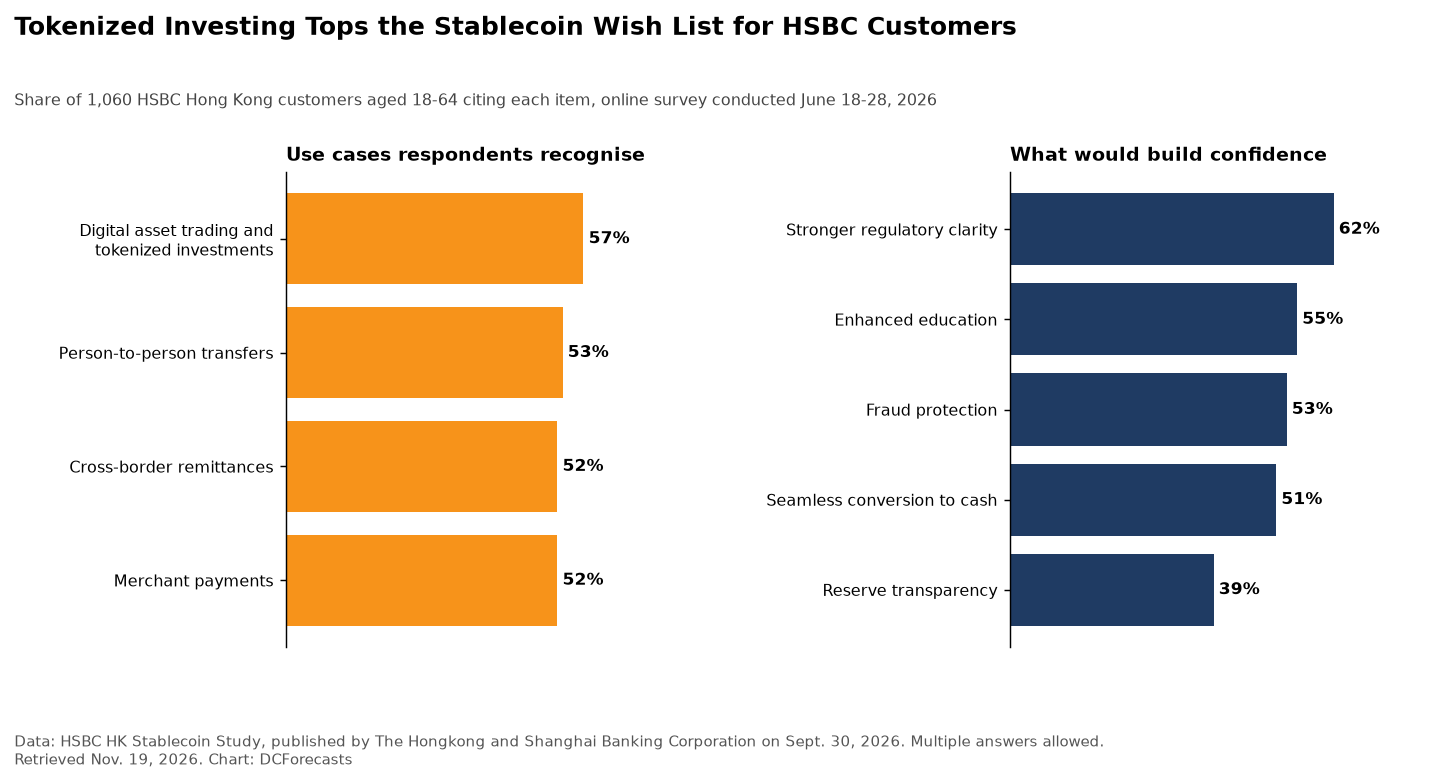
The same survey showed where trust still has to be earned. Respondents said stronger regulatory clarity (62%) and better education (55%) would do most to raise their confidence, ahead of fraud protection at 53%. One in four, 26%, assumed stablecoins were government-issued, and 10% thought they paid interest.
That last point helps explain why HSBC stressed that RedCoin pays no interest while the fund’s yield is kept separate.
Why the Launch Matters for Tokenization
HSBC is building a full digital asset stack in Hong Kong. Its Gold Token for retail clients had recorded 390,000 trades worth US$2.5 billion by the end of August, and its Orion platform has supported more than US$8.3 billion of digital bond issuance since 2023.
Connecting a licensed stablecoin to a regulated money fund on a public blockchain closes a loop that tokenization advocates have long described: cash and investments settling on the same rails. Hong Kong has been moving the same way, as our report on 24/7 tokenized deposit settlement showed, and U.S. market infrastructure is following, from the DTCC’s tokenization service to the Federal Reserve debate over central bank money for tokenized markets.
The guardrails remain tight. Wallets are whitelisted, the tokens cannot trade between users, and the product is sold in Hong Kong only. But with a HK$100 entry point, RedCoin now gives ordinary bank customers a working route from a regulated stablecoin into a tokenized fund on Ethereum.
DC Forecasts is a leader in many crypto news categories, striving for the highest journalistic standards and abiding by a strict set of editorial policies. If you are interested to offer your expertise or contribute to our news website, feel free to contact us at [email protected]












Discussion about this post