



Tokenized assets on public blockchains more than doubled in a year, and tokenized stocks grew even faster. That is the picture painted by the world’s securities regulators in a new monitoring report on asset tokenization.
The International Organization of Securities Commissions (IOSCO) published “Tokenization of Financial Assets: 2026 Monitoring Report” in November. Citing industry data, it says the value of tokenized real-world assets issued on public blockchains rose from about $16 billion on July 1, 2025 to $37 billion on June 30, 2026.
The report concludes that tokenization “is progressing but remains transitional and fragmented.” Even so, it finds clear evidence of scaling in some segments, with tokenized bonds, money market funds and fund interests moving “further beyond proof of concept toward more structured issuance and distribution.”
Tokenized Stocks Led the Growth
The standout segment was equities. According to the report, the value of tokenized equities and equity-linked products grew from $330 million on July 1, 2025 to $1.7 billion on June 30, 2026, about a fivefold jump. IOSCO says Ondo and xStocks are the two largest platforms.
By a second measure in the same report, the distributed value of tokenized equities on public blockchains went from less than $30 million in early 2025 to more than $1.8 billion as of July 2026. IOSCO links that growth mainly to retail demand for more accessible and flexible equity exposure.
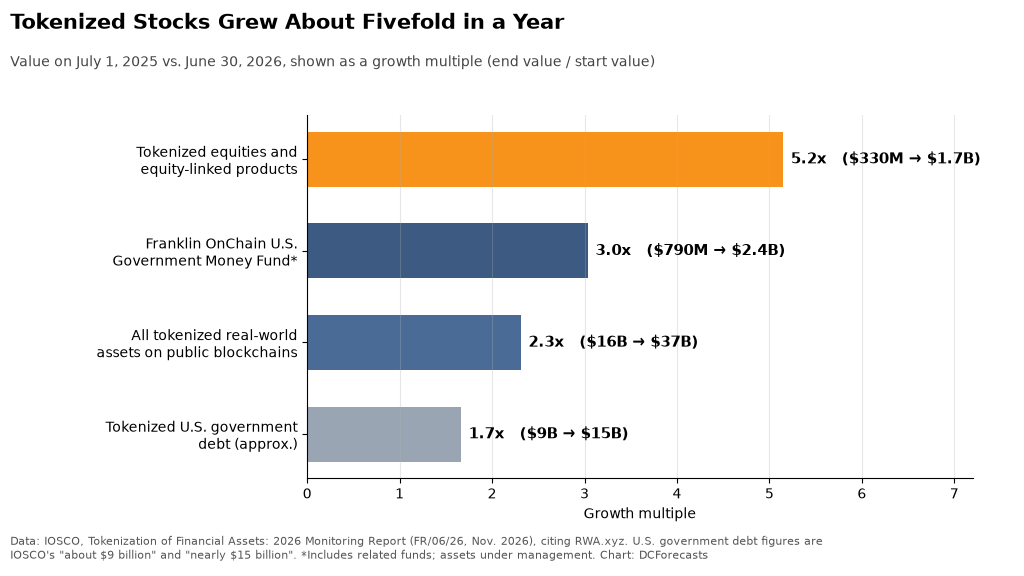
Government debt kept growing too. Tokenized U.S. government debt, including Treasury-focused money market funds, climbed from about $9 billion to nearly $15 billion over the same period. Tokenized non-U.S. government debt rose from roughly $900 million in November 2025 to $1.4 billion as of July 2026.
Individual funds show the trend. The Franklin OnChain U.S. Government Money Fund and related funds grew assets under management from $790 million to $2.4 billion over the year, while the BlackRock USD Institutional Digital Liquidity Fund ended June at $2.2 billion. In Europe, the Spiko EU T-Bills fund rose from about €260 million to around €900 million.
New products keep arriving. IOSCO lists tokenized shares of the Amundi Funds Cash EUR money fund in December 2025, JPMorgan’s OnChain Liquidity Token fund launched on Ethereum in May 2026, and State Street’s Stablecoin Reserves Money Market Fund in June 2026.
Banks Plan More Tokenized Funds
Survey data cited in the report suggest more is coming. Some 66% of firms plan to launch tokenized money market funds before the end of 2027, and 44% expect to accept them as collateral by then.

Collateral is a recurring theme. IOSCO says adoption is also emerging in post-trade servicing, “particularly collateral management services with a view to enable collateral movement and margin efficiency.” That matches recent moves in Asia, where HSBC began selling tokenized money fund units and Singapore scaled its tokenized MAS Bills to S$100 million.
Repo markets are earlier in the journey. IOSCO counts 34 publicized repo tests and transactions on distributed ledgers between 2017 and the end of 2025, most of them inside closed client networks.
Forecasts Point to Trillions
The report also reviews industry projections, while stressing that the path is “highly uncertain.” The Citi Institute projects the tokenized asset market at $5.5 trillion by 2030 in its base case, with a bear case of $2.7 trillion and a bull case of $8.2 trillion.
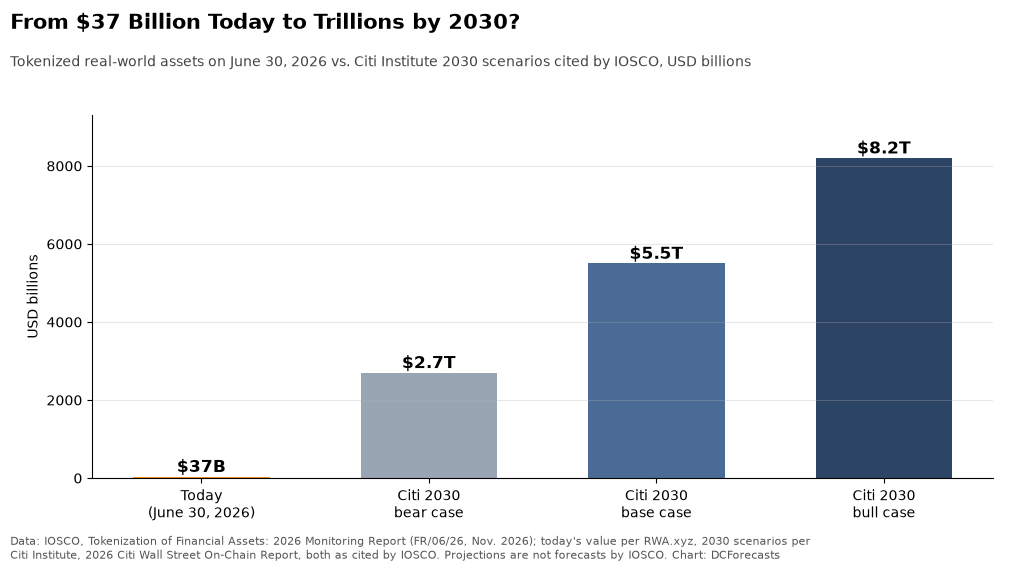
Even the bear case would mean a market roughly 70 times its June 2026 size. IOSCO says outcomes depend on regulatory harmonization, interoperability between platforms, institutional participation and the move away from legacy infrastructure.
What Regulators Want to See
IOSCO’s main concern with stock tokens is clarity. Some products give investors only contractual or economic exposure to a share, without shareholder rights or direct ownership. The report says this raises classification, disclosure and conduct issues, especially when such products are marketed across borders or built for trading in permissionless environments.
Retail investors are showing up through regulated intermediaries and digital platforms, drawn by accessibility, extended trading hours and fractional investing. But some firms told IOSCO that early enthusiasm for 24/7 trading has cooled because of liquidity and hedging limits, a debate also running in the U.S., where the CFTC is asking which markets are ready for round-the-clock trading.
Across jurisdictions, regulators are converging on the same checklist: legal certainty over token ownership, matching on-chain and off-chain records, custody, disclosure of investor rights, cyber resilience and the governance of smart contracts, bridges and oracles. IOSCO separately warned this month that blockchains must prepare for quantum computing risks.
Why It Matters for Crypto
The numbers are still small next to traditional finance. But the direction is clear: assets worth tens of billions of dollars now live on public blockchains, and the world’s securities watchdogs are treating that market as a permanent part of the landscape.
That growth runs on the open ledgers that crypto built. Every new tokenized fund or bond adds to on-chain activity and brings more institutional investors into contact with blockchain settlement, the same technology Bitcoin pioneered. If even the cautious projections hold, the shift has barely begun.
DC Forecasts is a leader in many crypto news categories, striving for the highest journalistic standards and abiding by a strict set of editorial policies. If you are interested to offer your expertise or contribute to our news website, feel free to contact us at [email protected]











Discussion about this post