


Washington’s latest strike on global drug networks came with a small but telling crypto detail.
On Nov. 19, the Treasury Department’s Office of Foreign Assets Control (OFAC) sanctioned the Australia-based Comanchero Outlaw Motorcycle Gang and Italy’s ‘Ndrangheta, along with leaders and associates of both groups. Of the 20 new entries added under the drug-trafficking order that day, only one carried a digital currency address: a Tron wallet tied to the Comancheros’ Spain-based “World Commander.”
That single line on the sanctions list says a lot about where enforcement is heading, and about why public blockchains keep showing up in these cases.
Who Treasury Targeted
According to the Treasury press release, the Comancheros have built partnerships with U.S.-sanctioned cartels including the Sinaloa Cartel, CJNG, Clan del Golfo and Los Choneros. Treasury says the gang has helped move multi-hundred-kilogram cocaine shipments from South America to the United States, Australia and Europe.
The department named Alexandre Varela Villar, known as Alex Vare, as the group’s World Commander based in Spain, and Allan John Norman Meehan as its Australia-based World President. Brothers Pasilika and Vetekina Naufahu were designated for acting on the gang’s behalf in New Zealand, while associate Marco Francis Coffen was named for supplying encrypted communication platforms that shielded traffickers from police phone taps.
The ‘Ndrangheta, first designated under the Kingpin Act in 2008, was re-designated under Executive Order 14059. Treasury said the syndicate operates in more than 80 countries and cited estimates that it controls almost 80% of the European cocaine trade. OFAC also targeted Angelo Figliomeni, whom it described as the leader of the group’s Toronto faction.
The action was coordinated with the Homeland Security Task Force, the FBI, the DEA and Homeland Security Investigations, plus the Australian Federal Police, New Zealand Police, Italy’s Guardia di Finanza and Canadian police forces.
One Crypto Address Among 25 New Entries
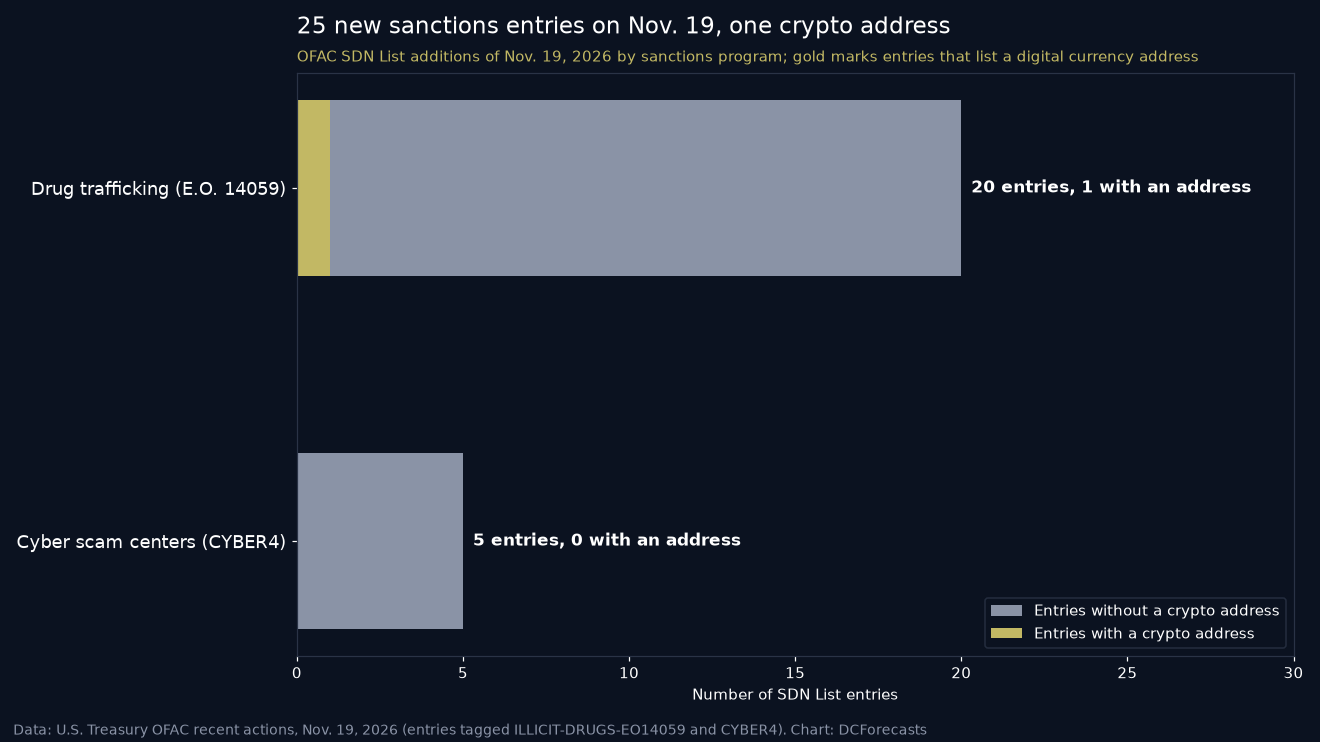
OFAC’s recent actions notice for Nov. 19 lists the full set of additions. It covers 20 entries under the drug-trafficking program and five under the cyber-related program, tied to a separate action against scam compound bosses that DCForecasts covered earlier.
Across those 25 entries, only Varela Villar’s record includes a crypto identifier. It reads: “Digital Currency Address – TRX TVwLtgUXyDhmcSoQ9x2z9QSua41f8mDFvU.”

Listing an address matters in practice. Once a wallet appears on the Specially Designated Nationals list, U.S. persons are generally barred from dealing with it, and compliance teams at exchanges and stablecoin issuers can screen against it automatically.
What the Wallet Actually Shows
Because Tron is a public blockchain, anyone can check the listed address. DCForecasts pulled its token history from the network’s public API after the designation.
The record is modest. The wallet received 15,419 USDT on Sept. 14, 2023, and sent 15,000 USDT two days later. It took in 5,234 USDT in January 2024 and sent 5,752 USDT on Jan. 23. A 1,657 USDT deposit in early February 2024 left again the same day.
In total, the address received roughly 22,500 USDT across these transfers and sent out about 22,400. Its last USDT transfer came on Feb. 7, 2024. As of Nov. 19, it held about 105.6 USDT and 124 TRX.
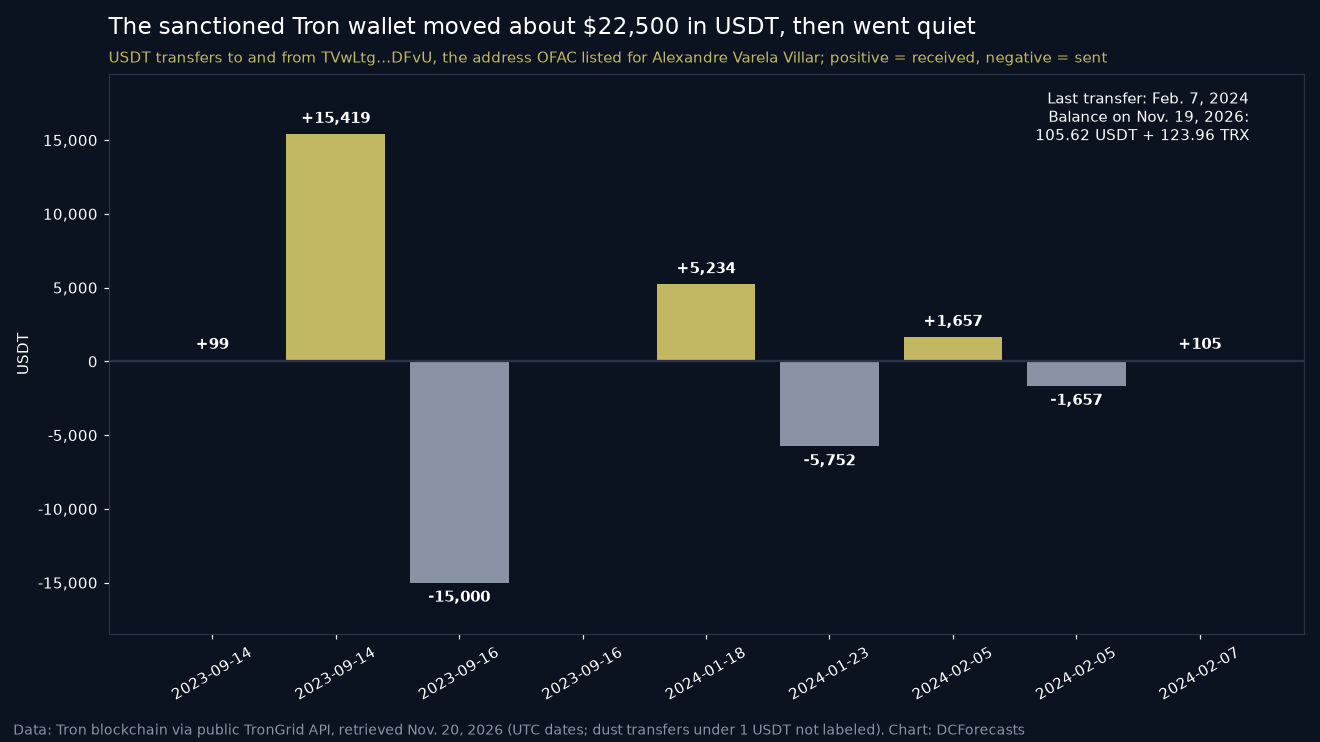
Those amounts are tiny next to the multi-hundred-kilogram cocaine shipments Treasury describes. The on-chain record does not show what the funds paid for, and OFAC did not say how the wallet was used. It is best read as one identifier investigators were able to attach to a named leader, not a map of the gang’s finances.
Why Transparent Ledgers Help Investigators
The case highlights a point that often gets lost in debates about crypto and crime. Every transfer on a public chain such as Tron or Bitcoin is permanently visible, timestamped and traceable.
That is very different from cash, which leaves no ledger at all. When authorities connect an address to a person, they can see its full history, and so can every compliant exchange screening deposits.
Bitcoin’s design takes this transparency furthest. Its ledger has been fully public since 2009, which means investigators can follow funds across its entire history. For long-term holders, that openness is a feature: it lets the network operate without a central gatekeeper while still giving investigators a clear trail when crimes occur.
Stablecoins add another lever. Issuers of tokens like USDT can freeze balances at the contract level, which gives sanctions lists like this one teeth beyond simple screening.
A Busy Day for Sanctions
Nov. 19 was one of OFAC’s heavier days. Treasury said it has taken nearly 40 actions against more than 500 individuals and entities with the Homeland Security Task Force since the start of 2025.
Secretary Scott Bessent framed the action around the cartels’ support networks. “Cartels do not operate in isolation,” he said. “They rely on other criminal organizations like the Comancheros and ‘Ndrangheta to move drugs, launder illicit proceeds, and ultimately poison Americans with narcotics.”
What to Watch Next
Sanctions designations often come before indictments, asset seizures or further listings. If investigators link more wallets to the Comancheros or the ‘Ndrangheta, OFAC can amend these entries to add new addresses.
For the crypto industry, the takeaway is practical. Screening tools need to pick up the new Tron address now, and exchanges that touched it in 2023 or 2024 may review those flows.
For the wider market, cases like this keep making the same argument: open blockchains give regulators more visibility than many traditional channels, not less. That steady record of traceability is part of what has helped Bitcoin and regulated stablecoins earn a place in mainstream finance.
DC Forecasts is a leader in many crypto news categories, striving for the highest journalistic standards and abiding by a strict set of editorial policies. If you are interested to offer your expertise or contribute to our news website, feel free to contact us at [email protected]











Discussion about this post