



The Republic of the Marshall Islands wants to sell up to $30 million of tokenized bonds to the public, and it has put the plan in front of the US Securities and Exchange Commission.
The Pacific nation filed a registration statement on Form S-B with the SEC on Nov. 20.
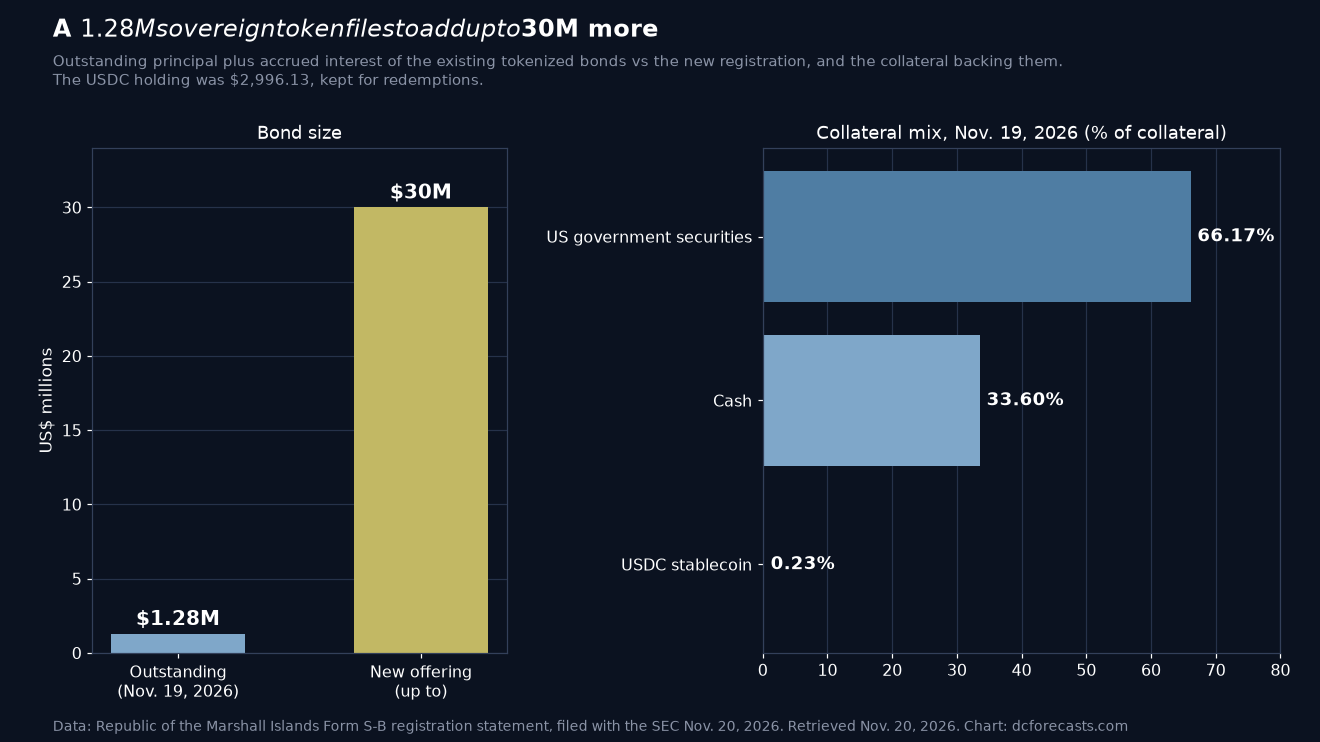
The new bonds would join a series that already exists on four blockchains, but is still tiny. As of Nov. 19, the outstanding bonds, including accrued interest, came to $1.28 million.
For crypto investors, the structure is what stands out. This is government debt that settles as tokens, pays a rate tied to US Treasury bills and can be redeemed for stablecoins.
The bigger question is whether a sovereign token this small can show other countries a workable model.
What the Marshall Islands Filed With the SEC
The filing covers “tokenized perpetual adjustable-rate secured bonds.” The new issue would be fungible with the existing bonds and vote with them as a single series.
The bonds have no maturity date. They are backed by the full faith and credit of the Republic and secured by a pool of collateral.
Ownership is recorded in book-entry form based on who holds the related tokens. According to the prospectus, the bonds cannot be held or transferred separately from those tokens.
As of Nov. 19, the tokens could be held on the Ethereum, Solana, Stellar and Canton networks.

The offering is on a best-efforts basis with no minimum, and the bonds will not be listed. The Republic estimates no material selling expenses, so every $1,000 sold should raise the full $1,000.
How the Tokenized Bonds Pay Interest
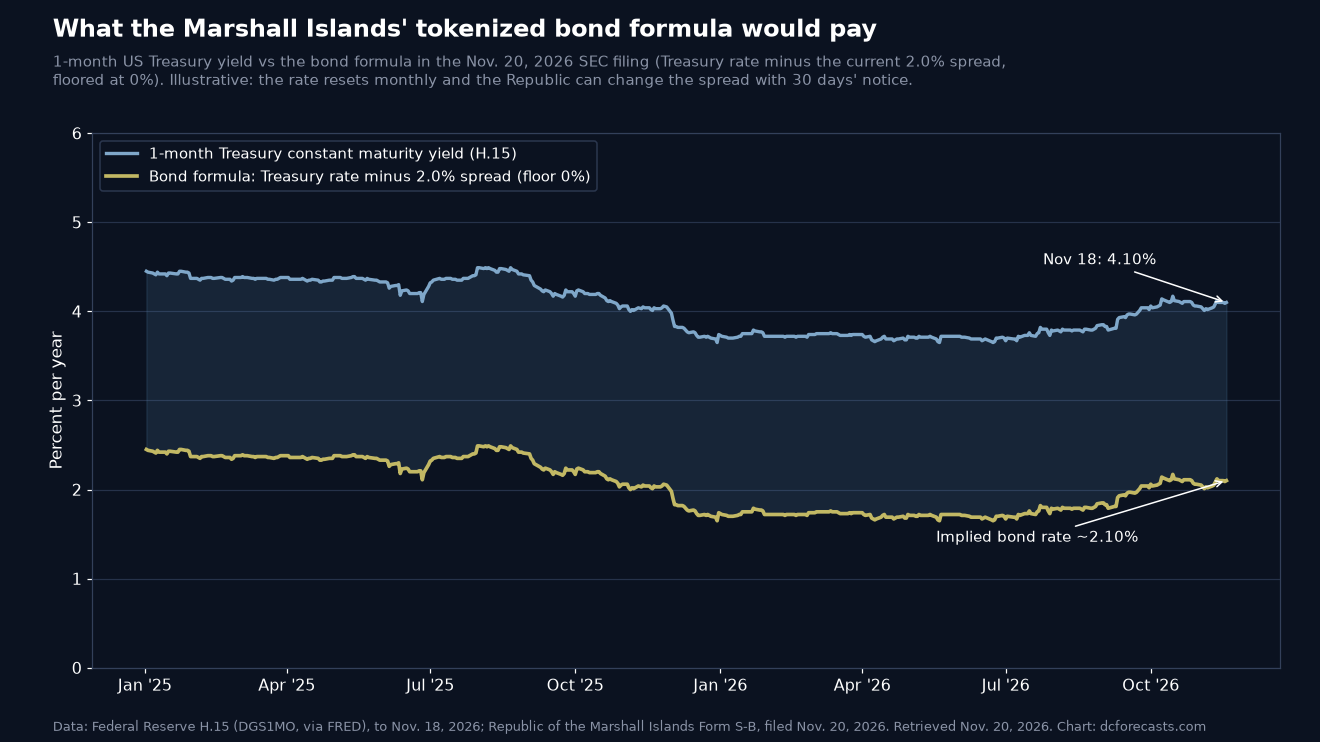
The rate formula is simple. Holders earn the one-month US Treasury yield published in the Federal Reserve’s H.15 release, minus a spread.
That spread is currently 2.0%. The Republic can change it with 30 days’ notice, and the rate can never fall below zero.
Interest is not paid out in cash. It is added to principal on the third Wednesday of each month, so the balance compounds.
The one-month Treasury yield stood at 4.10% on Nov. 18. On the current spread, that implies a rate of about 2.1% a year.
The prospectus also warns that the interest rate “may bear no direct relationship” to the yield the collateral earns.
The filing says collateral income, after covering fees and expenses, can be released to the Republic as a “Collateral Excess.” That makes this product closer to a yield-bearing digital dollar than a high-yield bond.
Where the Stablecoin Fits In
Proceeds go into US government securities maturing in less than a month. On Nov. 19, the collateral was 66.17% government securities, 33.60% cash and 0.23% USDC.
The USDC slice was worth $2,996.13. The Republic says it keeps such “Alternative Assets” to settle redemptions and expects them to be mainly US-dollar stablecoins.
Holders can ask the Republic to repurchase at least $1,000 of bonds at par plus accrued interest. The redemption date falls five business days after notice.
A holder can also name a blockchain asset it would accept instead of cash. The filing adds a candid caveat: the Republic “cannot assure” that any stablecoin used for payment will hold its par value.
That right ends if the Republic triggers an orderly wind-down.
Why a Small Island Is Building On-Chain Debt
The filing ties the bonds to domestic policy. The Lomalo digital citizen wallet, introduced in 2025, lets eligible people receive, hold and transfer the bonds through government programs.
The Republic made its first nationwide payment under its ENRA universal basic income program in November 2025. Quarterly payments can go by direct deposit, mailed check or an electronic option that uses Lomalo, the tokens and the Stellar Disbursement Platform.
For a nation of 29 atolls and five islands spread across the western Pacific, that matters. A token can reach a phone far faster than a check can reach an outer island.
The move also fits a wider trend we have tracked, from Singapore’s tokenized MAS bills to Kazakhstan’s first tokenized notes.
Can Tokenized Bonds Grow Beyond a Pilot?
The scale is still modest. Even if every new bond sells, the series would total around $31 million.
The Republic also says it does not plan any geographically targeted marketing, beyond distributions tied to its own programs. Demand will likely need to come largely from people who already use the networks where the tokens live.
Still, we believe the filing is a useful signal. A sovereign issuer is using public blockchains and a regulated stablecoin as working parts of its debt plumbing, and is disclosing the risks in an SEC document.
For Bitcoin holders, that is part of a bigger story. Public networks that started as an alternative to the old system are steadily becoming infrastructure that governments choose to use.
The coming months will show whether $30 million of on-chain sovereign debt finds buyers, and whether larger issuers follow the Marshall Islands’ lead.
DC Forecasts is a leader in many crypto news categories, striving for the highest journalistic standards and abiding by a strict set of editorial policies. If you are interested to offer your expertise or contribute to our news website, feel free to contact us at [email protected]












Discussion about this post