


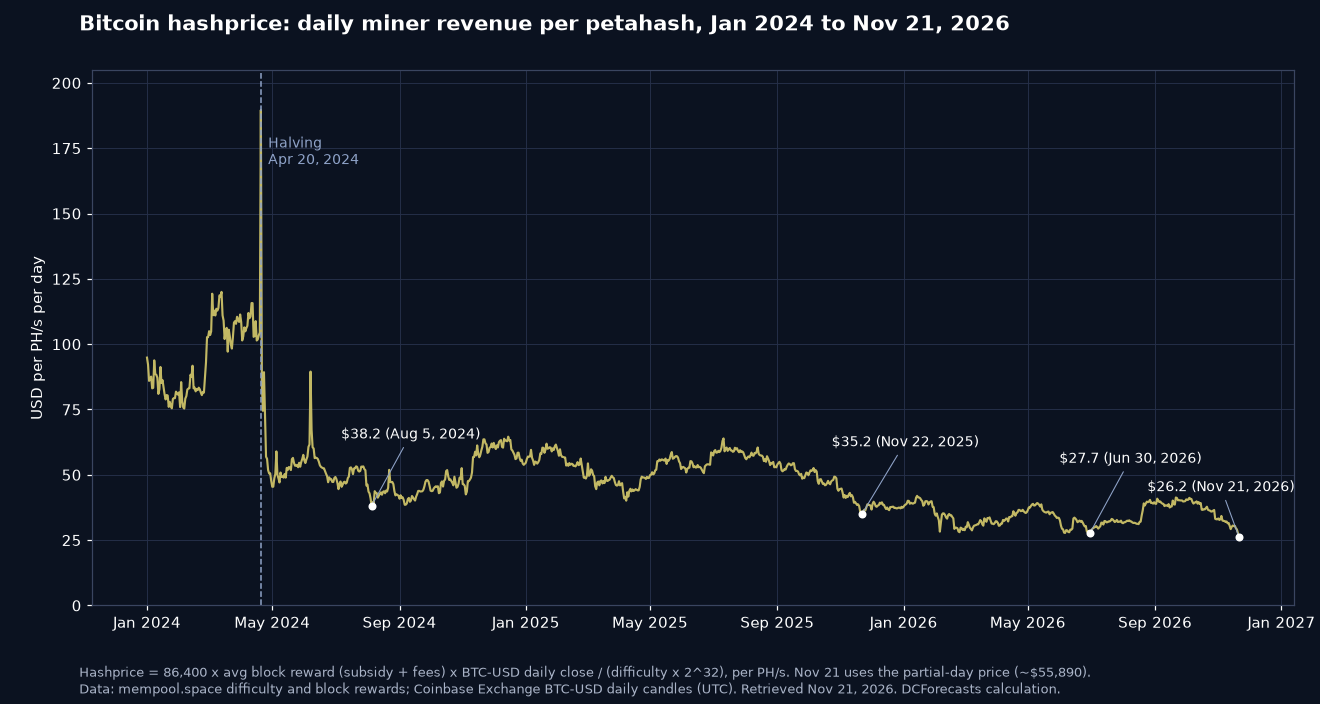
Bitcoin hashprice, the dollar revenue a miner earns for each unit of computing power, fell to about $26.20 per petahash per day on Nov. 21, the lowest reading in our data going back to 2015.
The drop followed Bitcoin’s slide to $55,500 on Coinbase early on Saturday, its lowest price since early September 2024.
Network difficulty has not moved since the Nov. 14 cut, so the entire squeeze came from price.
For Bitcoin investors, the more telling detail is what miners are doing anyway: blocks are arriving faster than the 10-minute target, and difficulty is set to rise about 9% next week.
The bigger question now is whether the industry can absorb another cut in revenue per machine without a wave of shutdowns.
Bitcoin Hashprice Breaks Below Its June Low
We calculate hashprice from three public inputs: the average block reward from mempool.space, the current mining difficulty and Coinbase’s BTC-USD daily price.
On that basis, hashprice stood near $26.20 early on Nov. 21 UTC, with Bitcoin trading around $55,890. That is the partial-day figure, so it will move with the price.
The previous low for this cycle was $27.72 on June 30, when Bitcoin closed at $58,524. Friday’s close of $58,815 already took hashprice to $27.67, almost level with it.
A year ago, on Nov. 22, 2025, the same measure read $35.19. That means miners are earning roughly 26% less per unit of hashpower than they did 12 months ago.

The longer view is starker. On Oct. 6, 2025, the day Bitcoin set its record high of $126,296 on Coinbase, hashprice was about $52.60. It has roughly halved since.
Why Miners Earn So Little per Machine Now
Three forces have compressed miner revenue since early 2024.
The first is the April 2024 halving. The day before it, hashprice was about $104. Two days later, with the subsidy cut to 3.125 BTC per block, it was near $84 and still falling as a post-halving fee spike faded.
The second is fees. The average block on Nov. 21 paid about 3.142 BTC in total, meaning fees added only around 0.017 BTC, or roughly 0.5% of revenue. Miners are living almost entirely on the subsidy.
The third is competition. Difficulty climbed to a record 155.97 trillion on Oct. 29, 2025, according to mempool.space. It now sits at 134.82 trillion, 13.6% below that peak, but still far above the roughly 86 trillion level at the 2024 halving.
Put together, a petahash today earns about a quarter of what it did just before the halving, measured in dollars.
A 9% Difficulty Increase Is Coming Anyway
Here is the part we find most revealing. Despite the falling price, the network is producing blocks quickly.
According to mempool.space, blocks in the current period have averaged about 9.1 minutes, and the next retarget at block 977,760 is projected to raise difficulty by about 9.4%. The estimate points to roughly Nov. 27.
That follows the 9.13% cut on Nov. 14 that we covered in our report on the November Bitcoin mining difficulty drop, and the rebound we tracked when hashrate bounced back after the cut.
If Bitcoin’s price held near $55,900 through the adjustment, a 9.4% rise in difficulty would pull hashprice down to roughly $23.90. That is simple arithmetic, not a forecast. A price recovery before Nov. 27 would offset part or all of it.
Hashrate itself remains enormous. Mempool.space’s current estimate is about 1,060 exahashes per second, against a peak daily average of about 1,306 EH/s on Oct. 25, 2025.
What Bitcoin Mining Profitability Looks Like at $26
Hashprice becomes more concrete when set against power bills.
A fleet running at 17.5 joules per terahash, the efficiency of current-generation machines, uses about 420 kilowatt-hours a day per petahash. At $26.20, that works out to about 6.2 cents of revenue per kilowatt-hour, before staff, hosting, depreciation or debt costs.
An older fleet at 30 joules per terahash burns about 720 kWh per petahash each day, which cuts the figure to about 3.6 cents.
That gap explains why Bitcoin miners with cheap power and new hardware keep running, while older machines are the first to switch off. It also explains why so many public miners have pivoted toward AI and data-center hosting this year.
We believe this is the self-correcting design at work. Weaker machines leave, difficulty eases, and the remaining operators earn more per unit of hashpower.
What Past Hashprice Lows Tell Bitcoin Holders
History offers an interesting, if imperfect, pattern.
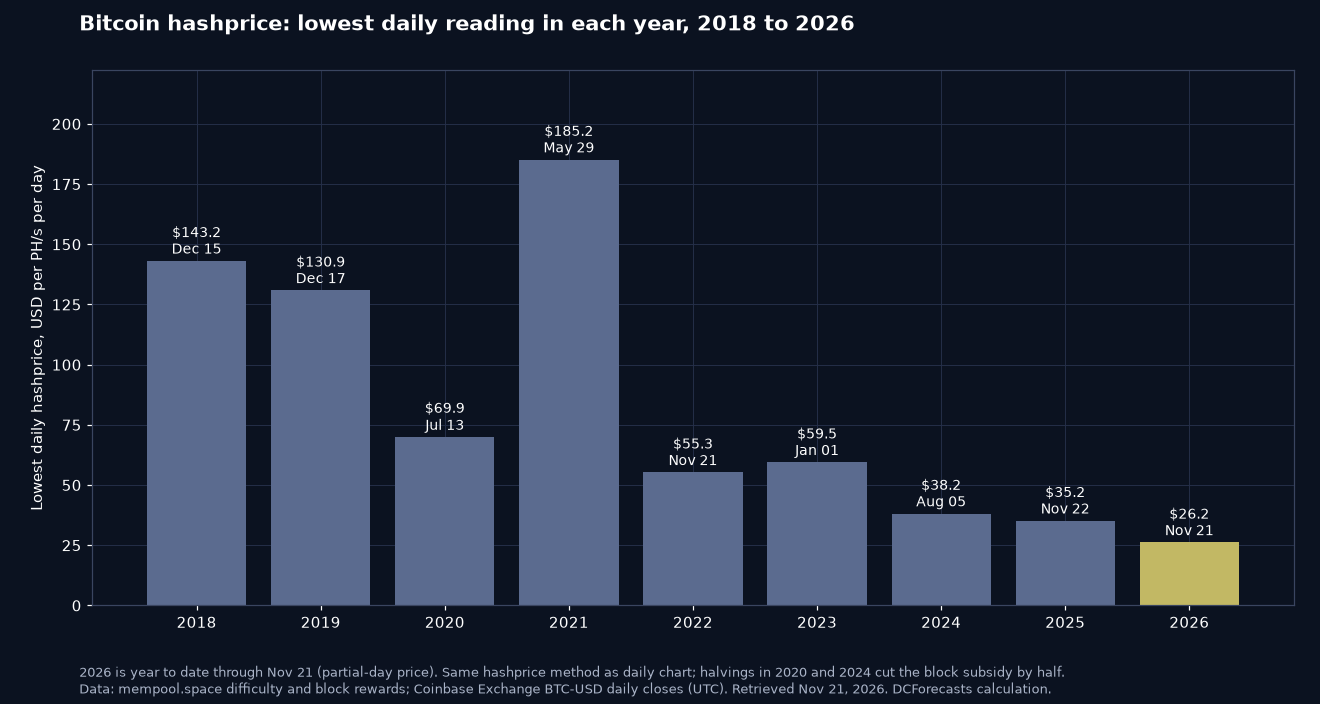
In 2018, the year’s lowest hashprice came on Dec. 15, the same day Bitcoin posted its lowest daily close of the year on Coinbase, at $3,183. In 2022, the yearly low fell on Nov. 21, again the day of Bitcoin’s lowest close, at $15,760.
We should be honest about why. Price is one of the inputs, so the two lows naturally tend to line up. The pattern does not tell anyone when a bottom has arrived.
What it does show is that peak miner stress has historically come during the deepest part of a drawdown, not at the start. Both of those years were followed by a strong recovery in Bitcoin’s price.
For us, the key signal to watch is the Nov. 27 retarget. A large increase while hashprice sits at record lows would show that miners are still adding capacity under pressure.
Bitcoin’s issuance schedule does not change with the price, its security budget is still backed by more than 1,000 EH/s of hardware, and the difficulty mechanism keeps rebalancing the industry. The coming week will show how much more pressure miners can absorb, and whether a reset in hashprice turns into the foundation for the next leg higher.
DC Forecasts is a leader in many crypto news categories, striving for the highest journalistic standards and abiding by a strict set of editorial policies. If you are interested to offer your expertise or contribute to our news website, feel free to contact us at [email protected]












Discussion about this post