



Bitcoin shorts are now paying to keep their bets open, after a pre-dawn Saturday slide took BTC to $55,500 on Coinbase while Wall Street was shut.
The drop came between 03:00 and 05:00 UTC on Nov. 21, according to Coinbase hourly price data. Bitcoin went from $58,492 to an intraday low of $55,500, a 5.1% move in about two hours.
That is the lowest Coinbase print since September 9, 2024.
For Bitcoin investors, the most interesting part is not the price itself. It is who was doing the selling, and what the futures market now looks like underneath it.
The bigger question is whether a market this tilted toward shorts is closer to exhaustion than it looks.
How the Saturday Slide Unfolded
Bitcoin spent the first hours of Saturday drifting near $59,000. US stock markets were closed for the weekend.
Then the selling arrived in Asian trading hours. On Binance, spot volume in the 03:00 and 04:00 UTC hours reached 5,598 BTC and 6,118 BTC, roughly four times the pace of the three hours before.
Binance’s own futures data shows the pressure came from aggressive sellers. In the 03:00 UTC hour, traders hit the bid for 25,308 BTC of BTCUSDT perpetuals, against 20,200 BTC of market buys, a buy-to-sell ratio of 0.80.
Binance spot touched $55,555.55 at the low. By 05:00 UTC, Bitcoin was trading near $56,150 on Coinbase, down about 8.7% over 24 hours, according to CoinGecko.

This was a different kind of day from Friday. As we covered when the Bitcoin selloff undercut July’s low, that drop started in New York hours alongside a sharp fall in tech stocks. Saturday’s leg was crypto-native.
Bitcoin Shorts Flip Funding Negative on Three Exchanges
Perpetual futures use small periodic payments, called funding, to keep their price close to spot. When funding is positive, longs pay shorts. When it is negative, Bitcoin shorts pay longs.
At the 00:00 UTC settlement on Nov. 21, Binance’s BTCUSDT funding rate was -0.0061% for the eight-hour period, according to the exchange’s funding history.
That is the deepest negative print since June 17, across the 500 settlements we pulled going back to June 7. Only 41 of those 500 settlements were negative at all.
The move was not limited to one venue. OKX settled at -0.0059% and Bybit at -0.0042% in the same window.
Binance’s live estimate for the next settlement, at 08:00 UTC, stood at about -0.0077% as of roughly 05:20 UTC. If it settles there, it would be the most negative reading in our 500-settlement sample.
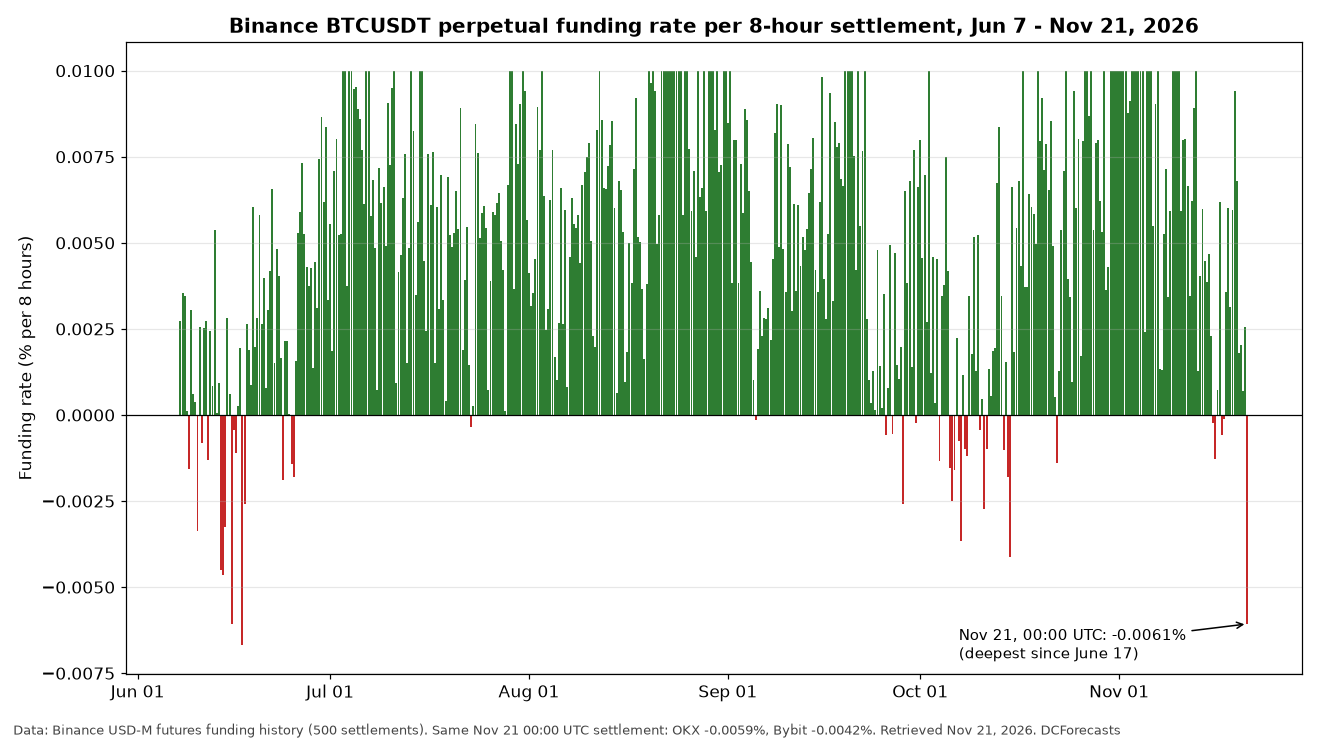
The absolute numbers are small. A -0.0077% rate every eight hours works out to roughly -8.4% a year.
The change in direction is what matters. Earlier this morning, our analysis of why Bitcoin funding rates stayed positive through a 34% slide noted that futures traders had barely leaned short during the decline. That has now changed.
Open Interest Held Steady While the Price Fell
The second clue sits in Bitcoin open interest, the number of futures contracts still open.
Binance BTCUSDT open interest stood at 95,776 BTC at 06:00 UTC on Nov. 19, when Bitcoin traded at $63,683 on Coinbase. By 05:00 UTC on Saturday, it was 95,493 BTC, nearly unchanged, even though the price had fallen 11.9%.
During the Saturday drop itself, open interest slipped only 682 BTC, or 0.7%.
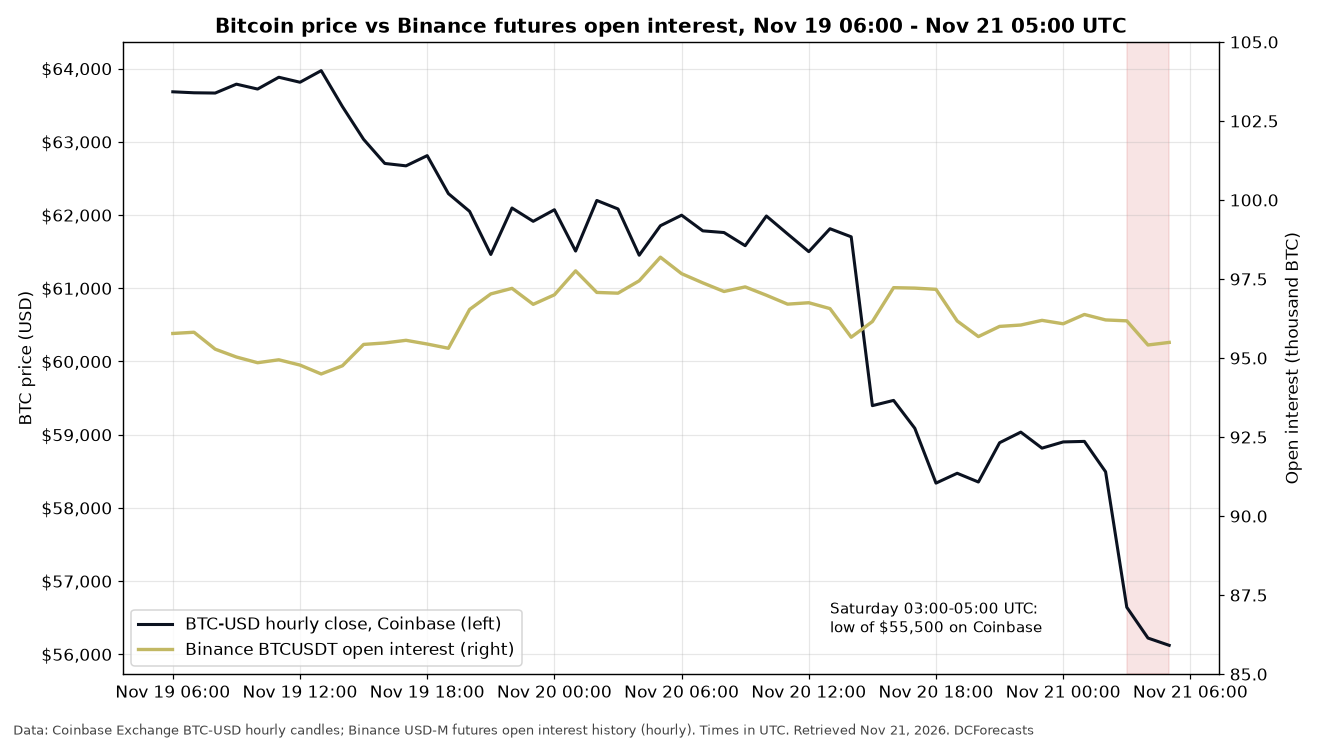
A classic long liquidation cascade usually drains open interest fast, as leveraged longs are closed out. That did not happen here.
We believe the more likely reading is that some long positions closed while fresh shorts replaced them. Steady open interest combined with negative funding points to new bearish bets, not just forced selling. We would treat that as an inference from the data, not a certainty.
Why a Short-Heavy Market Can Cut Both Ways
Crowded short positioning is a double-edged setup. If selling continues, shorts get paid. If the price stabilizes, those same traders may need to buy back their positions, which can add fuel to a rebound.
History this year urges patience. After Binance funding turned negative in mid-June, Bitcoin kept sliding for about two more weeks before setting its July 1 low near $57,700.
What came next is the constructive part. From that low, Bitcoin climbed to $87,397 on Coinbase by September 21, a gain of about 51%.
That is not a forecast. Negative funding is not a timing tool, and past rebounds do not guarantee future ones. But it shows that a sentiment washout in futures has, at least once this year, arrived close to an important turning point.
What We Are Watching Next
We would watch three things over the weekend and into Monday.
- Funding at the 08:00 and 16:00 UTC settlements. A deeper negative streak would suggest the short crowd is real, not a blip.
- Open interest. A sharp drop while the price rises would signal shorts being forced out.
- The September 2024 low near $52,500 on Coinbase, the next major reference below the market.
For long-term holders, we believe the picture is less dramatic than the candles suggest. The pressure is concentrated in leveraged futures trading, while Bitcoin’s fixed 21 million supply and its growing base of institutional infrastructure are unchanged by a weekend sell-off.
The coming days will show whether Bitcoin shorts pressed their advantage at the right moment, or whether they arrived late to a move that was already running out of sellers.
DC Forecasts is a leader in many crypto news categories, striving for the highest journalistic standards and abiding by a strict set of editorial policies. If you are interested to offer your expertise or contribute to our news website, feel free to contact us at [email protected]







Discussion about this post