


Bitcoin funding rates are doing something unusual for a market that has just lost a third of its value: they are still positive.
Bitcoin slid from a Coinbase high of $87,397 on September 21 to $57,655 on November 20, a 34% decline.
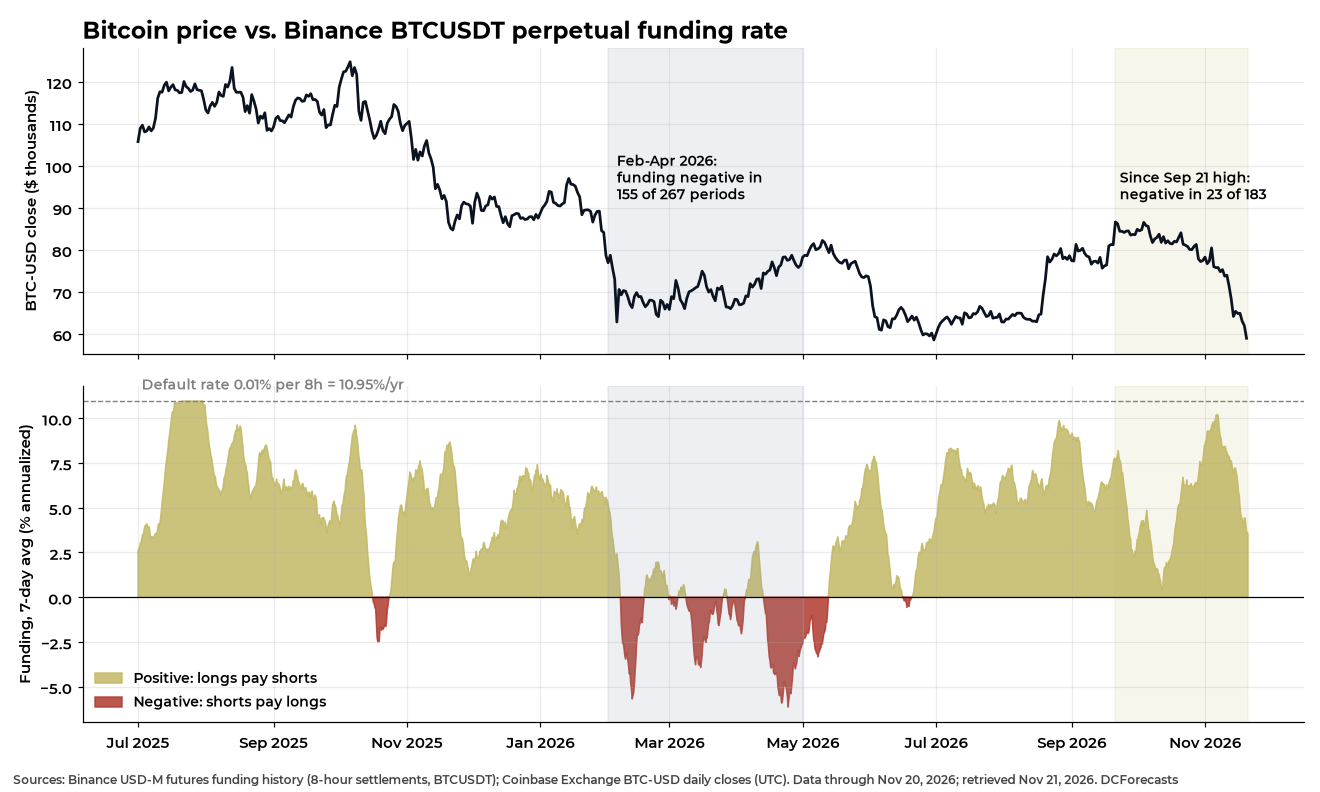
Yet across the 183 eight-hour settlements on Binance’s BTCUSDT perpetual since that high, only 23 have been negative, and the seven-day average never once dropped below zero.
For Bitcoin investors, that is the most interesting gap in the data right now, because the spring sell-off looked very different.
The bigger question is whether this market still needs a full leverage flush, or whether the selling has simply come from somewhere other than futures.
What Funding Rates Actually Measure
Perpetual futures never expire, so exchanges use a small periodic payment to keep their price tied to spot.
When funding is positive, traders holding longs pay those holding shorts. When it turns negative, shorts pay longs.
Binance’s default rate is 0.01% every eight hours, which works out to about 10.95% a year.
Readings well above that suggest crowded optimism. Readings below zero usually mean traders are leaning short or hedging hard.

On November 20, the three Binance settlements averaged an annualized 1.93%, and the seven-day average sat at 3.54%.
That is positive, but far below the default. Bybit and OKX settled at +0.0029% and +0.0038% at the same 16:00 UTC window, so Binance was not an outlier.
Spring’s Sell-Off Left a Very Different Footprint
Between February and April 2026, funding on Binance was negative in 155 of 267 settlements.
The average for those three months was an annualized -1.37%, and the seven-day average bottomed at -6.14% on April 24.
That period included Bitcoin’s February 6 low of $60,001 on Coinbase, followed by weeks of sideways trading.
By May 15, Bitcoin closed at $79,059, roughly 32% above that February low.
We would not treat one episode as a rule. Still, it shows what a market looks like when traders pile into shorts and get paid to wait.
Since September 21, the average has been an annualized +5.2%. In plain terms, traders kept paying to stay long almost the whole way down.
Open Interest Held Steady in Coins, Shrank in Dollars
The second clue sits in open interest, the total value of outstanding futures positions.
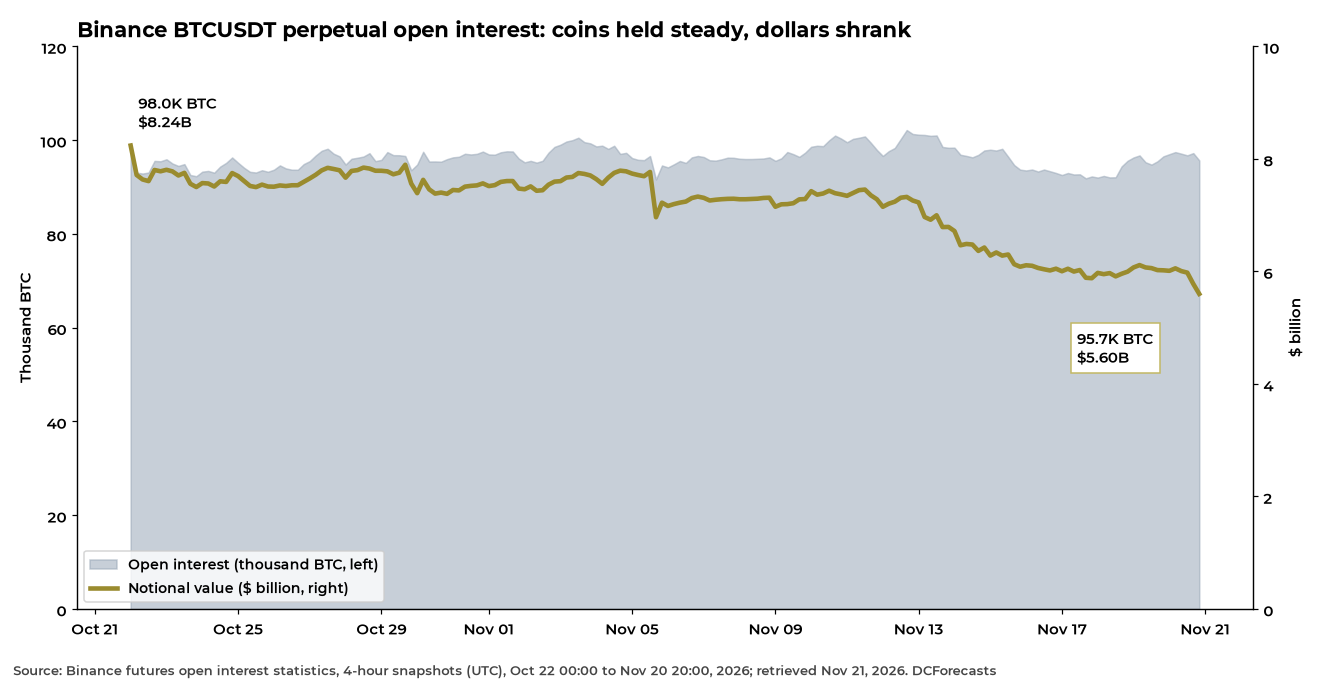
Binance’s BTCUSDT open interest stood at 98,002 BTC, worth $8.24 billion, at 00:00 UTC on October 22.
By 20:00 UTC on November 20 it was 95,677 BTC, worth $5.60 billion.
That is a 2.4% drop in coins against a 32% drop in dollar value. Almost all of the shrinkage came from price, not from traders closing positions.
On Bybit, open interest in the same contract rose from about 61,000 BTC on October 21 to 70,659 BTC on November 20, according to the exchange’s data.
Why Bitcoin Funding Rates Stayed Positive
Here we move from evidence to interpretation.
The simplest reading is that this decline was not driven by a leveraged blow-up. If forced selling in futures had led the way, coin-based open interest would usually have collapsed.
Instead, the pressure appears to have come largely from spot, including the record $541.1 million one-day outflow from BlackRock’s IBIT on November 19 and the broad November 20 sell-off across stocks and gold.
We believe that is constructive in one important way. Derivatives traders have not abandoned Bitcoin, and there is no sign of a crowded short bet against it.
The honest counterpoint matters too. Binance’s account data showed 77.5% of BTCUSDT accounts net long on November 20, up from 50.6% on October 22.
That ratio counts accounts rather than position size, but it suggests many smaller traders are buying the dip with leverage. If prices slip again, those longs are the fuel for further liquidations.
Options markets tell a calmer story than the headlines. As we noted when implied volatility climbed back to April levels, pricing for future swings is still well below February’s peak.
What Would Signal a Real Reset?
We would watch three things over the coming days.
- Funding: a run of negative settlements, pulling the seven-day average below zero, as in spring.
- Open interest: a meaningful drop in coin terms, not just dollars, on Binance and Bybit.
- Long-short mix: the share of long accounts easing back toward 50-60%.
The first hint may already be here. At 22:11 UTC on November 20, Binance’s indicative rate for the next settlement had dipped to -0.0037%.
One negative print would not make a bottom. But a cleaner derivatives market would remove one of the main sources of downside risk.
Can Bitcoin Rebuild From Here?
Bitcoin now sits close to its July 1 low of $57,718 after briefly undercutting it.
A return to the September 21 high would take a gain of roughly 52% from the November 20 low.
We believe the derivatives data points to a market that is bruised but not broken. Leverage has not been wiped out, but it has not been rushing for the exits either.
Meanwhile, the fundamentals that matter most have not moved: a fixed 21 million supply, deep regulated ETF and futures markets, and growing institutional plumbing.
The coming days will show whether funding finally resets or buyers keep absorbing the selling. Either way, the futures market is telling us conviction in Bitcoin has not gone anywhere.
DC Forecasts is a leader in many crypto news categories, striving for the highest journalistic standards and abiding by a strict set of editorial policies. If you are interested to offer your expertise or contribute to our news website, feel free to contact us at [email protected]











Discussion about this post