



The UK crypto tax overhaul heading to MPs on Monday would stop lending Bitcoin from being taxed as if it had been sold.
The Finance Bill 2026-27 is scheduled for its House of Commons second reading on November 23, according to the UK Parliament’s bill record.
Among its measures, it treats certain transfers into crypto loans and liquidity pools as “no gain, no loss”, deferring Capital Gains Tax until an investor makes a real economic disposal.
For Bitcoin holders who lend their coins for a return, we believe this is the most practical crypto tax change the UK has put into legislation so far.
The bigger question is whether clearer rules will draw more UK investors and institutions into regulated crypto lending.
What the UK Crypto Tax Bill Changes for Bitcoin Lenders
Today, HMRC’s cryptoassets manual says a loan is a disposal when beneficial ownership of the tokens passes to the borrower or lending platform.
That means a lender can face a tax calculation before any profit has been taken.
The new rules, set out in an HMRC tax information and impact note, cover three cases.
- Single cryptoasset lending: lending a coin and getting the same type back, plus a return, is treated on a no gain, no loss basis when entering and exiting.
- Single cryptoasset borrowing: borrowed coins are treated as acquired at market value, and collateral posted under the arrangement is disregarded for Capital Gains Tax.
- Automated market making: moving coins into and out of a smart-contract liquidity pool is no gain, no loss, but only for the same quantity originally deposited.
That last point matters. If a pool hands back more or fewer coins than went in, a gain or loss arises on the difference.

The rules apply to individuals and trustees from April 6, 2027. HMRC estimates they will affect about 700,000 people.
Four Years From Call for Evidence to Bill
This change did not arrive quickly.
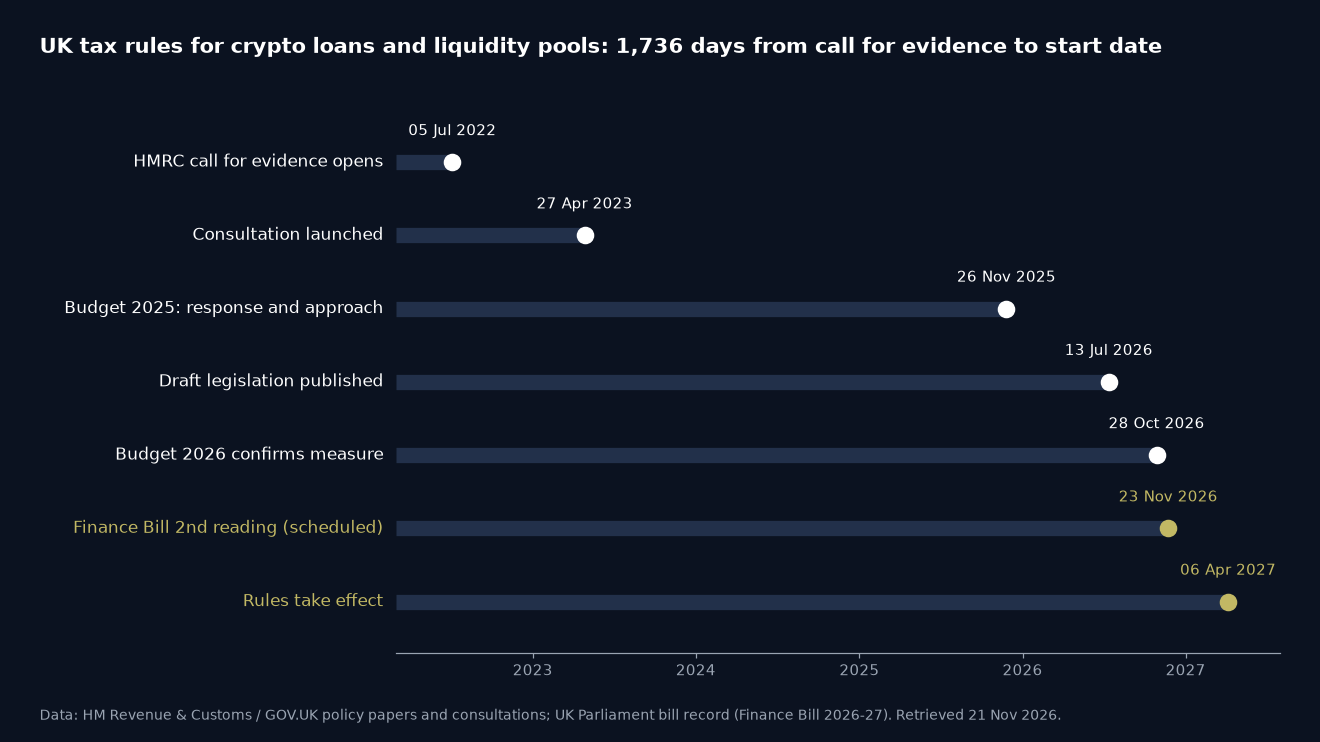
HMRC opened a call for evidence on July 5, 2022, then ran a full consultation from April 27 to June 22, 2023.
It published a summary of responses at Budget 2025 on November 26, 2025, released draft legislation on July 13, 2026, and confirmed the measure at Budget 2026 on October 28.
The bill had its first Commons reading on November 3, and after Monday’s debate it is listed for a committee of the whole House on November 30 and December 1.
We believe the slow pace is a feature as much as a flaw. Rules built over four years of feedback are less likely to be rewritten every Budget.
HMRC’s own paper says the goal is to align tax “more closely with the economics of these arrangements”.
In plain terms, lending a bitcoin and getting a bitcoin back should not look like selling it.
Stablecoins Get Treated More Like Money
The same bill carries a second crypto measure: a new tax treatment for eligible stablecoins.
For individuals and trustees, disposals of eligible stablecoins would be exempt from Capital Gains Tax, according to the HMRC stablecoin note.
To qualify, a token must hold a stable value against a fiat currency, be backed by fiat or other assets, be widely available and be designed for payments.
Interest-like returns from lending eligible stablecoins would be taxed as savings income instead.
Companies would be taxed on stablecoin transactions based on their accounts. The rules start on April 6, 2027 for individuals and April 1, 2027 for companies.
HMRC estimates about 1.2 million people use stablecoins, though it also notes they are still “rarely used to purchase goods and services”.
The Catch: Higher Savings Rates and More Reporting
The fine print is not all good news for yield seekers.
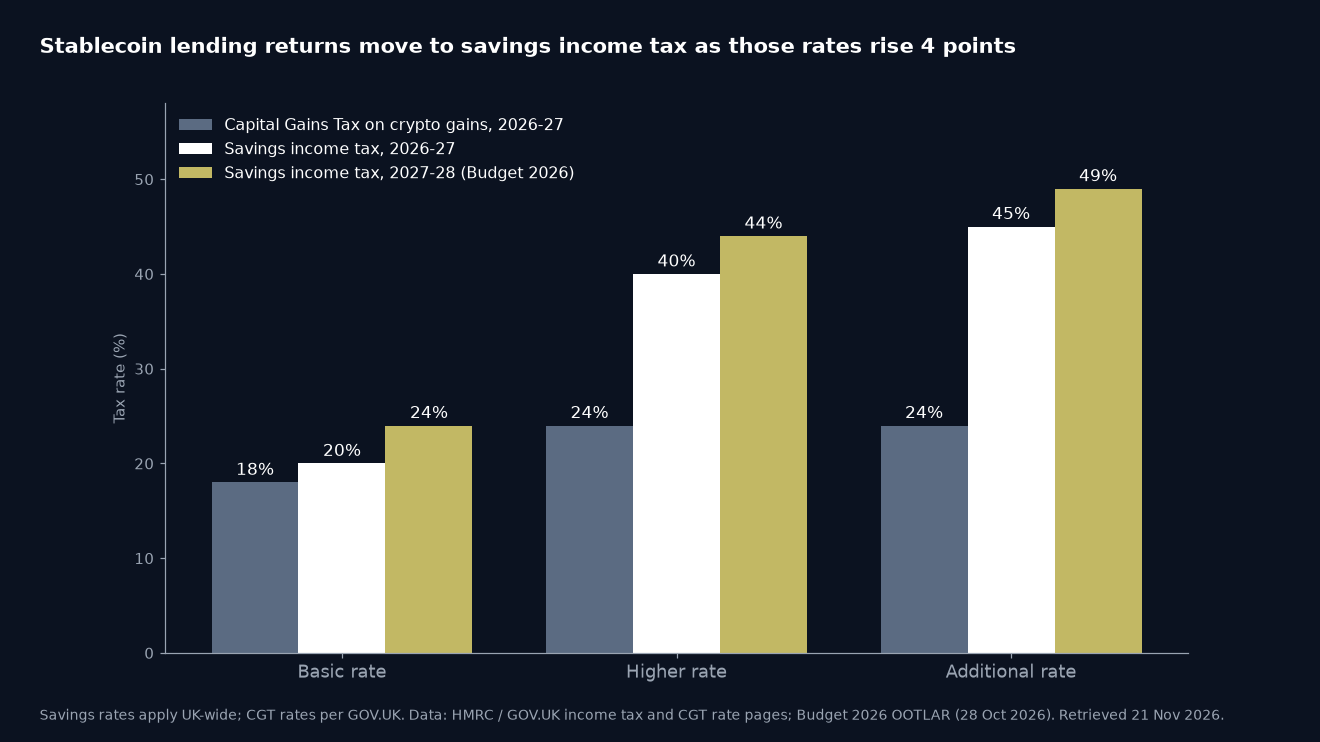
Budget 2026 raises savings income tax rates from 2027-28 to 24% for basic rate, 44% for higher rate and 49% for additional rate taxpayers, up from 20%, 40% and 45%.
By comparison, crypto gains currently face Capital Gains Tax of 18% or 24%, with a £3,000 annual exempt amount.
So stablecoin lending income will likely be taxed more heavily than many crypto gains, even as the paperwork gets simpler.
HMRC’s reach is also growing. The bill expands its Financial Institution Notice power to cover cryptoasset service providers.
Separately, under the Cryptoasset Reporting Framework, UK crypto service providers must file their first user and transaction reports by May 31, 2027, covering calendar year 2026.
That mirrors the European push we covered when Brussels escalated DAC8 crypto tax cases against Spain and Czechia.
Why Clear Rules Favour Bitcoin Holders
For us, the key takeaway is that Bitcoin holders get a fairer deal on lending and collateral, not just more oversight.
A tax system that charges people for moving coins into a loan discourages exactly the kind of productive, transparent activity regulators say they want.
The UK is also working on how to regulate decentralised finance itself, a debate we covered when CryptoUK warned the FCA’s DeFi draft could catch code writers.
Tax clarity and conduct rules together give UK institutions fewer reasons to stay on the sidelines.
HMRC scores both crypto measures as having a “negligible” impact on the Exchequer. That suggests the aim is simplicity, not revenue.
We would watch three things next: Monday’s second reading, any amendments in committee, and HMRC guidance on which arrangements qualify.
Bitcoin’s fixed 21 million supply does not change with any Budget. But the rules around holding, lending and using it keep getting clearer.
And if the bill passes intact, April 2027 could be the point when lending Bitcoin in the UK finally starts to make tax sense.
DC Forecasts is a leader in many crypto news categories, striving for the highest journalistic standards and abiding by a strict set of editorial policies. If you are interested to offer your expertise or contribute to our news website, feel free to contact us at [email protected]












Discussion about this post