



The Coinbase premium has been negative in every single hour since November 1, and many traders read that as proof that US buyers have walked away from Bitcoin.
Our numbers tell a different story.
From November 1 to 21, Bitcoin on Coinbase traded an average of 0.130% below Binance’s BTC-USDT market. Over the same stretch, Tether’s USDT traded an average of 0.122% below the US dollar on Kraken.
Put those two together and roughly 94% of the gap disappears. Priced in real dollars, the Coinbase discount shrinks to just 0.008%.
For Bitcoin investors, that matters. The bigger question now is whether a widely watched demand gauge is flashing a stablecoin signal rather than a Bitcoin one.
What the Coinbase Premium Is Supposed to Show
The idea is simple. Coinbase is the main spot venue for US investors and institutions, and it quotes Bitcoin in dollars. Binance’s deepest Bitcoin market is quoted in USDT.
When Coinbase trades above Binance, traders take it as a sign that US money is leading. When it trades below, they read it as US selling or fading interest.
The catch is that the comparison quietly assumes one USDT equals one dollar. Most of the time that is close enough. This month it was not.
Kraken’s USDT/USD market closed at $0.99763 on November 20, the lowest daily close in the 720 days of data the exchange’s public API returns, going back to December 2, 2024. It closed at $0.99792 on November 21.

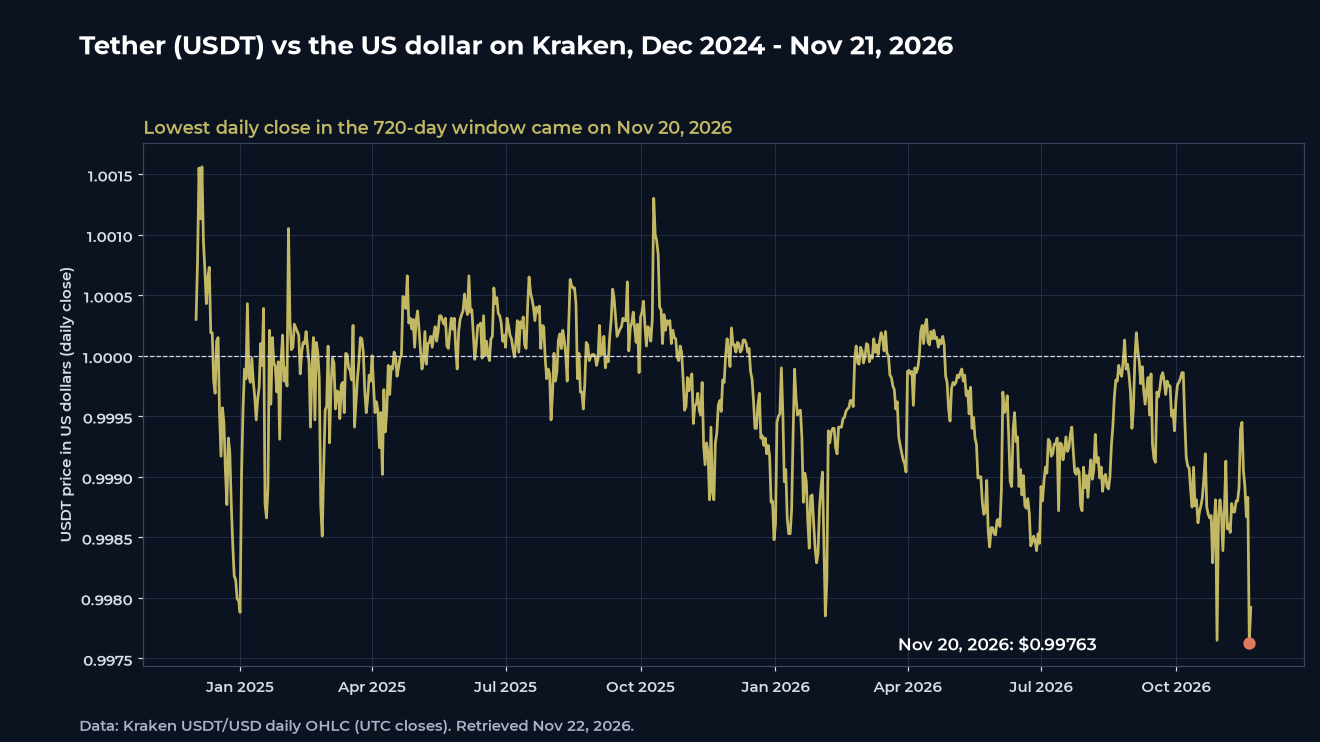
A Tether that trades a fraction of a cent below a dollar makes every Bitcoin quoted in USDT look slightly more expensive. That alone pushes the raw Coinbase premium below zero, even if nobody in the US is selling harder than anyone else.
How Much of the Coinbase Premium Is Really Tether?
We compared hourly closing prices for Coinbase’s BTC-USD pair and Binance’s BTC-USDT pair from early May through early Sunday, then converted the Binance price into dollars using Kraken’s USDT/USD rate.
The result is striking. Since early May, the daily raw gap and USDT’s distance from $1 have moved almost in lockstep, with a correlation of 0.96.
In the week from November 15 to 21, the raw gap averaged -0.119%. After the USDT adjustment, it averaged -0.002%, effectively zero.
Early Sunday, the raw reading stood near -0.22% while Bitcoin traded around $59,700 on Coinbase. Adjusted for Tether’s price, the day’s average gap was about -0.007%.
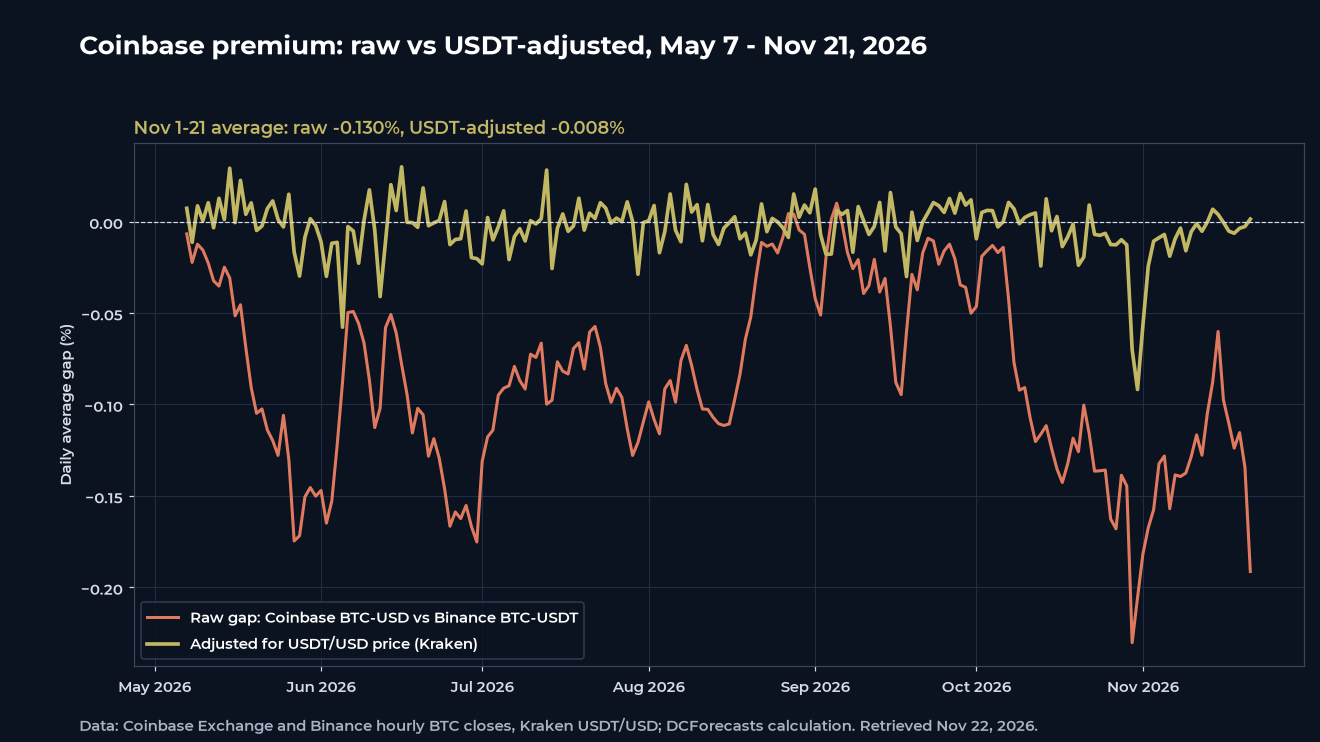
There is one honest exception. Around October 30 and 31, the adjusted gap did dip to between -0.07% and -0.09%, a genuine if small US discount during that week’s selling. It has since closed.
We believe that is the key evidence. US buyers paid essentially the same dollar price as everyone else through the slide from the $70,000s to below $60,000.
Why Is Tether Trading Below $1?
The likely explanation sits in Tether’s own supply. As we covered when USDT supply shed $8 billion in 30 days, holders have been redeeming and moving out of the token at the fastest pace since June 2022.
When more holders want dollars than new buyers want USDT, the market price slips a little below par until redemptions catch up. That is a stablecoin liquidity story, not a verdict on Bitcoin.
This is our interpretation, not a certainty. The data show the price gap; they cannot tell us every trader’s motive.
Still, the pattern fits. Premium readings elsewhere have moved for local reasons too, as we saw when Upbit buyers paid a 3.64% kimchi premium while Bitcoin slid below $65,000.
US Traders Are Showing Up, Not Leaving
Volume tells the same story from another angle.
In the week from November 9 to 15, Coinbase’s BTC-USD market traded 87,904 BTC, compared with 155,082 BTC on Binance’s BTC-USDT pair. That gave Coinbase 36.2% of the combined total, the highest weekly share in the 29 weeks we measured since May.
In mid-October, that share was 24.8%.
Volume counts buyers and sellers alike, so it cannot prove net demand on its own. But a rising US share at a flat dollar price points to deep two-way participation, not a buyers’ strike.
For us, that is a constructive sign. Coinbase also serves as custodian for most US spot Bitcoin ETFs, so its order books are where much of America’s institutional plumbing meets the market.
What We Would Watch Next
We would track three readings together rather than any single headline number:
- The USDT-adjusted Coinbase premium. A move clearly above zero would show US buyers paying up.
- Kraken’s USDT/USD rate. A return toward $1.000 would remove most of the raw discount on its own.
- Coinbase’s share of spot volume. Holding above 30% would keep US participation elevated.
If Tether simply drifts back to par, the raw Coinbase premium could flip toward neutral without a single extra US bid. Traders who missed the USDT effect could then misread a stablecoin fix as a sudden wave of American demand.
A Cleaner Read on US Bitcoin Demand
We believe the negative Coinbase premium has been overstated as a bearish signal this month. Once Tether’s price is stripped out, US investors paid fair value for Bitcoin through one of its sharpest slides of the year, and they traded more of it, not less.
That fits the longer-term picture. Bitcoin’s supply is fixed, US market infrastructure keeps deepening, and the deepest dollar order books are increasingly where price is set.
The coming weeks will reveal whether that steady US bid turns into a genuine premium. If it does, the move will be easier to trust, because it will not need a stablecoin discount to explain it.
DC Forecasts is a leader in many crypto news categories, striving for the highest journalistic standards and abiding by a strict set of editorial policies. If you are interested to offer your expertise or contribute to our news website, feel free to contact us at [email protected]











Discussion about this post