



South Korea crypto tax talks have narrowed to a single number, and it is not the tax rate.
Lawmakers from both main parties have tentatively agreed to push the tax on crypto gains back two years, to January 2029, and to keep the basic deduction at 2.5 million won.
What they could not settle, at subcommittee meetings on Nov. 12 and Nov. 17, is how long investors may carry a crypto loss forward: three years, as the government wants, or five.
For Bitcoin holders, that detail decides whether a loss taken in a bear market can still be used when the next recovery arrives.
The bigger question is whether Seoul will write a rule that fits how Bitcoin actually moves.
Two Bills, One Gap Left in Seoul
Two amendments to the Income Tax Act sit before the National Assembly’s Finance and Economy Planning Committee, according to the government’s legislative tracking service.
Bill No. 2222597, filed on Nov. 9 by Democratic Party lawmaker An Do-geol and nine others, follows the government plan announced on Nov. 5.
It delays crypto taxation from Jan. 1, 2027, to Jan. 1, 2029, requires crypto businesses to submit data to prepare for collection, and lets a year’s net crypto losses be deducted from gains over the following three years.
Bill No. 2222117, filed on Oct. 27 by opposition lawmaker Choi Eun-seok and nine others, asked for more. It sought a five-year carryforward and a basic deduction raised to 50 million won, along with the same two-year delay.

The committee’s tax subcommittee took up both bills on Nov. 12 and Nov. 17. As of Nov. 20, neither had been voted out.
What Lawmakers Already Agreed On
The parties first reached a tentative deal on the two-year delay on Nov. 11, Korean news agency News1 reported.
On Nov. 17, Bae Jun-young, the opposition People Power Party’s secretary on the committee, told reporters the two sides had agreed not to raise the deduction to 50 million won, according to Chosun Biz.
He said required data from crypto businesses would be submitted in a form that cannot identify individual users.
On the carryforward, his summary was blunt: “The government wants three years, but there is also an opinion for five years. Once that is settled, nothing else is in dispute.”
He expected a vote that day. It did not come, Aju Business Daily reported on Nov. 21.
The tax itself has a long history of slipping. It was first due in January 2022, moved to 2023, and was pushed back twice more to its current 2027 start. A 2029 start would be the fourth delay.
We covered the government’s side when Seoul first proposed moving the start to 2029. Now parliament owns the decision, and the gap has shrunk to one clause.
Why a Crypto Loss Carryforward Matters
Under the proposals, gains above the 2.5 million won deduction would be taxed at 22%, combining 20% national income tax and 2% local income tax.
A crypto loss carryforward lets an investor offset a bad year against later profits. Once the window closes, the loss is gone.
Aju Business Daily laid out the industry’s case. An investor who buys coins for 50 million won in 2029 and sells for 40 million won books a 10 million won loss.
If that investor earns 10 million won in 2033, the two years net to zero. Under a three-year rule, though, the 2029 loss expires after 2032.
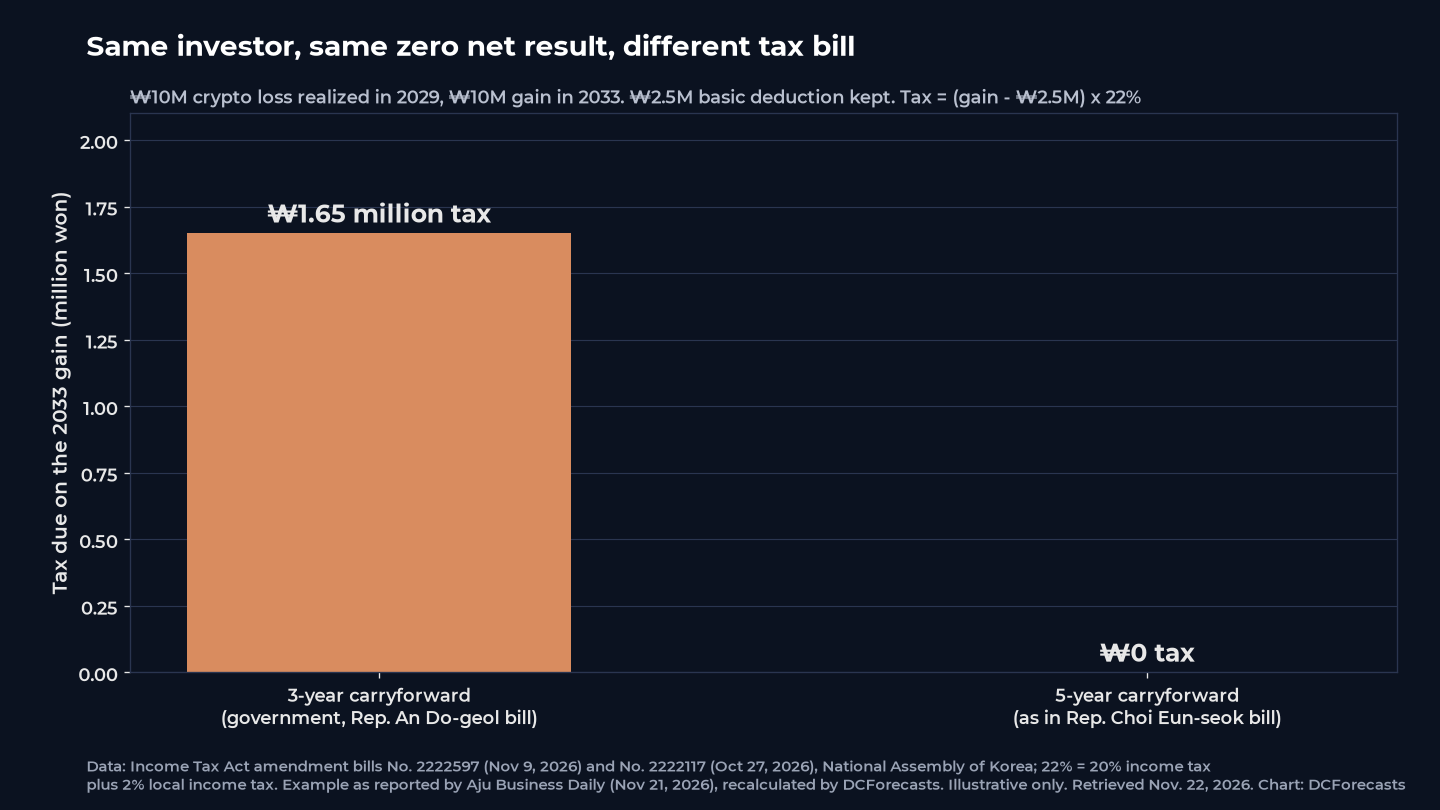
That leaves 7.5 million won taxable at 22%, a 1.65 million won bill. With five years, the bill is zero.
Supporters of five years note that the abolished financial investment income tax was designed with a five-year carryforward, and business losses can generally be carried for 15.
The United States and the United Kingdom set no time limit on carrying forward capital losses, while Japan is moving toward a three-year carryforward for certain crypto trades, according to Aju.
Hwang Seok-jin, a professor at Dongguk University, told the paper that given “the recent market downturn and the high price volatility,” extending the period beyond five years is worth considering over time.
How Long Bitcoin Recoveries Have Actually Taken
We tested the three-year window against Bitcoin’s own record, using Coinbase daily closes.
After its Dec. 16, 2017 close of $19,650, Bitcoin first closed higher on Nov. 30, 2020. That took 1,080 days, 16 days short of three years.
After the Nov. 8, 2021 close of $67,555, the first higher close came on March 4, 2024, after 847 days.
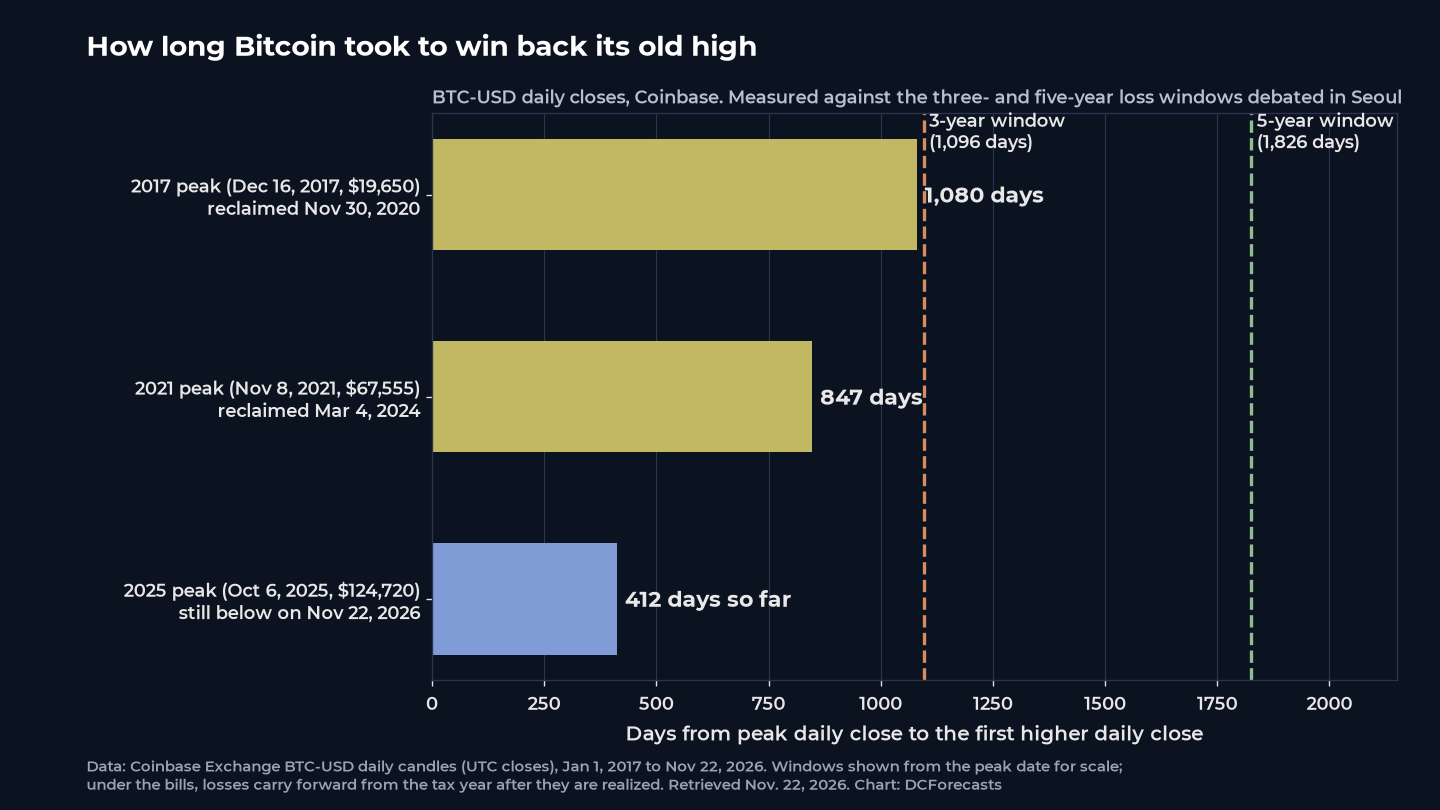
Both full recoveries landed inside three years, one of them barely. That gives each side its best argument: three years covered every recent cycle, but the margin was razor thin.
The current cycle is still running. Bitcoin’s Oct. 6, 2025 close of $124,720 was 412 days ago, and the price stood near $60,690 on Coinbase on Sunday afternoon, about 51% below that peak.
That drawdown is real. Historically, though, deep resets like this one have been where long-term holders built positions.
What This Means for Korea’s Bitcoin Investors
South Korea is one of the world’s busiest retail crypto markets, and its buyers have been paying up for Bitcoin even in this slide, as we found when Upbit’s kimchi premium hit 3.64%.
A workable loss rule would make that market easier to hold for the long term, instead of taxing only the rebound leg of a cycle.
We believe five years would be the more durable choice, because it fits Bitcoin’s four-year rhythm with room to spare. Three years would still be a real improvement on today’s law, which offers no carryforward at all.
Next, watch for a subcommittee vote, then the full committee and a plenary vote before the regular session ends.
Whatever Seoul picks, the direction is constructive: a fixed-supply asset is being written into a mainstream tax code with protections built for its cycles. The coming weeks will show whether Korea gives Bitcoin holders three years of patience, or five.
DC Forecasts is a leader in many crypto news categories, striving for the highest journalistic standards and abiding by a strict set of editorial policies. If you are interested to offer your expertise or contribute to our news website, feel free to contact us at [email protected]












Discussion about this post