



Europe’s MiCA stablecoin rules may lose one of their most distinctive features: the requirement that issuers park a fixed slice of their reserves in bank deposits.
In its Financial Stability Review published on Nov. 18, the European Central Bank said “the minimum deposit requirements for stablecoins could be removed and replaced with minimum liquidity requirements for reserve assets.”
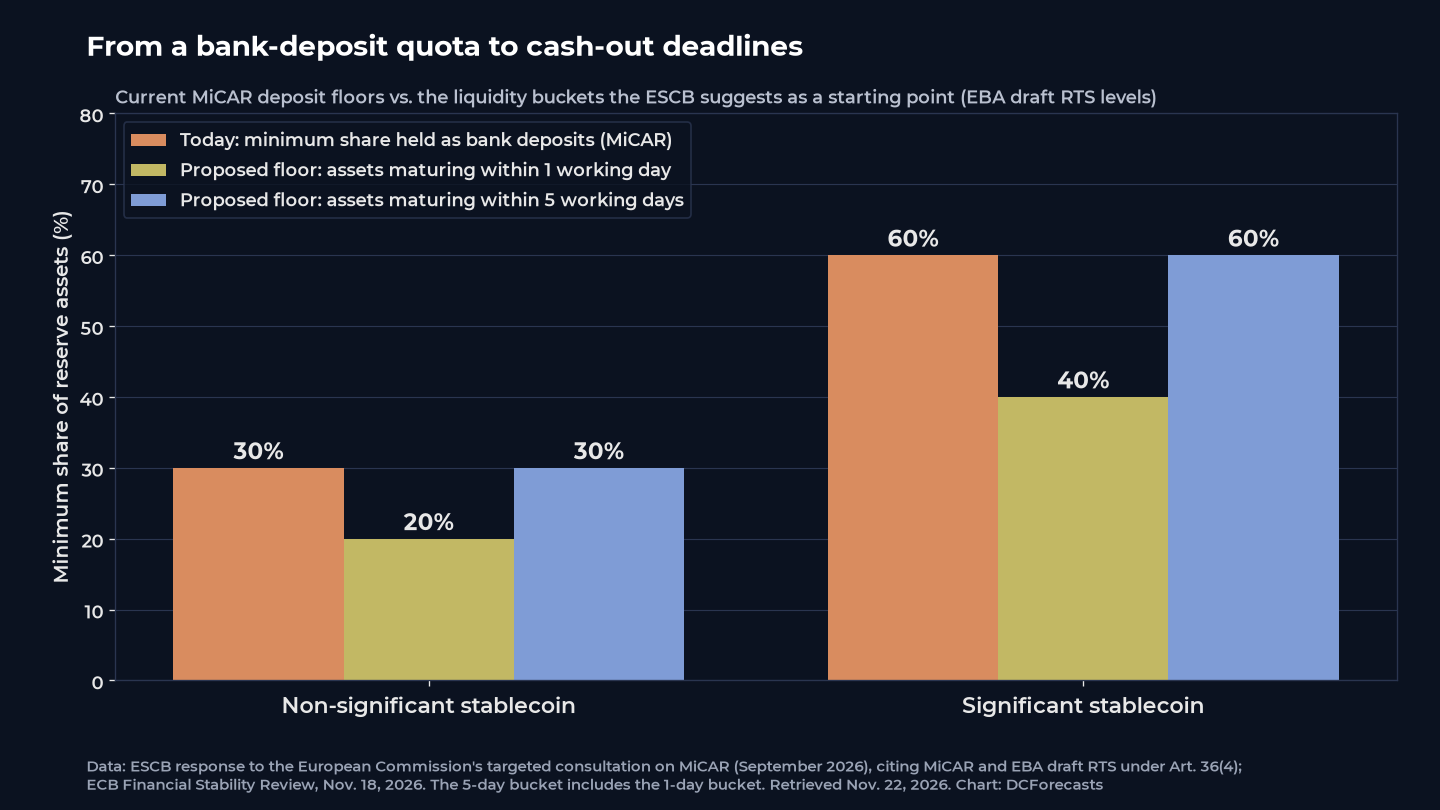
Today, MiCA requires at least 30% of reserves to sit in bank deposits, and 60% for tokens classed as significant.
For crypto investors, the ECB is effectively arguing that a rule meant to make stablecoins safer may be making banks less safe.
The bigger question is whether Brussels listens before euro stablecoins grow large enough for the answer to matter.
What the ECB Wrote on Nov. 18
The passage is short, but the reasoning is direct.
Swapping the deposit quota for liquidity floors “would provide issuers with more flexibility and still maintain their ability to meet redemption requests promptly,” the review said.
It added that the change “could also reduce potential channels for contagion between banks and stablecoins while ensuring that reserve assets remain sufficiently liquid.”
The ECB framed this as part of the European Commission’s review of the Markets in Crypto-Assets Regulation, which it welcomed. It still called MiCA “a robust, balanced and harmonised regime” for issuers and service providers.

The same review backed the Commission’s plan to move authorisation, monitoring and enforcement of all crypto-asset service providers to the European Securities and Markets Authority.
It also asked lawmakers to keep a tougher tier for significant providers, judged by size, cross-border reach and trading volumes.
Why MiCA Stablecoin Rules Tie Issuers to Banks
The detail sits in the response the European System of Central Banks sent to the Commission’s MiCA consultation in September, which the review cites.
That document lays out the problem in plain terms. A fixed deposit share creates “a direct link between issuers and credit institutions.”
If a stablecoin faces a run, its issuer must pull deposits quickly. If those deposits are a large part of one bank’s funding, the bank inherits the stress.
The central banks point to March 2023, when trouble at Silicon Valley Bank, which held part of USDC’s reserves, set off a run on the token. The contagion ran in the other direction that time, from bank to stablecoin.
Banks also get little comfort from the money. Under liquidity coverage rules, deposits from stablecoin issuers carry a 100% outflow assumption, so they cannot be counted on in stress.
And issuers earn little on it. The ESCB cited an average yield of 0.53% on corporate deposits in April 2026, warning that weak profitability could hold back a competitive euro stablecoin market.
From a Deposit Quota to Cash-Out Deadlines
What would replace it? The ESCB suggests minimum shares of reserves that mature within one and five working days.
As a starting point, it proposes the levels in the European Banking Authority’s draft technical standards: 20% within one day and 30% within five days for ordinary tokens, rising to 40% and 60% for significant ones.
Overnight reverse repos and short-term government bills, which large euro area states issue with three- to 12-month maturities, could provide that liquidity without a bank sitting in the middle.
There is a twist. Those draft standards still await Commission approval, so the deposit rule is currently the only hard liquidity floor. The ESCB even notes that issuers can meet it with term deposits that are not redeemable on demand.
The central banks want the draft standards, including caps on how much an issuer may place with any single bank, adopted quickly in the meantime.
We believe that is the right order of operations: set the new floors first, then remove the old one.
How Big Is the Euro Stablecoin Market?
Small, but growing fast.
CoinGecko data show Circle’s EURC rose from about €275 million to €459 million over the past year. Société Générale-Forge’s EURCV climbed from €66 million to €169 million.
Together, the two largest euro tokens grew 84%, to roughly €628 million.
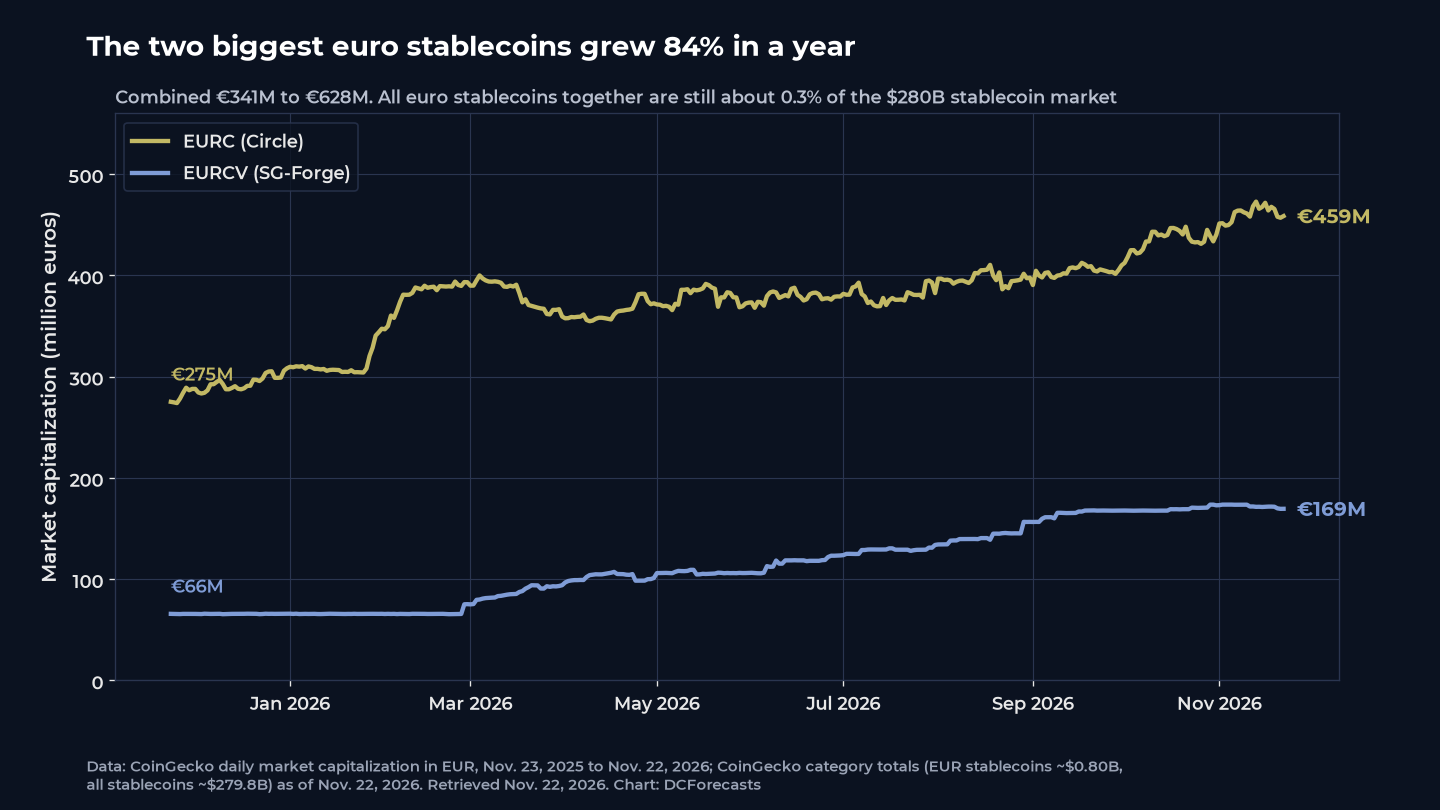
Even so, every euro stablecoin combined is worth about $800 million, roughly 0.3% of a stablecoin market near $280 billion.
That gap matters for the ECB. ECB survey data show more euro area crypto holders own Tether’s USDT than the euro-denominated EURC, as we covered when euro area investors picked Bitcoin first and Tether over a euro token.
For us, the deposit rule is one reason euro issuers struggle to compete. Lighter but well-defined liquidity rules could help close that gap.
What It Means for Crypto Markets in Europe
Nothing changes yet. The ECB’s view is an input to the Commission’s review, not law, and any amendment would still need the European Parliament and member states.
The central banks also want some limits kept, such as the ban on paying interest to stablecoin holders.
Still, the direction is constructive. Central bankers who have spent years stressing stablecoin risks are now asking how to make the rules workable.
That fits a wider pattern of European institutions building the plumbing for tokenised money, from the ECB’s tokenized deposit test bed to a single crypto supervisor at ESMA.
Deeper euro liquidity on-chain would also benefit Bitcoin. Stablecoins are the main bridge between bank money and crypto, and euro traders still rely heavily on dollar tokens to cross it.
Bitcoin traded near $60,770 on Sunday, up about 3% over 24 hours, according to CoinGecko.
We believe clearer, more competitive stablecoin rules in Europe strengthen the rails that carry new money toward Bitcoin, an asset with a fixed supply that needs no reserve rules at all.
The coming months of the MiCA review will show whether Brussels takes the ECB’s advice.
DC Forecasts is a leader in many crypto news categories, striving for the highest journalistic standards and abiding by a strict set of editorial policies. If you are interested to offer your expertise or contribute to our news website, feel free to contact us at [email protected]












Discussion about this post