



Core Lightning, one of the main software implementations of Bitcoin’s Lightning Network, has a new release candidate out, and it is unusually large because the team gave up an entire release cycle to fix security bugs.
Version 26.12rc1 was published on GitHub on Nov. 18. Its release notes say there was no v26.09, and that the slot was spent fixing an unusually high number of vulnerability reports.
The result is what the team calls effectively a double release: 832 commits since v26.06, written over 169 days by 41 authors.
For Bitcoin users, the most interesting part is not the size of the update. It is how openly a core piece of payment infrastructure handled a wave of bug reports.
The bigger question now is whether that slower, security-first cadence leaves the Lightning Network stronger heading into 2027.
Why Core Lightning Skipped v26.09
Core Lightning normally ships a feature release roughly every three months.
Its GitHub release records show gaps of 78 to 102 days between most feature releases from 2024 through 2025.
The 169 days between v26.06 on June 2 and the v26.12 candidate on Nov. 18 is the longest gap in that run.
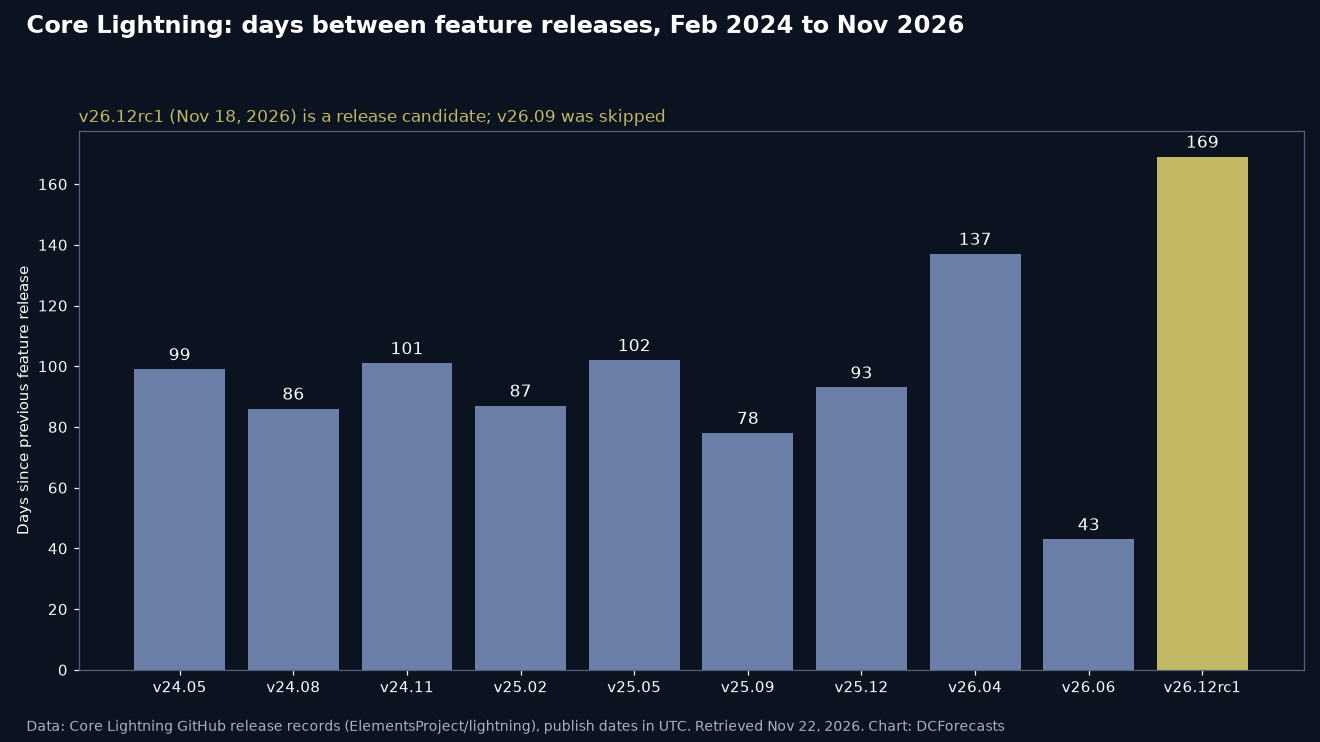
The reason was not a stall in development. According to the release notes, work on the main branch continued while maintainers shipped fixes through the v26.06.x point releases.

That matters, because it means users on the stable line received the fixes first, without waiting for new features.
Four Security Releases in Ten Weeks
Between Aug. 26 and Nov. 5, the project’s changelog records four point releases, from 26.06.7 to 26.06.10.
Together they list 152 entries under “Fixed”: 25, 47, 33 and 47 respectively.
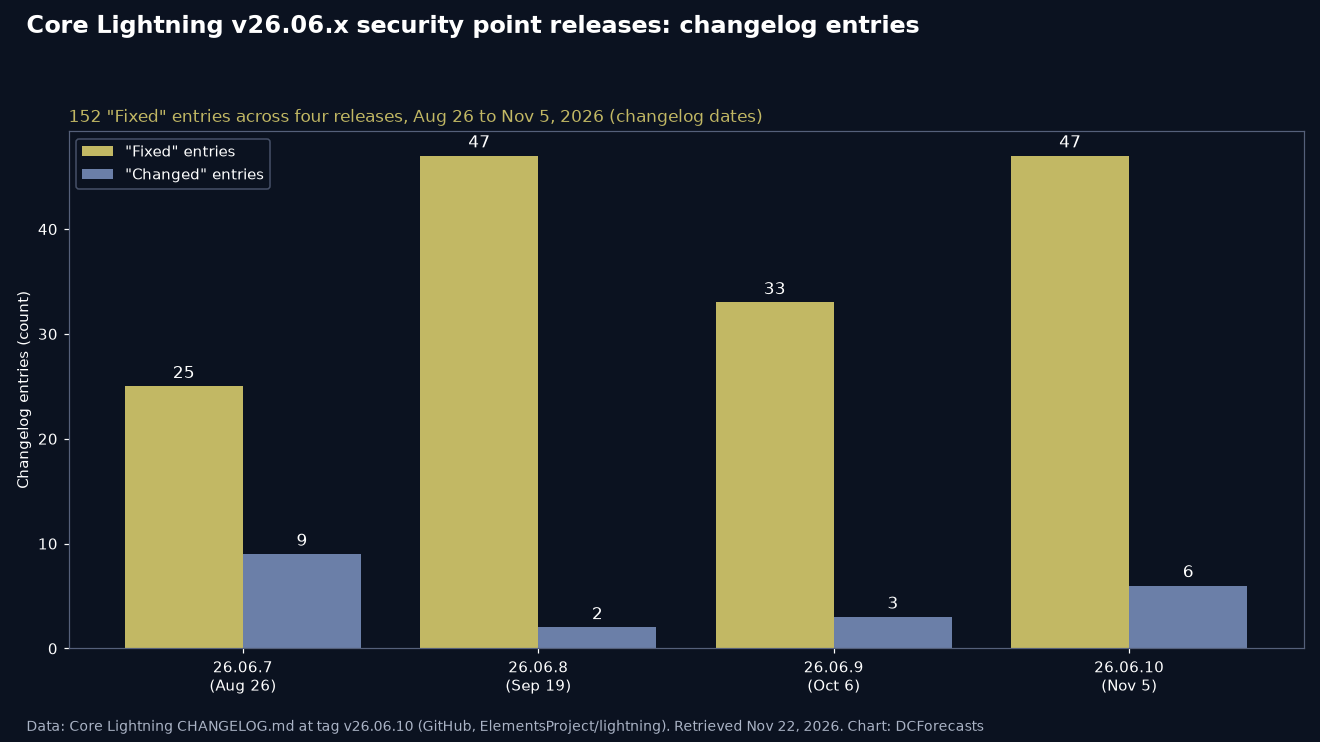
Not every entry is a vulnerability, since the “Fixed” sections also cover ordinary bugs.
Still, the 26.06.10 notes describe security fixes in dual funding and splicing, on-chain HTLC resolution, gossip resource limits, runes, plugin hooks and the hardware security module daemon, plus remote-crash and hardening fixes.
The 26.06.7 notes were candid about the backdrop. They said increasingly capable AI models were being used to find potential flaws in open-source code, sharply raising the volume and pace of security reports.
That release used a two-week embargo, with binaries shipped first and source code published on Sept. 11.
From 26.06.8 onward, the team dropped the embargo but temporarily withheld the tests for the security fixes, to make the patches harder to reverse-engineer into working exploits.
What Changes for Lightning Node Operators
The v26.12 candidate carries several practical changes for anyone running a Lightning node.
- The older
paycommand is being phased out and is set to be replaced byxpayin v27.03. lightning-hsmtoolcan now recover HTLC outputs after a node loses channel state.- Failed forwards now report a reason, such as insufficient outgoing liquidity or too many HTLCs.
- The askrene routing engine now remembers successful payments through a channel and factors fees into its route choices.
- Splicing fixes remove a crash and a stray message on reconnect.
The notes also add an experimental option for simpler one-shot mutual channel closes, and a check that rejects channel negotiations whose outputs add up to more than 21 million BTC.
We like that last detail. It is a small line of code that writes Bitcoin’s fixed supply cap directly into Lightning’s channel-opening logic.
Because two cycles of changes are bundled, the team asks operators upgrading from v26.06.x to read the changelog carefully, particularly developers using its Rust and gRPC interfaces.
A Pattern Across Bitcoin Lightning Software
Core Lightning is not alone in this busier security environment.
As we reported when an AI-flagged Bitcoin Core vulnerability was patched, Bitcoin Core published versions 31.3 and 30.5 on Nov. 20.
The 26.06.8 notes credit more than a dozen named reporters, including Bitcoin Red Team and an account named project-loupe, plus reporters who chose to stay anonymous.
We believe this is the healthy version of the AI story. The same tools that could help attackers are being used by researchers to find flaws first, and maintainers are turning those reports into public fixes.
The process is also visible to anyone. Release dates, changelogs and signed binaries all sit in the open, which is how Bitcoin software earns trust.
Why This Matters for Bitcoin Payments
Lightning is where much of Bitcoin’s everyday payment activity happens, from small merchant sales to exchange withdrawals.
We recently looked at Block’s first data on Bitcoin payments on Square, a reminder that this plumbing is now serving real retail checkouts.
Better routing, clearer failure messages and stronger recovery tools make that experience more dependable for merchants and node operators alike.
A 169-day wait for features is a real cost for developers who wanted them sooner. But we think prioritizing security over a calendar is the right trade for software that moves real bitcoin.
What Comes Next for Core Lightning
A release candidate is a test build, not a final release. Further candidates are possible before v26.12 ships.
The team has not given a final release date in the notes, though the version name points to December.
We would watch three things: whether more candidates follow, how quickly operators move off older 26.06.x builds, and whether the project returns to its usual three-month rhythm with v27.03.
The release also lists 19 first-time contributors, a sign that the developer base around Lightning keeps widening.
Bitcoin’s base layer stays fixed and conservative by design. The layers built on top of it keep getting sturdier, and this release shows that work continuing in public, one commit at a time.
DC Forecasts is a leader in many crypto news categories, striving for the highest journalistic standards and abiding by a strict set of editorial policies. If you are interested to offer your expertise or contribute to our news website, feel free to contact us at [email protected]












Discussion about this post