



Coinbase perpetual futures, the US-regulated perp-style Bitcoin contract listed on Coinbase Derivatives, now show smaller traders holding a net short position for a sixth straight week.
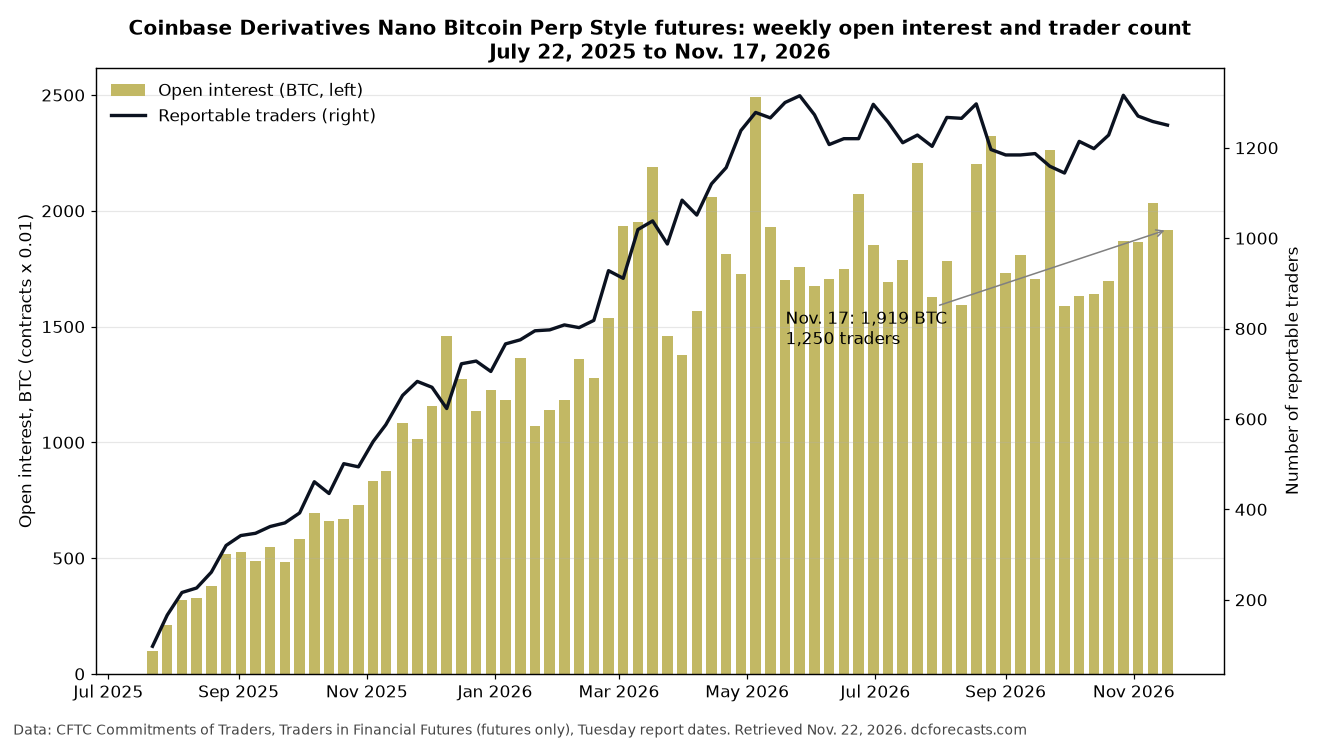
The latest Commitments of Traders data from the Commodity Futures Trading Commission, covering positions as of Tuesday, Nov. 17, put open interest at 191,903 contracts.
Each contract is worth one-hundredth of a coin, so that equals about 1,919 BTC, or roughly $124 million at CoinGecko’s Nov. 17 price near $64,800.
For Bitcoin investors, the most interesting detail is not the size of the market but who is leaning which way inside it.
The bigger question now is whether a crowd of smaller short sellers becomes fuel for the next bounce.
How Big Have Coinbase Perpetual Futures Become?
The contract first appeared in the CFTC’s weekly report on July 22, 2025, with 9,722 contracts open, or about 97 BTC.
Sixteen months later, open interest is nearly 20 times larger.
It peaked at 249,307 contracts, about 2,493 BTC, on May 5, 2026. The Nov. 17 reading was 5.7% below the prior week’s 203,537 contracts.
The trader count tells a stronger growth story. The CFTC counted 1,250 reportable traders in the contract on Nov. 17, up from 97 in its first report.

That is more than ten times the 112 reportable traders in CME’s standard Bitcoin futures contract and almost seven times the 180 in CME’s Micro Bitcoin futures in the same report.
Scale still favors Chicago. CME’s standard contract held 19,257 contracts of 5 BTC each, about 96,285 BTC, while its micro contract held roughly 2,219 BTC.
On that basis, the Coinbase product is about 2% of CME’s combined Bitcoin futures book. It is small in coins but wide in participation, which fits a contract sized for individual traders.
Smaller Traders Hold a Net Short Six Weeks Running
The CFTC splits positions into dealers, asset managers, leveraged funds, other reportable traders, and non-reportable positions, the last being accounts below its reporting thresholds.
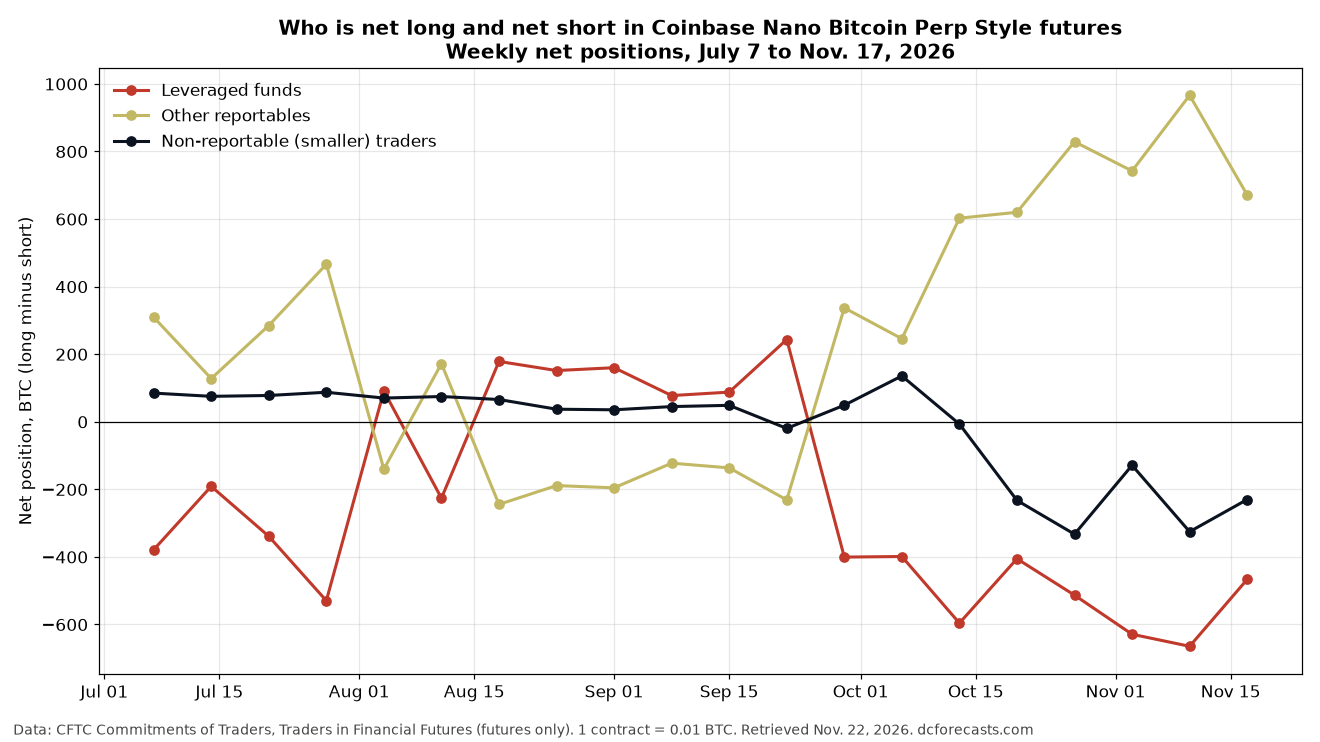
On Nov. 17, non-reportable traders held 18,295 long contracts against 41,304 short ones. That is a net short of 23,009 contracts, or about 230 BTC.
They have been net short in every weekly report since Oct. 13. Before that run, the group had been net short only once, on Sept. 22, 2026, since the contract’s first report.
Their largest net short came on Oct. 27, at 33,273 contracts, or roughly 333 BTC.
That shift lines up with the price. CoinGecko data shows Bitcoin near $75,300 on Nov. 10 and close to $64,800 a week later.
In other words, the smaller traders on this venue have been adding downside bets after the decline, not before it.
Leveraged Funds Trimmed Their Shorts
Leveraged funds, the CFTC’s bucket for hedge funds and similar money managers, were also net short on Nov. 17.
They held 21,092 longs and 67,755 shorts, a net short of 46,663 contracts, or about 467 BTC. They have been net short since Sept. 29, eight reports in a row.
Yet the direction changed last week. Their net short shrank from 66,454 contracts on Nov. 10, as gross shorts fell by 11,515 contracts and longs rose by 8,276.
On the other side sit “other reportables,” large traders that fall outside the CFTC’s other categories. They were net long 67,152 contracts, about 672 BTC, down from 96,638 a week earlier. Dealers held 2,520 longs and no shorts, while asset managers held none.
The same trend showed up on CME, where, as we covered, hedge funds now hold their smallest net short in CME Bitcoin futures since January 2023.
Why a Short-Heavy Crowd Can Turn Into Support
We believe the split matters more than the headline open interest figure.
Short positions have to be bought back to close. When smaller traders crowd into shorts after a sharp drop, any rebound can force them to cover, adding buying pressure on the way up.
That is not a forecast. It is a description of how positioning can amplify moves in either direction, and the CFTC data shows only weekly snapshots, not intraday flows or funding payments.
Still, the pattern is constructive. Funds were reducing shorts while the price fell, and smaller traders were taking the other side late in the move.
The broader signal is that Bitcoin derivatives are moving onshore. Perpetual contracts were once almost entirely an offshore product. Now a regulated US version reports 1,250 large traders, and Binance.US has filed a rulebook of its own, as we noted in our look at Binance.US plans for Bitcoin perpetual futures.
What to Watch in the Next Commitments of Traders Report
The next report will capture positions as of Tuesday, Nov. 24, with Bitcoin trading near $61,200 on Sunday, according to CoinGecko.
We would watch three things in the CFTC’s Commitments of Traders tables.
- Whether non-reportable traders stay net short for a seventh week or start covering.
- Whether leveraged funds keep shrinking their net short, as they did in the week to Nov. 17.
- Whether open interest climbs back above 200,000 contracts, which would show fresh capital returning rather than positions simply rotating.
For us, the key takeaway is simple. Bitcoin perps are no longer an offshore-only market, and the US version already shows a familiar setup: smaller traders leaning short after a deep drop while professional money eases off.
Bitcoin’s fixed 21 million supply, a growing base of regulated products and a widening pool of US traders give the long-term case solid footing. The coming weeks will reveal whether those late shorts end up powering the next leg higher.
DC Forecasts is a leader in many crypto news categories, striving for the highest journalistic standards and abiding by a strict set of editorial policies. If you are interested to offer your expertise or contribute to our news website, feel free to contact us at [email protected]












Discussion about this post