



OCBC is piloting stablecoin payments that reach business customers as ordinary money in the bank accounts they already use, Singapore stablecoin issuer StraitsX said on Monday, November 23.
The recipient never has to open a crypto wallet, hold a token or arrange its own off-ramp.
NTT DOCOMO ASIA is the first company taking part, and the pilot starts with selected cross-border business-to-business flows.
It is also the third StraitsX announcement in five days, and the second with OCBC.
The bigger question is whether this “invisible stablecoin” model becomes the way banks bring blockchain settlement to corporate clients.
How OCBC’s Stablecoin Payments Pilot Works
StraitsX handles the crypto side through what it calls Dedicated Wallet Address infrastructure.
Each participating business gets its own address, so an incoming stablecoin payment can be tied to that business before anything else happens.
StraitsX then runs payment identification, on-chain compliance checks, reconciliation and settlement. OCBC supplies the banking relationship and the conversion into fiat.
The result, in the words of the use-case title published by Singapore’s central bank, is “cross-border B2B payments via stablecoin rails, received as fiat in existing bank accounts.”

“Our work with OCBC demonstrates how stablecoin infrastructure can operate behind the scenes while businesses continue to use the banking relationships and accounts they already rely on,” said Tianwei Liu, StraitsX’s CEO and co-founder.
Carmen Chan, deputy head of global transaction banking at OCBC, said the bank wants clients to “harness their benefits without adding complexity to their day-to-day financial operations.”
We think that design choice matters more than the technology. Most finance teams do not want new wallets to manage. They want faster money in the account they already reconcile.
One of 11 Pilots in Singapore’s BLOOM Playbook
The pilot did not appear out of nowhere. It is one of 11 industry use cases the Monetary Authority of Singapore listed on November 19, when it published a field guide for its BLOOM initiative.
MAS launched BLOOM in October 2025 to let financial institutions settle in tokenized bank liabilities and well-regulated stablecoins. In October 2026, Bank Negara Malaysia and the Bank of Thailand joined as policymaker members.
Our count of the published list shows stablecoins doing most of the work. Eight of the 11 use cases settle with stablecoins, while the rest focus on tokenized deposits or tokenized fund shares.
StraitsX appears in four of the 11, more than any other participant. OCBC appears in three.
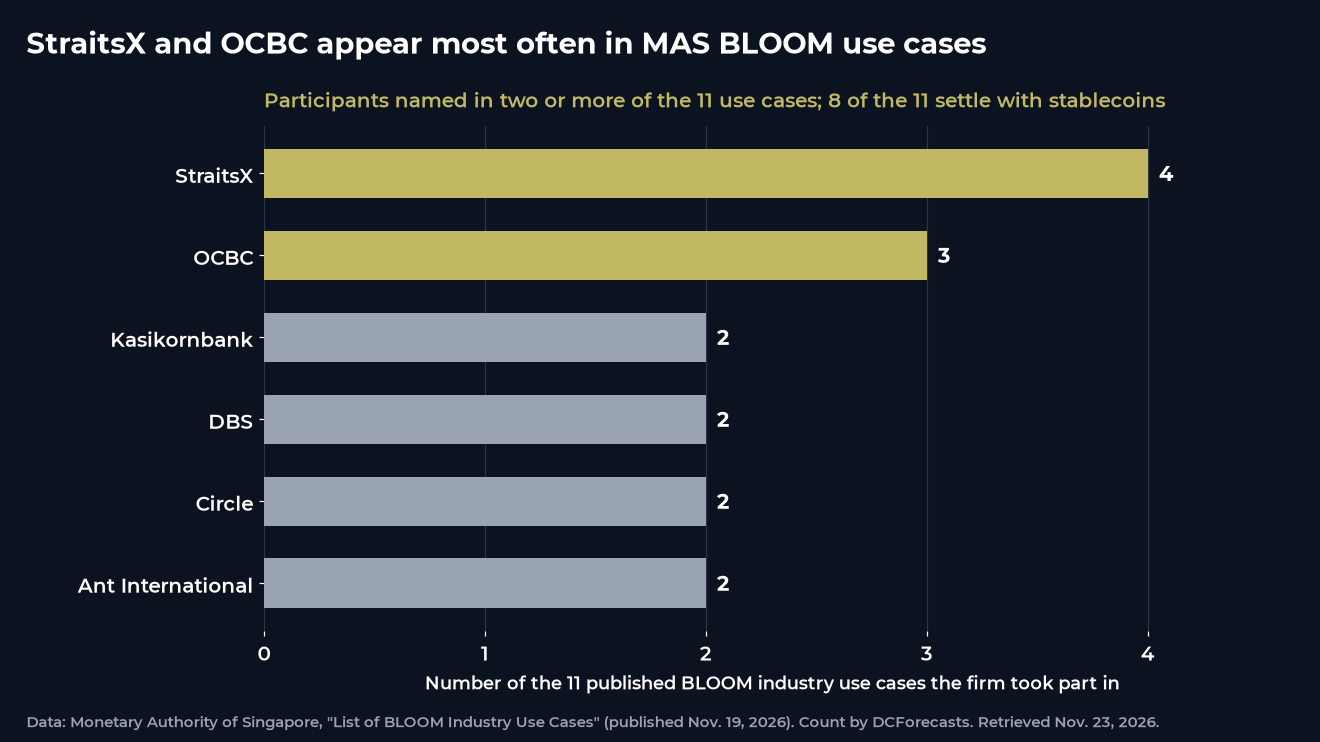
The two firms also lead BLOOM’s programmable controls working group, according to the field guide. That group covers identity checks, sanctions screening and transaction limits built into digital money.
MAS stresses that the guide is descriptive and does not endorse any participant, product or settlement asset. Still, it shows where real implementation work is happening.
Tokenized Deposits Get a Cross-Bank Test Too
Four days before the OCBC pilot, StraitsX, OCBC and Standard Chartered said they had completed a proof of concept for tokenized deposits issued by different banks.
Tokenized deposits are claims on a single bank, so they cannot simply move into another bank’s system. StraitsX acted as shared settlement infrastructure between the two banks’ ecosystems.
The partners said they completed US dollar payment flows outside conventional banking cut-off windows, with value moving between the two banks within minutes. They also said the shared model reduced the need for bilateral prefunding.
That builds on the cross-bank work we described when DBS and Kinexys opened a weekend lane for tokenized dollars between the US and Singapore.
On the same day, StraitsX signed a memorandum of understanding with Taiwanese memory maker ADATA and its subsidiary BaaS Innovation. They will explore settling semiconductor trade with its XSGD and XUSD stablecoins.
Small Tokens, Big Banking Partners
The scale of StraitsX’s own tokens shows how early this market still is.
XUSD had a market value of about $41.2 million on November 23, up from $38.1 million a year earlier but below its 12-month peak of $71.3 million in April, according to CoinGecko data.
XSGD, the Singapore dollar token, was worth about $15.0 million, or roughly 19.4 million Singapore dollars. For comparison, Tether’s USDT is worth about $174.6 billion.
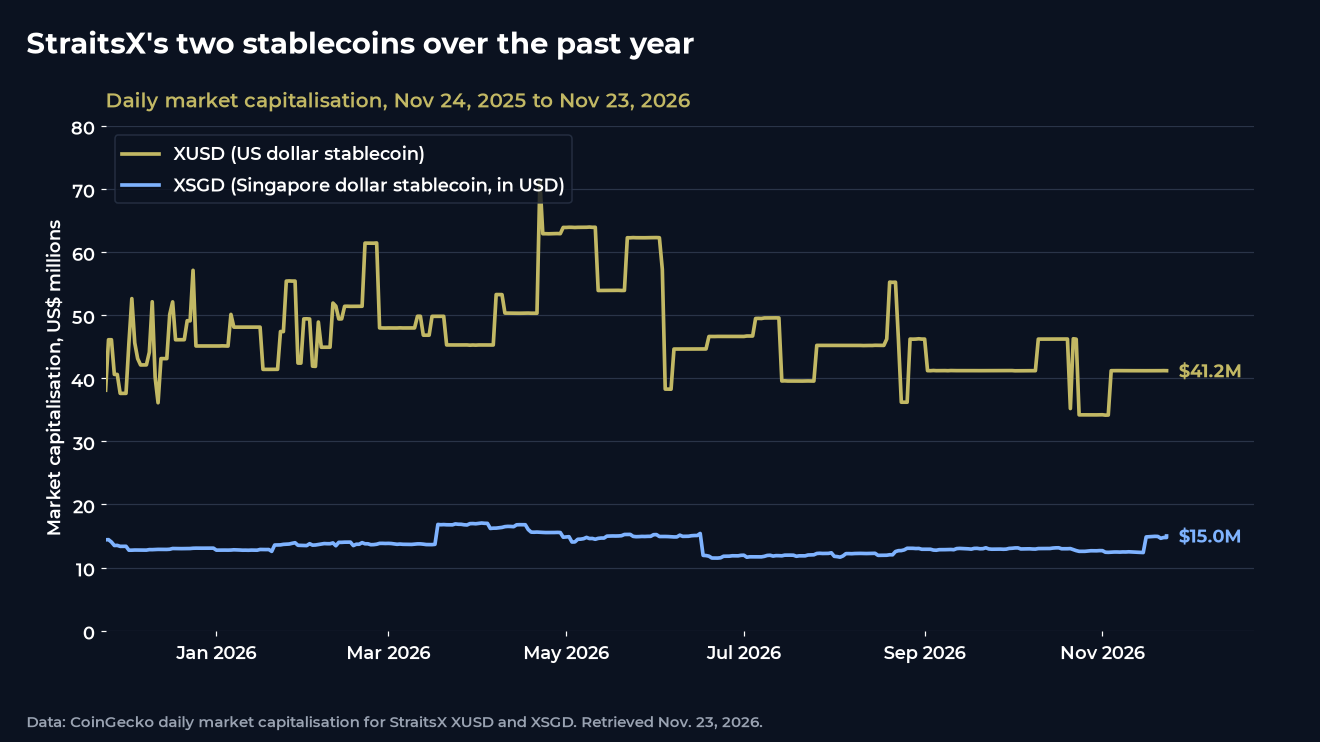
We do not read the modest supply as a weakness. Corporate stablecoin cross border payments tend to move in bursts tied to invoices, not in balances that sit idle.
What matters more is distribution. A bank pilot puts a small issuer’s rails in front of corporate clients it could never reach alone.
Singapore’s Stablecoin Law Is the Next Step
The regulatory backdrop is still being written. MAS consulted on changes to the Payment Services Act on September 1 to put its single-currency stablecoin framework into law. Feedback closed on October 16.
The draft covers Singapore dollar and G10 stablecoins and includes reserve, par-redemption and capital rules. MAS also proposed banning interest payments on MAS-regulated stablecoins.
StraitsX says it is substantively compliant with the upcoming framework. The partners say any further development of the pilot depends on regulatory, compliance and operational requirements.
We believe Singapore is building the regulated plumbing that turns stablecoins from trading chips into working capital tools. Its tokenized bill program, which we covered when tokenized MAS bills hit S$100 million, points the same way.
The key test now is whether NTT DOCOMO ASIA becomes the first of many corporate users, and whether MAS’s BLOOM pilots turn into permanent services once the stablecoin law is final.
DC Forecasts is a leader in many crypto news categories, striving for the highest journalistic standards and abiding by a strict set of editorial policies. If you are interested to offer your expertise or contribute to our news website, feel free to contact us at [email protected]












Discussion about this post