



North Korean hackers who stole more than $6 billion from Binance are now at risk of losing $1.1 billion of it for good, after the U.S. Justice Department filed to forfeit the funds on Monday.
The money sits in USDC, the dollar stablecoin issued by Circle. According to the department, it had already been frozen under a government-requested restraining order.
Monday’s filing moves it a step further: from frozen to a court case that could hand the government legal title.
For crypto investors, the bigger number may be the running total. The department says it has now helped freeze, seize or return more than $2.9 billion since the theft.
The question now is how much of the rest can still be stopped before it is laundered out of reach.
What the Justice Department Filed on Monday
According to the Justice Department announcement, the United States filed a civil claim to forfeit more than $1.1 billion of USDC that it describes as proceeds and laundered funds from the Binance theft.
The department dates that theft to on or about Oct. 29 and attributes it to North Korean actors. It called Monday’s action part of a wider government effort to help Binance recover more than $6 billion in stolen assets.
The FBI, the U.S. Secret Service and IRS Criminal Investigation are investigating. The department also said Circle provided valuable assistance.
Prosecutors from the U.S. Attorney’s Office for the District of Columbia, the National Security Division and the Criminal Division’s computer crime section are handling the case.

“The commencement of this forfeiture action so soon after the restraint of these same assets reflects our commitment to ensuring that victims remain at the forefront of our work,” said M. Scott Proctor, the acting principal deputy assistant attorney general for national security.
From $2.7 Billion Frozen to $2.9 Billion Recovered or Held
Monday’s figures build on what the department published on Nov. 12. At that point, it said more than $2.7 billion had been frozen, and that it held court authorization to seize or restrain more than $1.2 billion of it.
As we reported then, nearly half of the Binance heist had already been frozen within about two weeks.
Eleven days later, the total frozen, seized or returned with U.S. help has climbed to more than $2.9 billion, drawn from multiple sources.
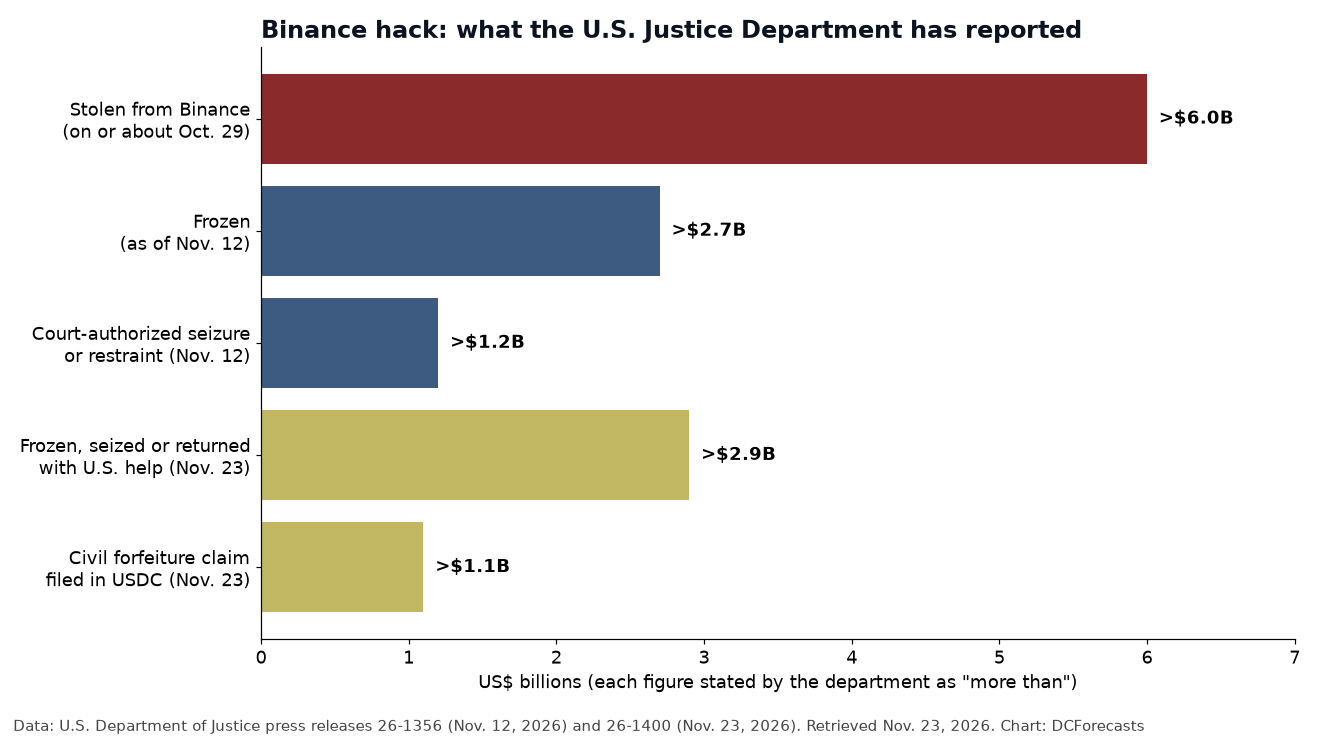
That still leaves a large gap. Measured against the more than $6 billion taken, roughly half of the stolen value has not been reported as frozen, seized or returned.
We believe the direction is still encouraging. Each update from the department has shown the recovered share moving up, not down.
Why North Korean Hackers Now Face More Than a Freeze
A freeze stops funds from moving. It does not settle who owns them.
A civil forfeiture case is brought against the property itself rather than against a person. If a court grants it, the government takes title to the assets, which is the legal step that can open a path for victims to be repaid.
The officials quoted on Monday stressed speed. Special Agent in Charge Todd Bratz of the Secret Service said investigators worked “to identify and freeze stolen funds within minutes of the hack.”
FBI Cyber Branch Operations Director Brett Leatherman said the bureau moved quickly to trace and freeze assets and to share information with virtual asset service providers.
No court has ruled on the new claim yet, and the outcome will depend on the case going forward.
How Big Is $1.1 Billion of USDC?
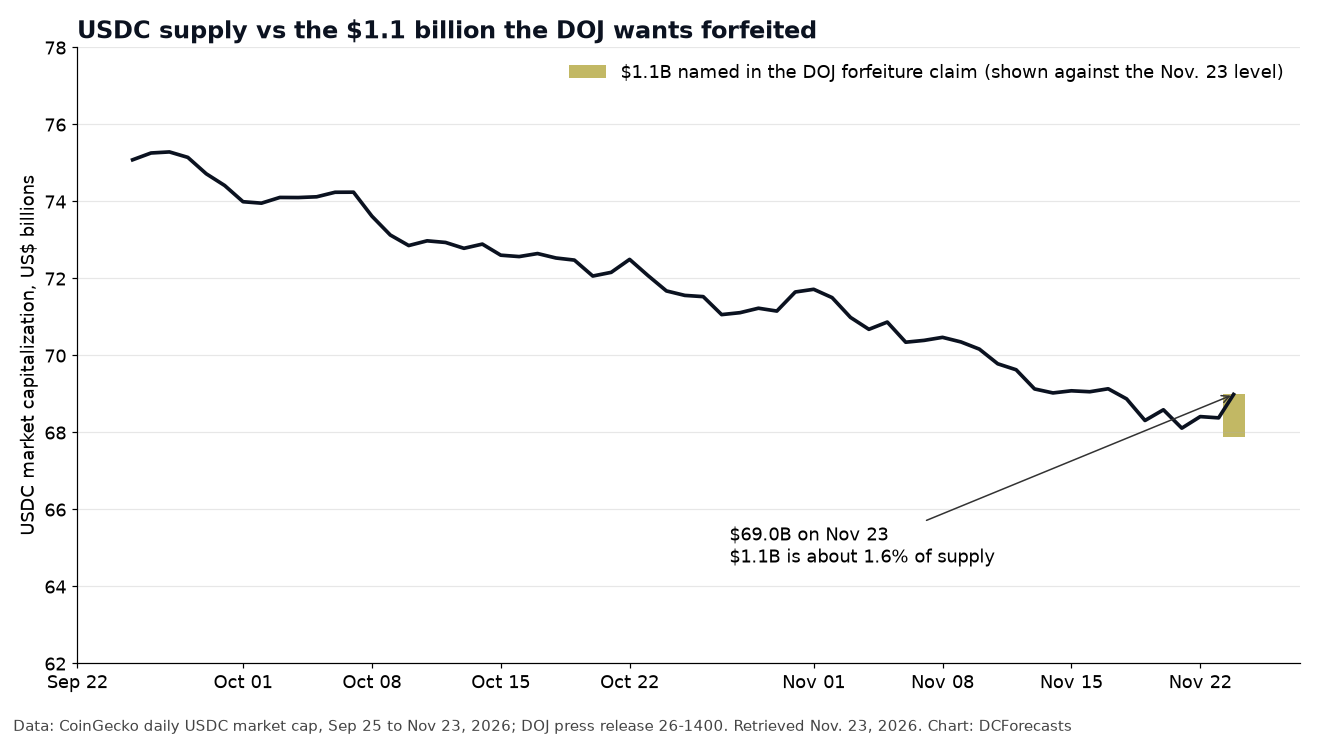
For context, CoinGecko data puts USDC’s market capitalization at about $69.0 billion on Nov. 23. The amount named in the forfeiture claim equals roughly 1.6% of all USDC in circulation.
The same data shows USDC supply drifting down from about $75.1 billion on Sept. 25, a decline of about 8% in two months.
That such a large block of stolen value ended up in a freezable stablecoin is telling. Tokens with a central issuer can be locked at the request of authorities, and here that feature helped protect a victim.
The laundering has not stopped, though. In its Nov. 12 release, the department said the hackers it calls TraderTraitor were still moving funds through crypto bridges, mixers and exchanges.
We have tracked part of that trail ourselves, including the 2,310 BTC pushed through coinjoins after the theft.
What the Binance Hack Case Says About Bitcoin
This was a breach of a company’s systems, not of Bitcoin’s network. Bitcoin’s blocks kept arriving and its rules kept working throughout.
The case also shows two different designs side by side. A stablecoin issuer can freeze balances on request. Bitcoin has no issuer and no freeze button, which is exactly why holders who keep their own keys cannot have their coins locked by anyone else.
That neutrality does not make stolen bitcoin invisible. Every movement still lands on a public ledger, which is why investigators and analysts can keep following the funds months later.
For us, the key takeaway is that the crypto industry’s response to the Binance hack has matured. Exchanges, issuers and agencies are now freezing funds within minutes and moving to forfeiture within weeks.
We believe that kind of coordination makes the market stronger for long-term Bitcoin investors. It raises the cost of crypto crime without touching the open network that makes Bitcoin worth holding.
The coming weeks will show whether the court grants the claim and whether the $2.9 billion figure keeps climbing toward the $6 billion that was taken.
DC Forecasts is a leader in many crypto news categories, striving for the highest journalistic standards and abiding by a strict set of editorial policies. If you are interested to offer your expertise or contribute to our news website, feel free to contact us at [email protected]












Discussion about this post