



Event contracts on U.S. exchanges now have a permanent reporting rulebook, ending nine years of case-by-case relief from Commodity Futures Trading Commission staff.
The CFTC on Monday, Nov. 23, announced a final rule that adds a new Section 16.03, titled “Covered Event Contracts,” to its regulations.
It replaces a stack of 17 staff no-action letters, the first two dated June 30, 2017.
The number that stands out is the new reporting threshold: 125,000 contracts, worth $125,000 in notional value, instead of the default 25 contracts.
For Bitcoin traders who use $1 yes-or-no price markets, this is the plumbing those markets will run on. The bigger question is whether a fixed federal rulebook helps prediction markets keep growing while the fight over who regulates them goes on.
What the CFTC’s Final Rule Changes for Event Contracts
The rule covers contracts that count as swaps under the Commodity Exchange Act, are listed on a designated contract market (DCM), are cleared, and are fully collateralized.
They must also pay out in one of two ways: a fixed amount to one side only, or a variable amount based on the final settlement price.
Instead of the swap regime, which sends data to swap data repositories, these contracts will be reported under the futures and options framework in Parts 15 to 18.
“The CFTC will no longer regulate market participants through a patchwork of no-action letters, which serve as band-aids for unworkable regulations,” Chairman Michael S. Selig said.

He called the rule “an important step in future-proofing the regulatory framework for event contracts.”
The CFTC proposed the change on July 1, 2026, and comments closed on July 31. It received 28 substantive letters, including from Kalshi, Coinbase Derivatives, CME Group, Intercontinental Exchange, Robinhood Derivatives and DraftKings.
Most commenters backed dropping swap reporting for these products. The Commission expects staff to withdraw the vast majority of the old letters once the rule takes effect.
Why 125,000 Contracts Instead of 25?
The CFTC’s own numbers explain the choice.
On Feb. 8, 2026, a high-volume day, the agency estimated that 1,184,165 unique traders in the exchange data it examined would have crossed the default 25-contract position or volume threshold.
At 125,000 contracts, that count falls to 402.
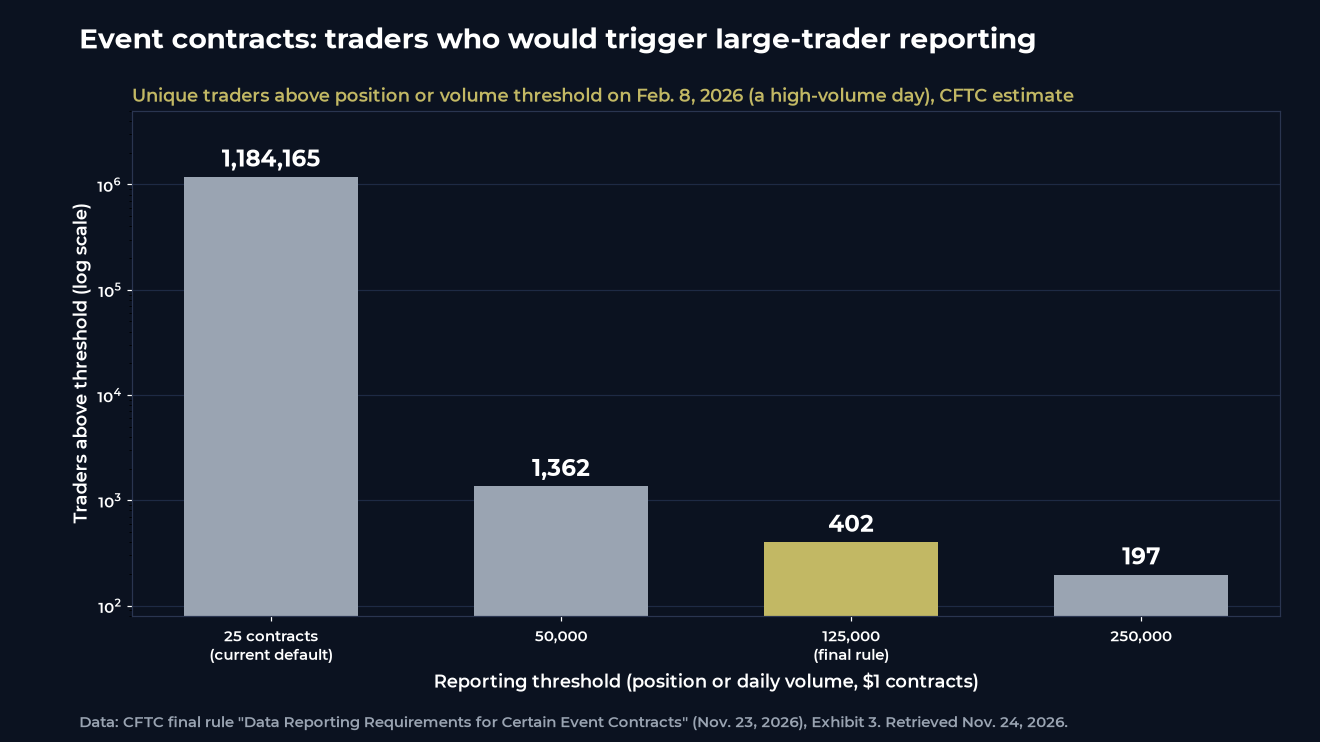
The agency says the change cuts the number of accounts with reportable positions by more than 1 million. At 0.33 hours per form, it puts the savings at 330,000 hours or more.
The daily trading volume trigger moves the same way, from 50 contracts to 125,000. For contracts larger than $1, the threshold scales by value, so a $100 contract reports at 1,250 contracts.
Oversight does not disappear. On that February day, the 125,000 level still captured about 14% of the long side and 72% of the short side across the top 50 markets on the largest DCM.
For comparison, the rule cites the CFTC’s Feb. 10 Commitments of Traders data: 236 reportable traders in CME’s Micro Bitcoin futures held 77.2% of long and 90.9% of short open interest.
We believe the trade-off is sensible. Regulators keep sight of the large players without filing paperwork on every retail $1 bet.
Trader Identity and Public Trade Data Come Attached
The lighter thresholds arrive with stricter transparency.
Exchanges must publish every covered trade as soon as technologically practicable: the timestamp, ticker, quantity and U.S. dollar price. The data must be free and stay online for at least a year.
They must also report and publish how each contract settled, including whether the event happened, when, and which source decided it.
Under Section 16.03(g), exchanges must collect each trader’s name, physical address, email, phone number, occupation and employer. They must also record anyone who guarantees an account or holds a 10% or larger financial interest in it.
That data must be kept for at least five years after a contract ends, and records stay open to the CFTC, the Justice Department and the SEC.
Compliance is staggered. The definition, settlement reporting and public trade data apply 60 days after Federal Register publication. Large-trader reporting follows at the later of that date or July 26, 2027, and the trader-identity rule after 12 months.
Event Contracts Outgrew the No-Action Era
The pace of listings shows why the letters stopped working.
From 2006 through 2020, DCMs listed about five event contracts a year. That jumped to 131 in 2021 and held near that level until 2025, when exchanges certified about 1,600.
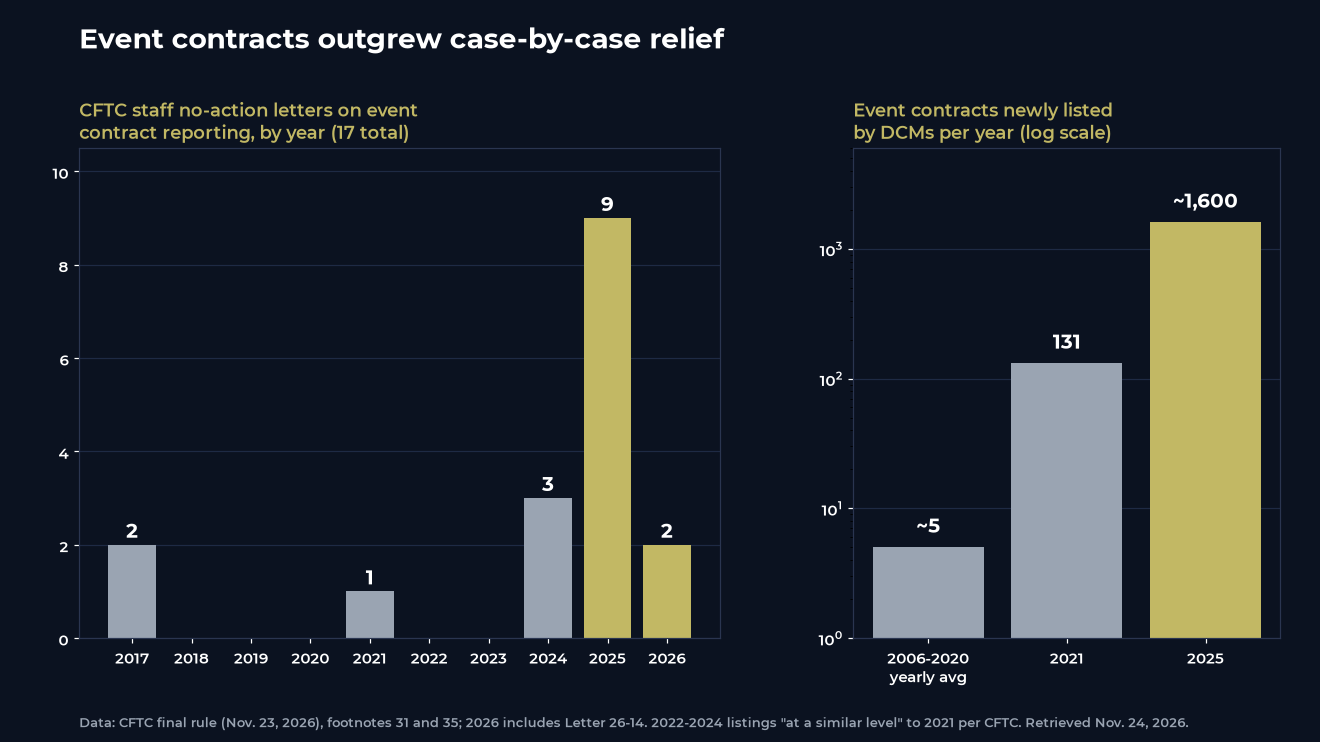
Staff letters followed the boom: nine of the 17 came in 2025 alone. The CFTC also notes several pending DCM applications from would-be prediction market operators as of Sept. 1.
The rule itself calls the letters staff positions, not Commission actions “carrying the force of law,” and an “inefficient approach to a recurrent issue.”
It does not settle the bigger jurisdiction dispute. That fight centers on a separate October proposal to treat sports and political contracts as swaps, which drew a challenge from 44 attorneys general.
The new rule applies only to contracts solely under CFTC jurisdiction, and its definition is not meant to define “event contract” for any other purpose.
Why CFTC Prediction Markets Rules Matter for Bitcoin
Bitcoin already has its own markets on these venues.
Kalshi’s year-end price bands, which we analyzed on Sunday, are fully collateralized $1 contracts of the type this rule describes.
For us, the takeaway is constructive. Free public trade data and set settlement disclosures turn these markets into a cleaner, regulated read of Bitcoin sentiment.
We believe clearer prediction market regulation also lowers the cost of launching new venues, which should widen access to Bitcoin price discovery on U.S. exchanges.
Nothing here guarantees volume. Exchanges still face new identity checks, and the state-level legal fights continue.
The next step is publication in the Federal Register, which starts the 60-day clock. Once it ticks, Bitcoin’s $1 markets will stand on a permanent rule rather than a staff letter.
DC Forecasts is a leader in many crypto news categories, striving for the highest journalistic standards and abiding by a strict set of editorial policies. If you are interested to offer your expertise or contribute to our news website, feel free to contact us at [email protected]












Discussion about this post