


A new CFTC crypto advisory says the futures exchanges, swap venues and clearinghouses the agency oversees may count bitcoin toward the financial cushion they must hold to cover a full year of operating costs.
Staff in the Commodity Futures Trading Commission’s Division of Market Oversight and Division of Clearing and Risk issued the guidance on Monday, Nov. 23, as CFTC Letter No. 26-31.
It names bitcoin, ether and payment stablecoins as acceptable financial resources, with haircuts of at least 20% for bitcoin and ether and 2% for payment stablecoins.
In plain terms, a registered venue could count one bitcoin at roughly 80 cents on the dollar toward that requirement.
The bigger question is whether venues that already hold crypto will start treating it as part of their regulatory reserves, rather than as an asset that sits outside them.
What the CFTC Crypto Advisory Actually Allows
The letter covers three kinds of registered entities: swap execution facilities, designated contract markets and derivatives clearing organizations.
Each must hold financial resources that exceed a year of projected operating costs, calculated on a rolling basis, under Commission Regulations 37.1301, 38.1101(a) and 39.11(a)(2).
Those rules let a venue count its own capital plus “any other financial resource deemed acceptable by the Commission.” Staff now say bitcoin, ether and payment stablecoins fit that description.
The request came from the industry itself. According to the letter, a number of registered entities and applicants “now hold crypto assets, including payment stablecoins, in connection with their businesses” and had asked whether those holdings could count.

Other tokens are not shut out entirely, but a venue that wants to use them has to engage with staff first. Any crypto asset that is not readily marketable and is not a payment stablecoin would generally take a 100% haircut, which means it counts for nothing.
Why Bitcoin Counts at 80 Cents on the Dollar
The haircuts are not new numbers. Staff borrowed them from the capital treatment they already accept for futures commission merchants’ own crypto positions, which the letter ties to SEC staff’s treatment of broker-dealers’ own positions in the same assets.
That means a 20% minimum haircut for bitcoin and ether and a 2% haircut for payment stablecoins.
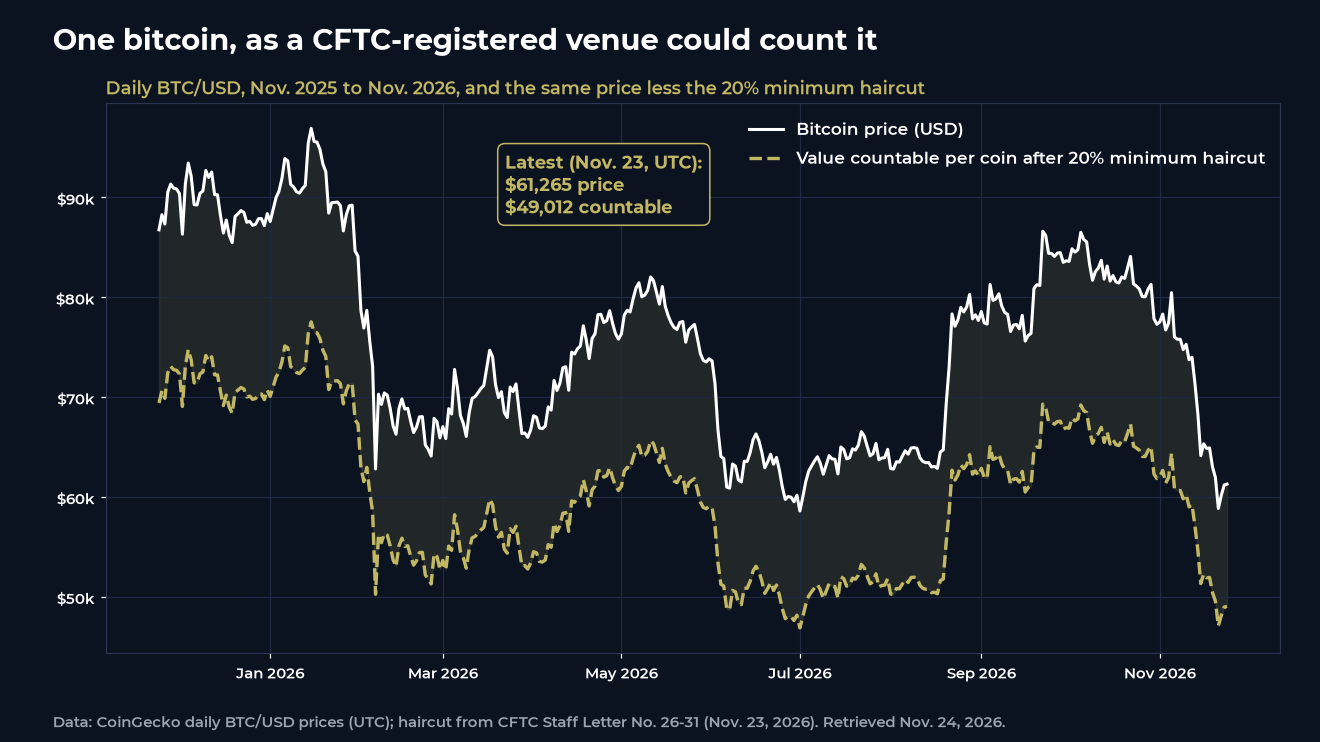
At the $61,265 CoinGecko price late on Monday (UTC), one bitcoin would count as about $49,012.
Staff also asked venues to think about “wrong-way risk,” meaning moments when operating losses and falling crypto prices hit at the same time.
That caution is fair. Bitcoin’s daily price over the past year peaked near $96,900 on Jan. 15, per CoinGecko, and now sits about 37% lower, so a single 20% haircut is a floor rather than a guarantee of coverage.
Clearinghouses face a stricter test, since their haircuts must reflect market, credit and liquidity risk and be evaluated monthly.
The Cash Floor Stays in Place
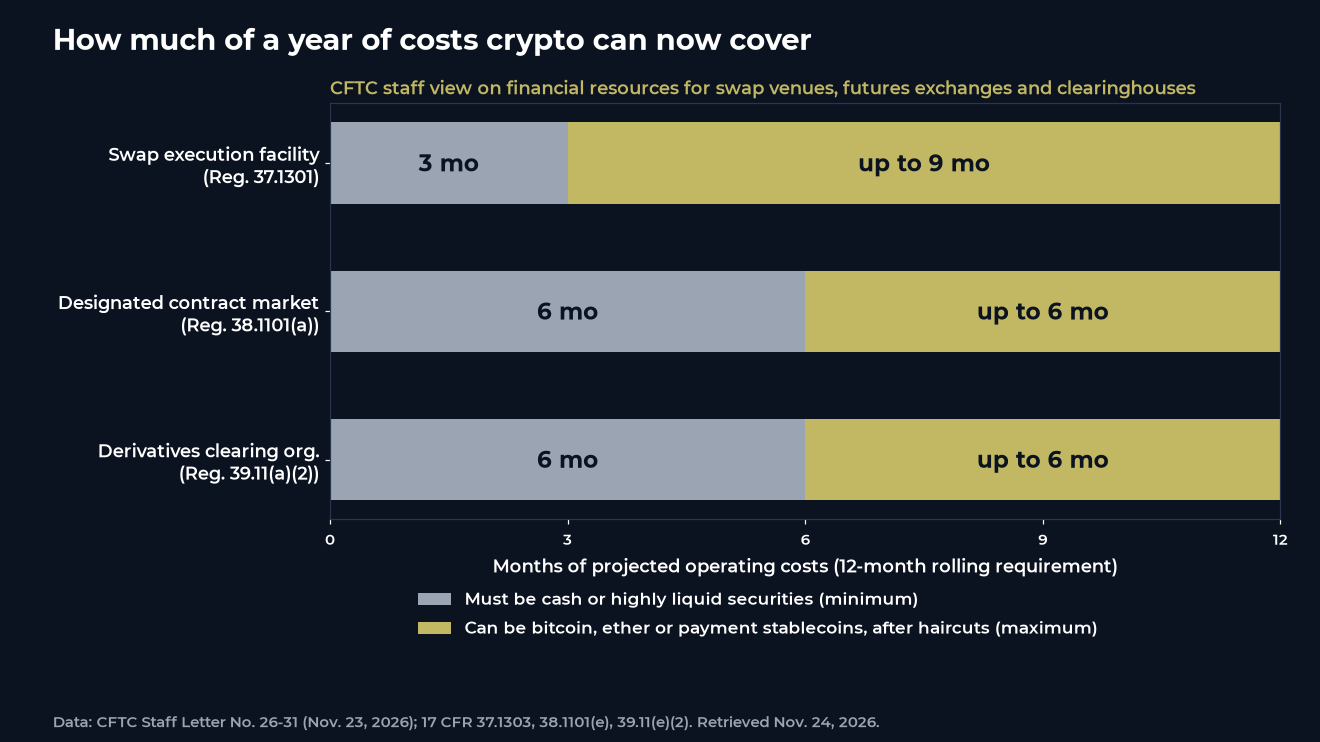
The advisory does not let crypto replace cash. Each rule keeps a slice of the one-year requirement that must sit in “unencumbered, liquid financial assets (i.e., cash and/or highly liquid securities).”
For a swap execution facility, that slice is at least three months, or its projected wind-down costs if greater, leaving up to nine months that bitcoin, ether or stablecoins could cover after haircuts.
A designated contract market and a clearinghouse must each keep six months in cash or highly liquid securities, leaving up to six months for crypto.
The reason is definitional. Staff note that crypto assets, payment stablecoins included, are not “cash” under generally accepted accounting principles, and as non-security crypto assets they are not “highly liquid securities” either.
The letter is also narrow on clearinghouses: it does not address whether crypto can help meet a clearinghouse’s default resources, the money set aside to cover a failing clearing member.
A Year of Steady CFTC Crypto Groundwork
The advisory caps a series of staff steps that the letter itself lists.
On Dec. 8, 2025, staff issued a no-action position on digital assets accepted as margin collateral, later reissued as Letter 26-05, along with tokenized collateral guidance. Crypto FAQs followed on March 20, 2026, and were expanded on Sept. 24.
The same Monday, the agency also published a final rule on reporting for certain event contracts, which we covered in our look at the CFTC’s new event-contract rulebook.
The caveats are real. The advisory represents staff views only, creates no new rules, is not a no-action position and does not necessarily reflect the Commission’s views. It is signed by Acting Directors Duncan Hennes and Richard Haynes.
Why We See a Quiet Win for Bitcoin’s Institutional Standing
We believe the significance lies in the classification more than the dollars.
A U.S. derivatives regulator’s staff now treats bitcoin as an asset sound enough to help backstop market infrastructure, alongside dollar-backed payment stablecoins, rather than as a risk to be kept off the regulatory balance sheet.
Nothing here forces any venue to hold bitcoin, and the letter does not say any venue plans to. For a designated contract market or swap execution facility that already holds BTC, though, the guidance turns an idle asset into one that can count, at a discount.
It also fits the broader push toward round-the-clock, crypto-native market structure, from the perpetual futures plans we tracked at Binance.US to the stablecoin rules now taking shape under the GENIUS Act.
For us, the long-term thesis is unchanged: a fixed supply of 21 million coins, and a financial system that keeps building room for them.
The coming quarters will reveal whether registered venues actually move bitcoin into their reserve calculations, and how often they lean on the full nine months the rules now allow.
DC Forecasts is a leader in many crypto news categories, striving for the highest journalistic standards and abiding by a strict set of editorial policies. If you are interested to offer your expertise or contribute to our news website, feel free to contact us at [email protected]












Discussion about this post