


The European Commission’s newest Russia sanctions proposal puts crypto platforms outside Russia at the center of its financial crackdown.
Presenting the 22nd package in Strasbourg on Nov. 23, Commission President Ursula von der Leyen said Brussels is “cracking down on the crypto and payment networks,” and will also go after third countries that help Russia evade EU measures.
She paired that with a new Crypto Sanctions Task Force and a transaction ban on some 60 more Russian banks, all of which would be cut off from SWIFT.
For crypto investors, the interesting part is the direction of travel. Each package since October 2025 has widened the net, from a single rouble-backed token to all Russian crypto providers and then to offshore platforms.
The bigger question is whether member states sign off quickly, and how far the final text reaches beyond Russia’s borders.
What the 22nd Russia Sanctions Package Proposes
Von der Leyen described three pressure points: Russia’s war financing, its international isolation and enforcement.
On finance, she said the package is “striking harder at Russia’s ways to finance its war by targeting its banks and crypto platforms.”
The crypto language was direct. “We will focus on Russia but also include third countries that help Russia to evade our sanctions. This is a major focus of our new package,” she said, according to the Commission’s published statement.
She added that the Commission has “launched a Crypto Sanctions Task Force to support this work,” framing it as a way to align efforts with international partners.

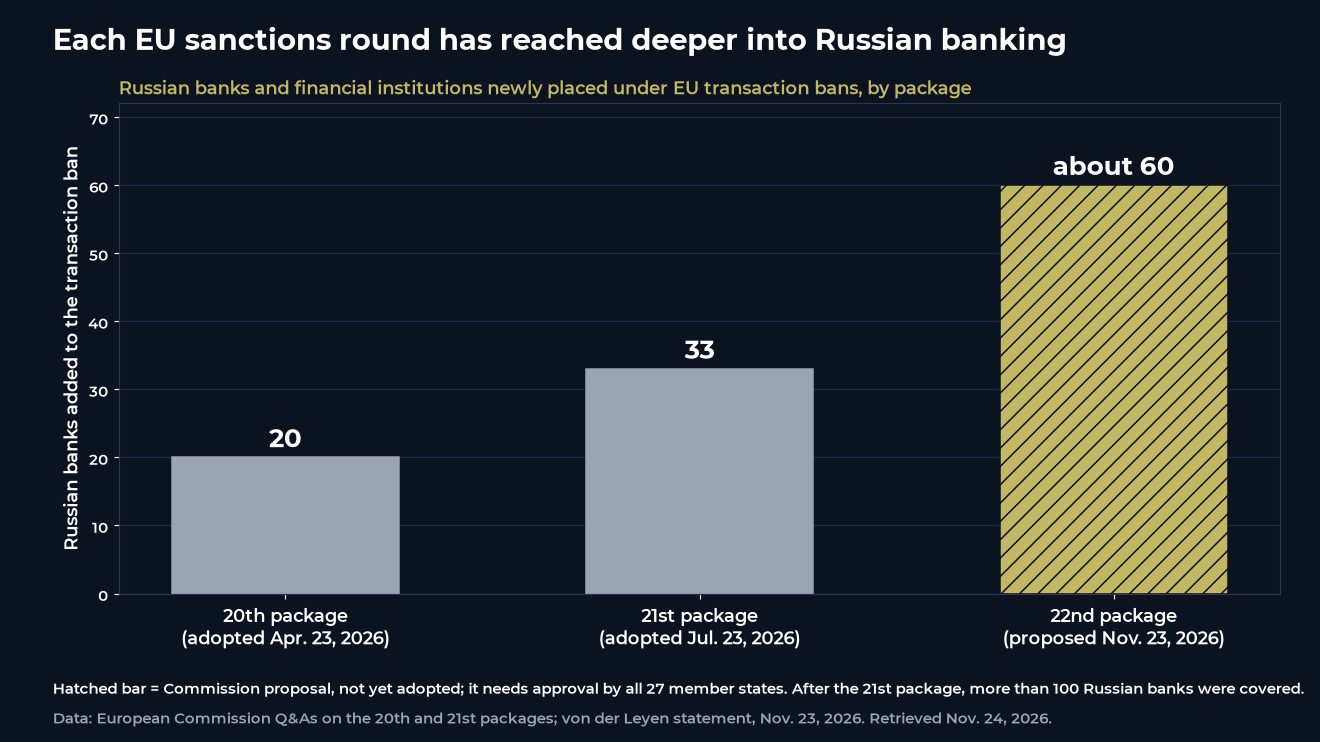
The banking piece is larger than in recent rounds. The 20th package added 20 Russian banks to the transaction ban, and the 21st added 33. The new proposal names about 60.
The rest of the package covers energy services, more than 70 additional shadow fleet ships, a visa ban for Russian ex-combatants and limits on Russian teams at sports events in the EU.
Four Packages, One Direction for Crypto Sanctions
The crypto measures did not appear overnight. Commission documents show a steady widening over four rounds.
The 19th package, adopted on Oct. 23, 2025, banned transactions in the rouble-backed A7A5 stablecoin and placed a Paraguay-based crypto exchange under a transaction ban.
The 20th package, adopted on April 23, 2026, added what the Commission called a “total sectorial ban” on interacting with any Russian crypto-asset service provider, as well as decentralised platforms enabling crypto trading. It also banned the rouble-pegged RUBx stablecoin and the digital rouble.
The 21st package, adopted on July 23, 2026, went offshore. It listed 14 crypto platforms and crypto-linked firms in Georgia, Panama, El Salvador, the UAE, the Marshall Islands and Belarus.
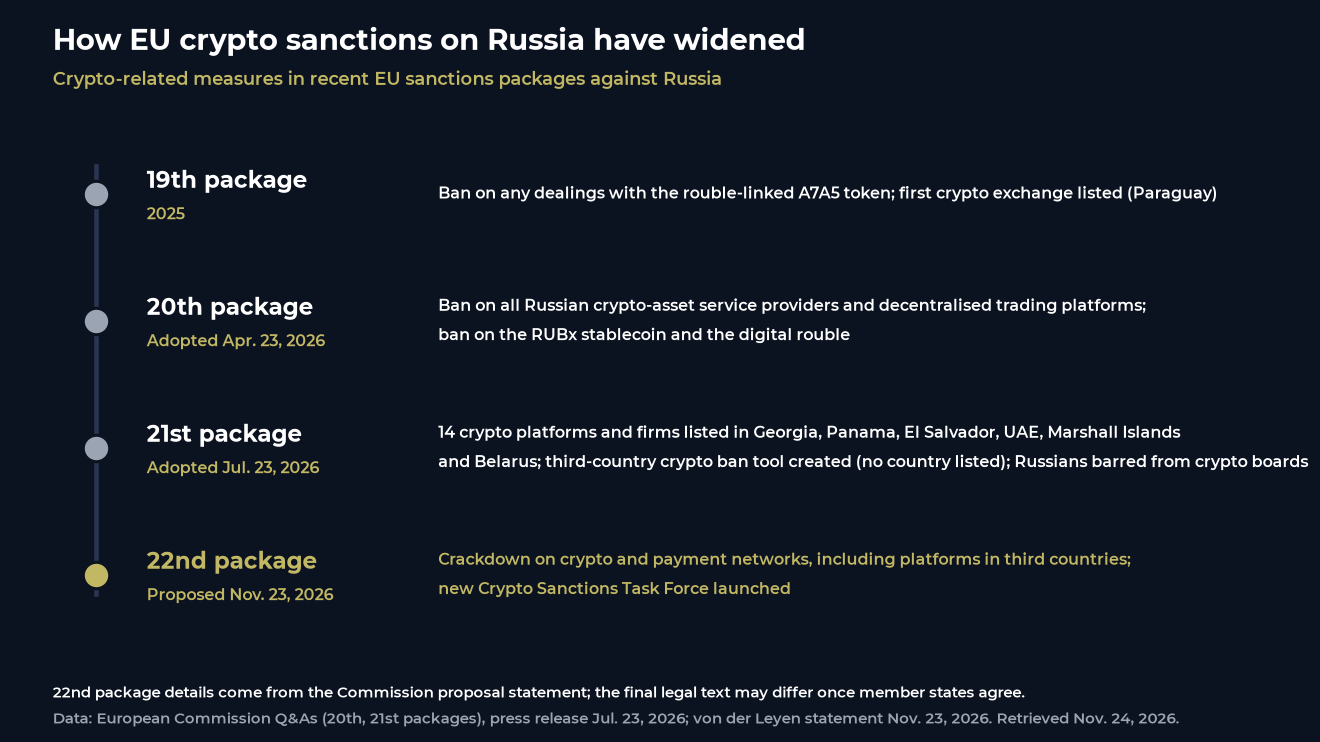
That progression matters. Brussels is no longer only naming Russian entities. It is building tools aimed at the jurisdictions where evasion happens.
Why Third Countries Are Now the Target
The 21st package created a dedicated third-country ban for crypto-asset services. It allows the EU to prohibit any transaction between EU operators and crypto platforms in listed countries that “systematically and persistently” fail to stop sanctions evasion.
No country has been listed under that tool yet. The Commission said it was meant to “act as a deterrent.”
The 22nd package proposal suggests that deterrent is moving toward action, even though the statement did not name any country or platform.
The new task force also signals a coordination push. Earlier this month, a high-level EU meeting on sanctions implementation put the use of crypto assets to circumvent sanctions on its agenda as an emerging threat.
We would watch two details in the final text: whether any third country is listed under the crypto ban tool, and whether payment networks beyond crypto get the same treatment.
What It Means for Regulated Crypto in Europe
For licensed crypto firms in the EU, the rules are getting stricter but also clearer.
The 21st package extended a ban on Russian nationals owning, controlling or sitting on the boards of companies offering crypto services. It also let EU nationals withdraw their own funds from newly listed banks and crypto platforms.
That fits with the wider MiCA build-out. As we covered, German co-op banks took 57 of 78 new MiCA register entries since August, a sign that mainstream institutions are moving into regulated crypto.
We believe that is the constructive reading here. Monday’s statement targets banks, platforms and rouble-linked tokens tied to evasion, not Bitcoin itself or ordinary users of EU-licensed services.
Bitcoin’s open, public ledger is also part of why crypto sanctions enforcement works at all. Flows through named intermediaries can be traced and blocked.
Moscow, meanwhile, keeps debating its own crypto stance. As we reported, communist deputies want seized crypto added to Russia’s $719 billion reserves.
What Happens Next in Brussels?
The 22nd package is still only a proposal. EU sanctions need unanimous approval from all 27 member states, and the legal text can change in negotiation.
For a sense of timing, the 21st package was presented on June 9, 2026 and adopted on July 23, or 44 days later.
A similar pace would put adoption around early January, though that is our estimate, not a Commission date.
Our watch list is short:
- Which crypto platforms and payment networks are named in the final listings.
- Whether the third-country crypto ban is used for the first time.
- How the new Crypto Sanctions Task Force coordinates with international partners.
For long-term Bitcoin holders, tougher rules on evasion are not a threat to the asset. They draw a sharper line between illicit intermediaries and the growing regulated market.
The coming weeks will show how wide that line is drawn, and how quickly Europe’s crypto rulebook keeps maturing.
DC Forecasts is a leader in many crypto news categories, striving for the highest journalistic standards and abiding by a strict set of editorial policies. If you are interested to offer your expertise or contribute to our news website, feel free to contact us at [email protected]











Discussion about this post