



Monero crypto developers have quietly moved their biggest privacy upgrade in years into its next audit phase, and the market seems to have noticed.
In a November 23 developer meeting log, developer jberman, author of the FCMP++ integration code, wrote that Phase 2 of the integration audit had started with zkSecurity, with Phase 3 possibly starting as soon as next week.
On Monero’s GitHub, the milestone tracking the FCMP++ hard fork now shows 32 items closed and 10 still open.
Meanwhile, XMR traded near $508.63 on Wednesday morning, according to CoinGecko, up 2.9% in 24 hours while Bitcoin fell 2.1%.
The bigger question is whether a code milestone, rather than a market catalyst, can keep a privacy coin climbing in a weak tape.
What Changed in the FCMP++ Audit This Week?
FCMP++ stands for Full-Chain Membership Proofs. It is designed to replace Monero’s ring signatures, which today hide each real input among 16 possible outputs.
Under the new scheme, a spender proves an output belongs to the whole set of eligible outputs on the chain without revealing which one. In plain terms, the crowd you hide in grows from 16 to the entire chain.
The code that checks those proofs at the consensus level sits in pull request 11440, opened on September 30. It adds 1,363 lines and removes 218 across 23 files.
Its description states that, with the change, “all potential inflation vulnerabilities are expected to be protected and prevented,” and asks reviewers to hunt for inflation bugs specifically.

That focus matters. With hidden amounts, the worst failure is silent supply inflation.
In the November 23 log, jberman said he had addressed every reviewer comment and every issue flagged by AI review tools on that pull request. The one remaining dependency, he wrote, is pull request 10916, a mempool caching change.
How Close Is the Monero Crypto Hard Fork?
The honest answer is closer, but still without a date.
None of the meeting logs, pull requests or funding pages we reviewed sets a mainnet activation date for FCMP++. Even pull request 11440 keeps the tree-building code behind a compiler flag that is disabled by default.
What the project does publish is a to-do list. The chart below shows the two GitHub milestones that matter most right now.
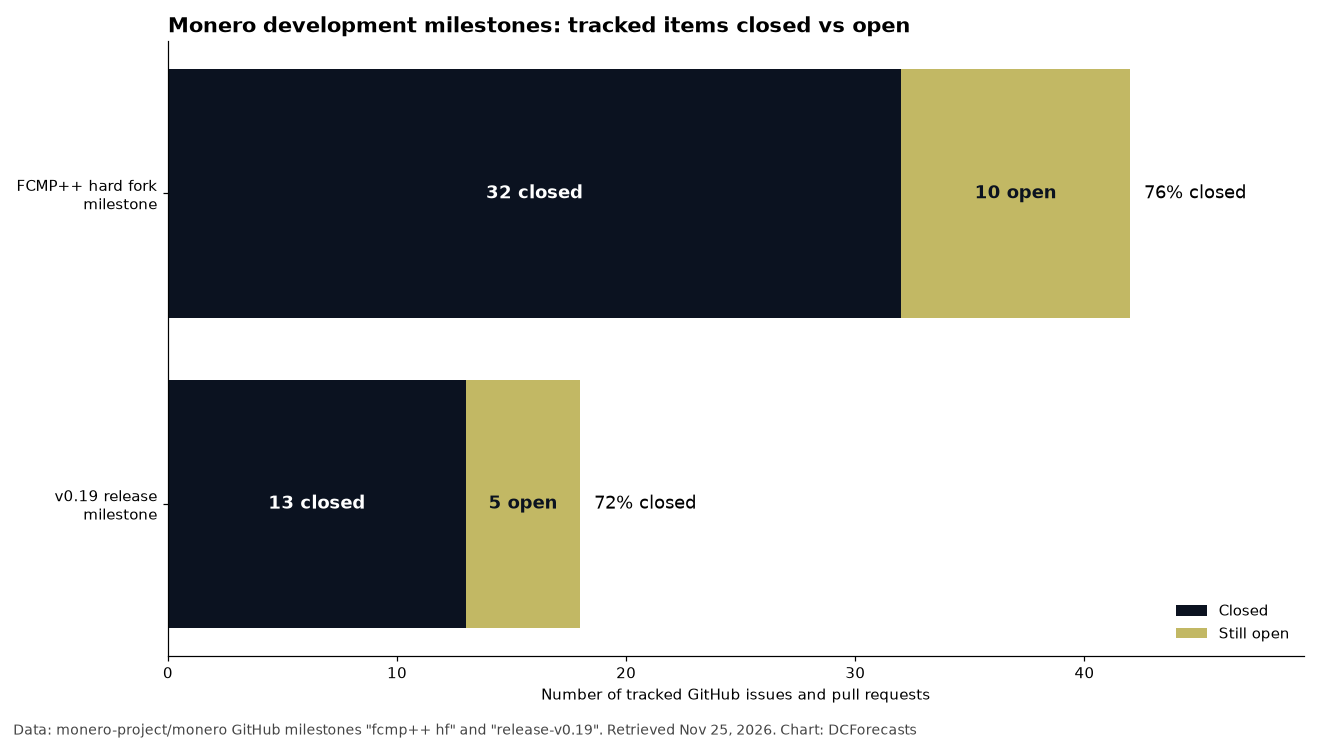
The FCMP++ milestone is 76% closed by item count. That is a rough gauge, since one open item can take longer than ten closed ones.
The separate v0.19 software release is 13 of 18 items done. In the same meeting, maintainer selsta said the tx-relay v2 change was close to merge-ready and confirmed that a mitigation for the “Nyx” eclipse attack, raised by researcher Rucknium, is on the v0.19 list.
Contributors also debated whether the community has the hours to build Monero support for Trezor hardware wallets before the fork. Wallet support is often the slowest part of any upgrade.
Who Is Paying for the Monero Audit?
The audit is crowdfunded. Monero’s Community Crowdfunding System page shows a proposal from j-berman dated April 6, 2026, asking for 500 XMR across three audit phases.
At the time of writing, the proposal valued that at about $150,000 plus a 5% buffer. At today’s price, 500 XMR is worth roughly $254,000.
The page lists 56 contributors and shows zero of three milestones paid out so far. The phases cover the FCMP++ cryptography, curve tree building and, finally, consensus integration.
We believe this is the healthy part of the story: users funded independent scrutiny before launch, not after a failure.
That contrast is sharp after this month’s exploit of a wrapped Monero token issued outside the Monero network, which we covered when XMR1 collapsed. That loss hit a third-party wrapper, not Monero’s own blockchain.
Monero Price vs Bitcoin: XMR BTC Ratio at a One-Year High
The market angle is just as striking. Measured in bitcoin, one XMR was worth about 0.00862 BTC on November 25, the highest reading in CoinGecko’s 365-day daily series.
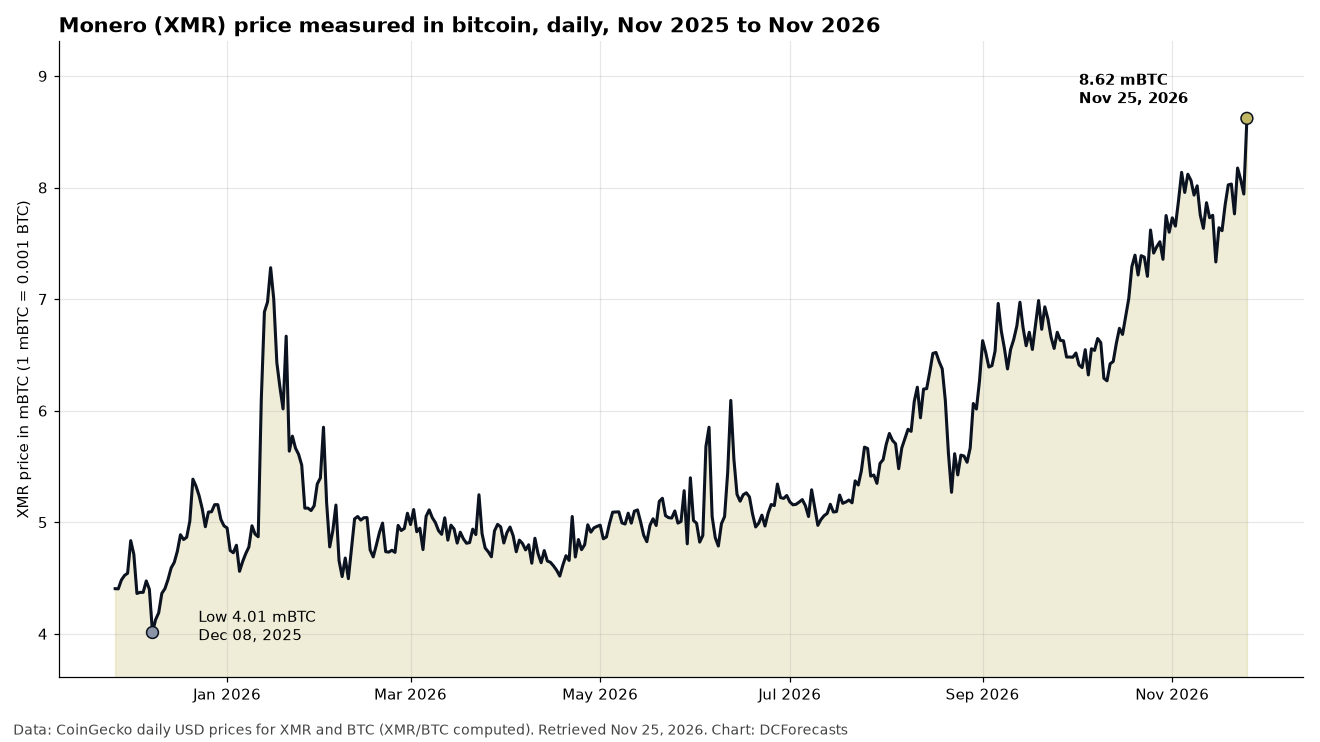
The ratio has more than doubled from its low of 0.00401 BTC on December 8, 2025.
In dollar terms, XMR is up about 32% from $384.63 a year ago, while Bitcoin has slipped from $87,317 to about $59,127 over the same window.
Still, Monero has its own scars. XMR is down 13.7% over 30 days, per CoinGecko, and remains about 36% below its January 14 all-time high of $797.73.
We would not read the ratio as a verdict on Bitcoin. Bitcoin’s market value of about $1.19 trillion is roughly 124 times Monero’s $9.58 billion, and the two coins serve different jobs.
What Should Investors Watch in Privacy Coins Next?
For us, the watch list is short and concrete.
- Whether pull request 10916 merges before zkSecurity begins Phase 3.
- The open count on the FCMP++ hard-fork milestone, now 10.
- Any formal announcement of a hard-fork height or date.
- Exchange and regulatory treatment of privacy coins, which has driven past delistings.
The Monero Research Lab meets again today, November 25, at 17:00 UTC, according to the project’s meeting schedule.
We believe the broader lesson is constructive for the whole crypto market. Open-source networks that fund audits in public, ship upgrades slowly and publish their to-do lists tend to earn durable trust.
Bitcoin built its lead the same way, through conservative, heavily reviewed changes. That approach has helped it hold its place as the market’s anchor asset through this year’s drawdown, as our look at 30-day losses across large coins showed.
If Monero’s last 10 hard-fork items close on schedule, the next few weeks could tell us whether XMR’s run is about privacy demand or simply a strong week in a weak market.
DC Forecasts is a leader in many crypto news categories, striving for the highest journalistic standards and abiding by a strict set of editorial policies. If you are interested to offer your expertise or contribute to our news website, feel free to contact us at [email protected]












Discussion about this post