



Fidelity has filed for a Chainlink ETF, putting one of the largest asset managers in the United States behind a fund that would hold LINK directly.
The registration statement for the Fidelity Chainlink Fund reached the SEC on November 25, 2026. The trust behind it was formed in Delaware only six days earlier, on November 19.
The timing is not flattering for the token. LINK traded near $9.04 late Wednesday, according to CoinGecko, about 83% below its May 2021 record of $52.70.
For us, the more interesting signal is the template. The same Fidelity unit that runs the Fidelity Wise Origin Bitcoin Fund is now copying that structure, coin by coin.
The bigger question is whether demand for a fourth Fidelity crypto product exists while prices sit near yearly lows.
What Fidelity’s Chainlink ETF Filing Actually Says
The prospectus says shares are expected to trade on the Nasdaq Stock Market. The ticker is shown in brackets as FLNK, which means it is still a placeholder.
The sponsor is FD Funds Management LLC, a Fidelity affiliate. CSC Delaware Trust Company is the trustee.
Three firms are named as LINK custodians: Anchorage Digital Bank, BitGo Bank & Trust and Coinbase Custody Trust Company.
The fund will value its shares using a Fidelity-built index that takes LINK prices from eligible spot markets every 15 seconds and computes a volume-weighted median over rolling 60-minute windows. Coin Metrics is named as the independent calculation agent.

Key numbers are still blank: the annual sponsor fee appears as “[ ]%”, and seed capital details are left open, which is normal for a first filing.
Why the Fund Will Not Stake Its LINK
The filing is blunt on one point: “The Trust will not stake its LINK.”
That choice matters because staking is part of the Chainlink pitch. According to the prospectus, Chainlink Staking lets node operators and community members lock LINK to help secure certain oracle services, and the program is currently capped at roughly 4% of total supply.
We believe the decision is a conservative one. It keeps the product simple, avoids slashing and lockup risks inside an exchange-traded wrapper, and mirrors how Fidelity’s Bitcoin fund works: hold the asset, track the price, nothing more.
Chainlink ETF Competition: Fidelity Is Not First
Fidelity would be entering a lane that already has occupants.
SEC records show the Grayscale Chainlink Trust ETF, ticker GLNK, filed its exchange registration form on December 1, 2025. The Bitwise Chainlink ETF, ticker CLNK, filed the same form on January 5, 2026.
The filing notes that the sponsor already runs the Fidelity Wise Origin Bitcoin Fund, the Fidelity Ethereum Fund and the Fidelity Solana Fund. A LINK fund would make Chainlink the fourth coin in that lineup.
As we noted when Schwab added Chainlink to its crypto trading lineup, big brokers have been widening access beyond the top two coins one asset at a time.
How LINK and Bitcoin Compare After a Hard Year
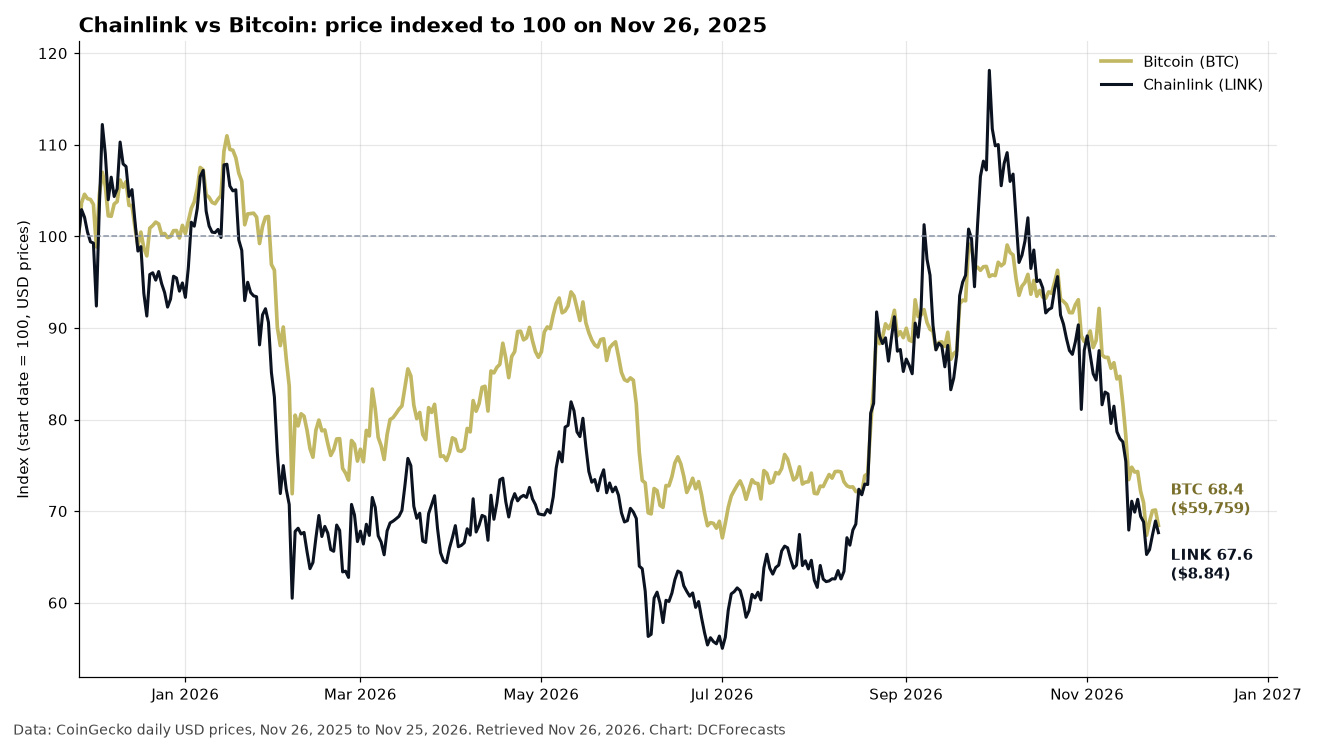
Over the past year, LINK is down about 30.6% and Bitcoin about 31.0%, per CoinGecko.
LINK fell harder in the spring, hitting a 12-month daily low of $7.19 on July 1. It then rallied to $15.44 by September 29, before giving most of it back.
Bitcoin held up better through the middle of the year and now trades near $60,086, roughly 52% below its October 2025 peak of $126,080.
We read that as a reminder that Bitcoin remains the steadier anchor in a broad crypto drawdown. Chainlink, with a market value near $6.9 billion against Bitcoin’s roughly $1.21 trillion, swings harder in both directions.
Fixed Supply Is the Common Thread
One section of the prospectus will sound familiar to Bitcoin holders. It states that a fixed supply of 1,000,000,000 LINK was created at Chainlink’s 2017 launch and that no additional LINK can be created.
Unlike Bitcoin, though, LINK was not mined into existence. Part of that supply is still being released from wallets tied to Chainlink Labs and the node operator and ecosystem allocation.
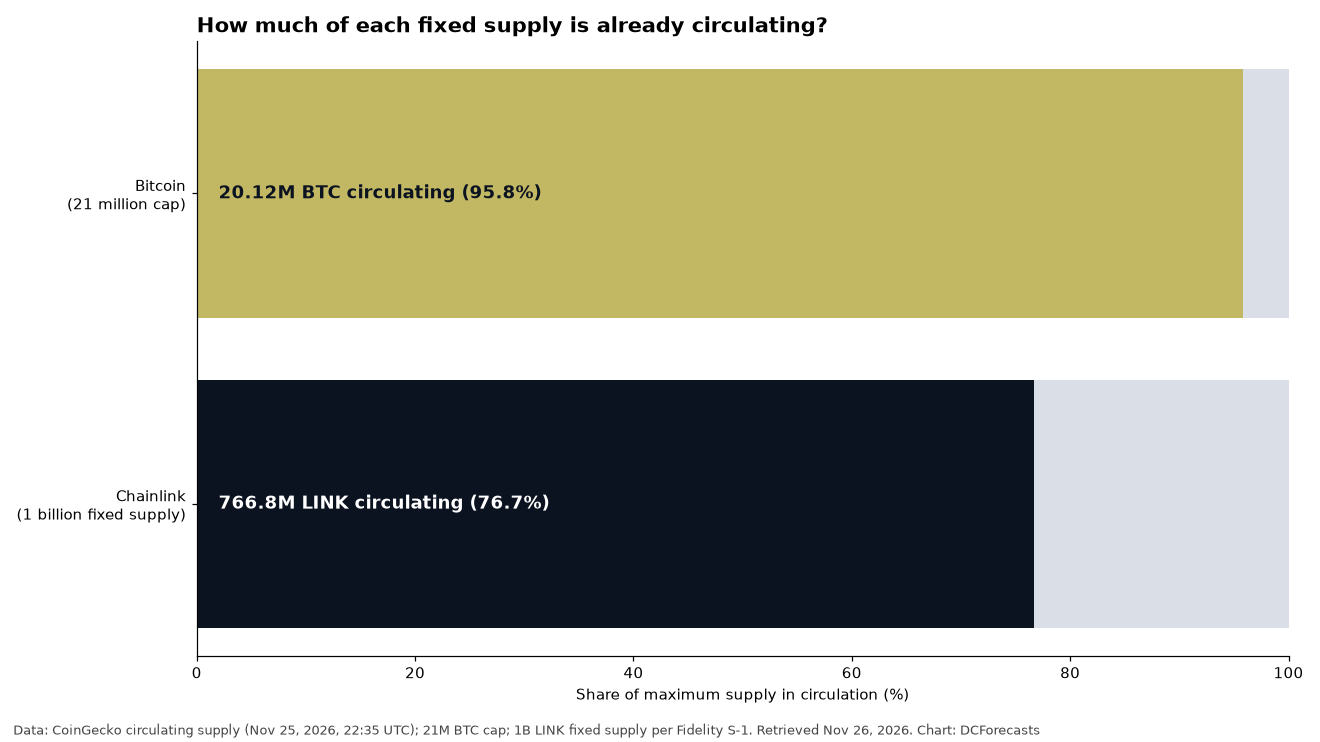
CoinGecko counts about 766.8 million LINK in circulation, or 76.7% of the fixed supply. Bitcoin, by contrast, already has 95.8% of its 21 million cap in circulation.
That gap is a useful lens for any LINK fund buyer. More than 230 million LINK can still reach the market, while Bitcoin’s remaining issuance is small and set by code.
What Comes Next for the Fidelity Crypto ETF Lineup?
An S-1 is a starting point, not an approval. The fee, the seed investment and the final ticker still have to be filled in through amendments.
Here is what we would watch:
- The sponsor fee, compared with the fees on GLNK and CLNK.
- Whether Fidelity amends the filing to add Chainlink staking later, as some rivals have done with other coins.
- Exchange listing paperwork from Nasdaq for the new fund.
- LINK’s ability to hold the $7 to $9 area that marked this year’s lows.
We believe the broader story is constructive. Today a firm of Fidelity’s size can file for a fourth single-coin fund in a down market, built on the rails first laid for Bitcoin.
As T. Rowe Price’s first crypto ETF results showed, even multi-asset funds tend to keep Bitcoin as the largest holding.
For long-term investors, that is the point worth keeping. New tokens get their own funds, but Bitcoin remains the foundation the whole category is built on.
DC Forecasts is a leader in many crypto news categories, striving for the highest journalistic standards and abiding by a strict set of editorial policies. If you are interested to offer your expertise or contribute to our news website, feel free to contact us at [email protected]












Discussion about this post