



France crypto tax hawks lost a full round in the Senate on Tuesday, and the €100,000 self-custody wallet register went down with them.
At its November 24 sitting on the 2027 budget, the upper house rejected two identical amendments that would have forced taxpayers to declare crypto wallets they hold themselves.
In the same debate, senators also turned down a tax on crypto-to-stablecoin swaps and a plan to pull crypto into France’s exit tax.
For Bitcoin holders, the result keeps self-custody where it was: legal, untaxed until gains are realized, and off any special register.
The bigger question is whether this closes the file for now, or simply moves the fight to the next budget.
What the Senate Rejected on November 24
The wallet texts were amendment I-2447 rect., from the communist-led CRCE-K group, and its twin I-2992 rect. bis, signed by senator Anne-Sophie Romagny and seven colleagues.
Both would have extended Article 1649 bis C of the tax code to crypto held outside any service provider, once its value reached €100,000 on December 31.
The Senate’s official summary record states that amendment I-2421 “is not adopted, nor are the identical amendments I-2447 rectifié and I-2992 rectifié bis.”
A few exchanges earlier, CRCE-K’s exit tax amendment, I-2428, met the same fate after both the finance committee and the government opposed it.

The amendment register now marks all four as rejected. The record shows no recorded ballot on any of them.
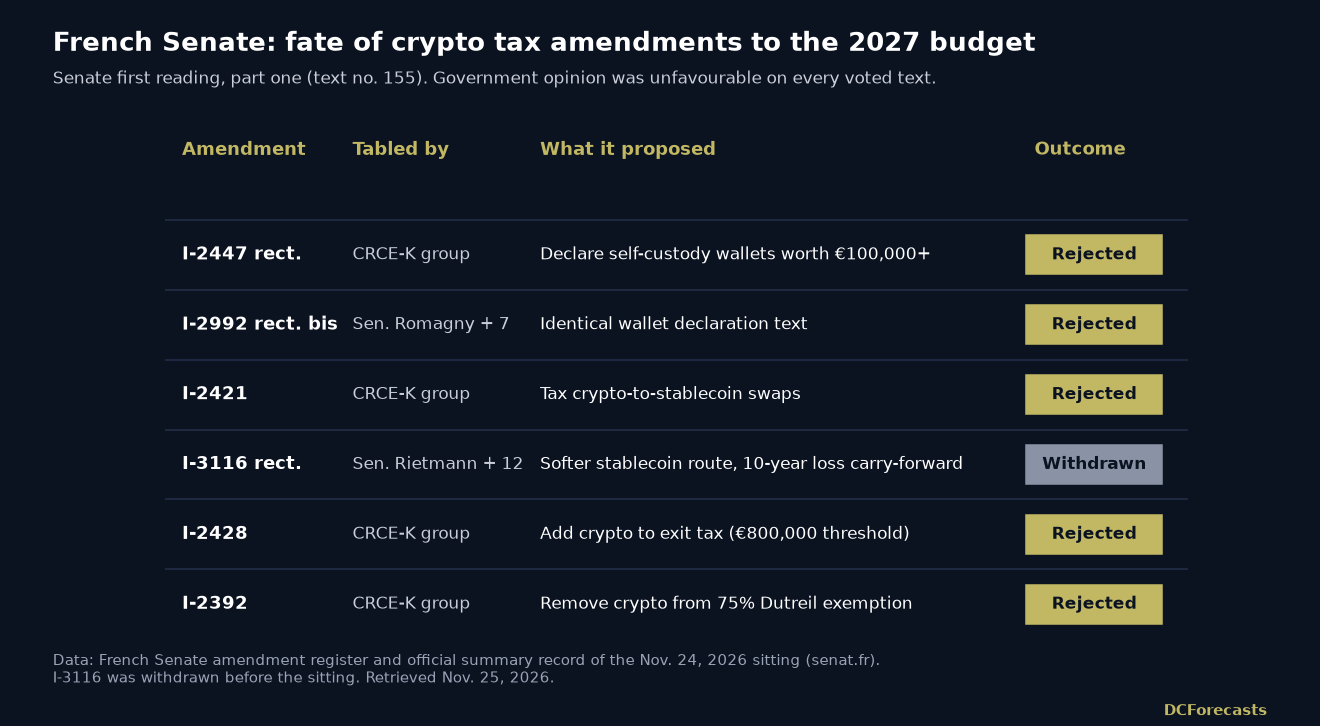
Not every crypto text even reached a vote. A softer stablecoin amendment from senator Olivier Rietmann, I-3116 rect., was withdrawn before the sitting, and an attempt to strip crypto from the 75% Dutreil exemption on family business transfers, I-2392, had already been rejected.
Why the Government Said No to the Self-Custody Wallet Rule
The decisive voice was the government’s. Rapporteur general Christine Lavarde noted that the wallet amendments reflected a recommendation of the Husson-Raynal report, then asked ministers for their view on the threshold, the penalties and how the rule would fit with other texts under review.
Minister David Amiel answered that the EU’s DAC8 directive, already written into the French tax code, has brought transparency by placing reporting duties on the professionals who handle crypto transactions.
He said he was “more circumspect” about a purely declarative duty. France needs to be able to follow how crypto is used, notably in money laundering or tax fraud cases, he argued, and “these amendments do not allow it.”
The committee then followed the government with an unfavourable opinion.
Supporters had pressed hard. CRCE-K senator Alexandre Basquin said the current rules light up the shop window but leave the back room in the dark.
We believe the minister’s reasoning is the more practical one. A yearly form listing a self-custody wallet adds paperwork and a sensitive database, while the reporting that matters already flows from regulated platforms.
As we covered when the declaration returned in the Senate, the proposal never said what the filing would contain. Public addresses could have exposed a holder’s full on-chain history.
Stablecoin Swaps and the Crypto Exit Tax Also Fell
Amendment I-2421 would have ended the tax deferral on swaps into e-money tokens, the MiCA category that covers euro and dollar stablecoins, from January 1, 2027.
Its author, Pascal Savoldelli, argued that converting crypto into money should trigger tax and called it an “amendement d’appel,” a text meant to flag the issue, adding that it had been voted by the National Assembly even if “not perfectly finished.”
Amiel rejected the premise. Stablecoins, he said, are not money: they have neither legal tender status nor the power to discharge debts, and many do not meet prudential stability requirements.
The crypto exit tax amendment would have counted crypto, including self-custodied coins, toward the existing €800,000 threshold for taxing unrealized gains when residents move abroad.
For long-term Bitcoin savers, that combination mattered. Under current French rules, moving between crypto assets without cashing out generally does not trigger tax, and that remains the case after Tuesday.
What Comes Next for France Crypto Tax Rules
This is the wallet register’s second dead end. On November 3, the National Assembly adopted an identical amendment, I-2701, as we reported in our first look at the self-custodial wallet plan, but the lower house then rejected the budget’s first part, wiping it out.
With neither chamber’s text now carrying the measure, we believe reviving it in this budget would be difficult, though backers could return with a stand-alone bill or a future finance law.
Enforcement is moving in a different direction. Article 30 of the government’s bill, still ahead in the debate, would create a €10,000 fine per request for financial institutions, crypto-asset service providers and platform operators that refuse documents in a specific tax audit, according to the description in amendment I-829.
That approach targets intermediaries, not individuals holding their own keys.
Why This Vote Is a Quiet Win for Bitcoin Self-Custody
At CoinGecko’s price of about €53,800 on Wednesday morning, the rejected €100,000 threshold equaled roughly 1.86 BTC.
A fixed euro line measured once a year would have pulled holders in and out of scope with every market swing, without a single coin moving. A Bitcoin recovery would have swept more ordinary savers into the register.
Instead, French holders keep the same rules as before: gains are taxed when realized, and platforms carry the reporting load under DAC8.
We believe that is the right balance. Self-custody is one of Bitcoin’s core features, and Tuesday’s debate showed it is now important enough for a national parliament to debate it on the floor.
The coming stages of the budget will show whether France keeps that balance, but for now the wallet stays private, and the keys stay with their owners.
DC Forecasts is a leader in many crypto news categories, striving for the highest journalistic standards and abiding by a strict set of editorial policies. If you are interested to offer your expertise or contribute to our news website, feel free to contact us at [email protected]












Discussion about this post