



The Strategic Bitcoin Reserve bill is now eligible for a vote by the full U.S. House, after the House Financial Services Committee formally reported H.R. 8957 on November 24.
The bill, called the American Reserve Modernization Act of 2026, was filed with House Report 119-894 and placed on the Union Calendar as No. 789, according to Congress.gov records.
The committee had approved it by a 28-21 roll call at a September 16 markup, and the reported version replaces everything after the enacting clause.
For Bitcoin holders, the standout line is simple: Bitcoin placed in the reserve could not be sold, swapped, auctioned or pledged for at least 20 years.
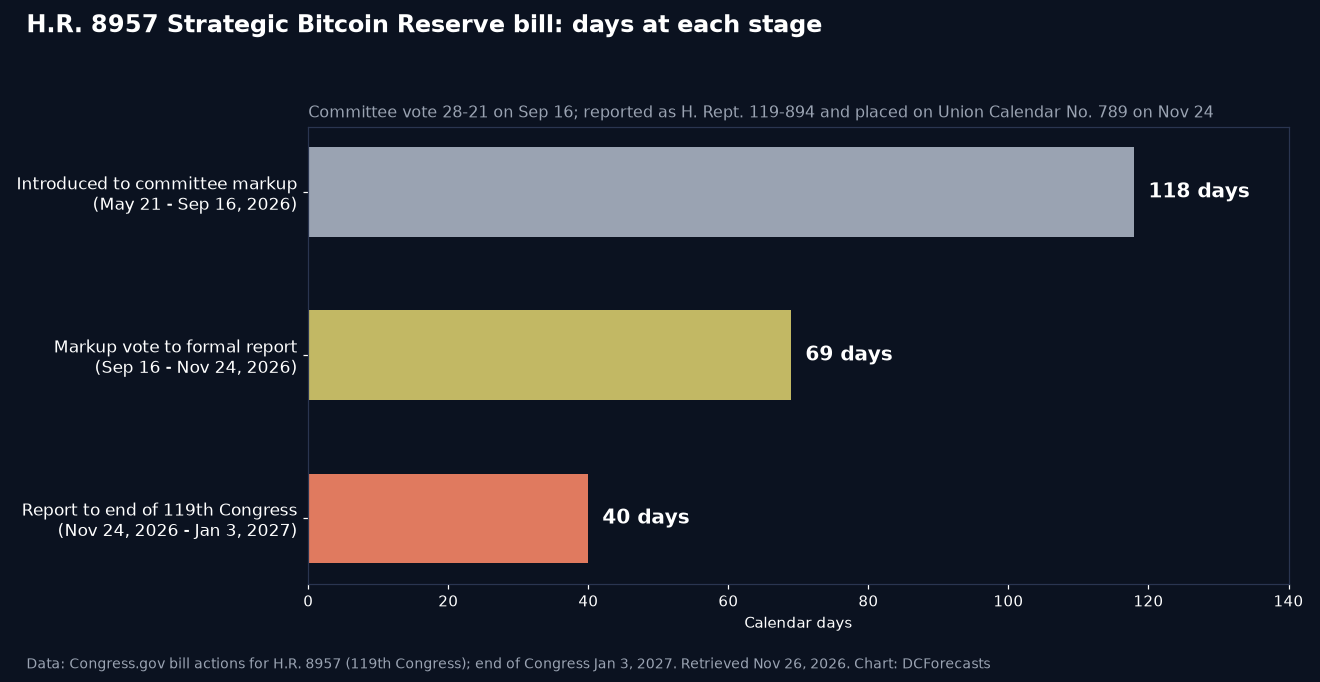
The bigger question now is whether House leaders find floor time before the 119th Congress ends on January 3, 2027, just 38 days from today.
What the Strategic Bitcoin Reserve Bill Would Do
The reported text tells the Treasury Secretary to set up two things within 180 days of enactment: a Strategic Bitcoin Reserve and a separate Digital Asset Stockpile for other coins.
The reserve would hold “qualifying Bitcoin,” meaning Bitcoin the federal government owns and is not required by law to use for other purposes, including coins finally forfeited in criminal or civil cases.
Every federal agency would have 60 days to give Treasury a full accounting of its Bitcoin and other digital assets, then repeat it yearly.
Until the reserve exists, agencies could not sell those coins, except for national security, when the law requires it, or when a court orders assets returned to identifiable crime victims.

The bill also asks for a public Proof of Reserve system: an annual report on holdings, transactions and private-key control, checked by an independent auditor, with oversight by the Comptroller General.
States could also keep their own Bitcoin in segregated accounts inside the reserve and withdraw it later.
That matters. As we noted when Texas marked one year of its own Bitcoin reserve, states already hold Bitcoin and need custody options.
The reserve itself already exists on paper: Executive Order 14233, signed March 6, 2025, created it. H.R. 8957 would put it into statute, where a future administration could not undo it with a signature.
A 20-Year Lock, Then at Most 10% Every Two Years
Section 5 is the heart of the bill. Treasury would have to hold all Bitcoin deposited in the reserve, however it was acquired, for at least 20 years from enactment.
Two years before that period ends, the Secretary would send Congress a recommendation on whether to keep holding or allow a gradual release.
Even then, the Secretary could recommend selling no more than 10% of the reserve’s assets in any two-year period.
One quiet change sits here. The introduced bill also ran a separate 20-year clock from each later deposit; the reported text keeps a single clock that starts on enactment.
For us, the key takeaway is supply. A legal ban on government sales would remove a known overhang for two decades.
What the Committee Took Out of the Bill
The rewrite narrows how the government might add more Bitcoin.
Rep. Nick Begich’s introduced text asked Treasury and Commerce to study buying Bitcoin with surplus remittances from Federal Reserve Banks, a revaluation of the Fed’s gold certificates, tax payments, tariff revenue and gifts.
Those options are gone. The reported study looks only at swapping other coins in the stockpile, forfeitures, penalties and settlements, and cooperative programs with states, private entities or international partners.
A new rule of construction adds that nothing in the study authorizes borrowing, pledging government assets as collateral, new taxes or deficit spending to buy Bitcoin.
The committee also dropped a section on Exchange Stabilization Fund reporting and amended the title to remove the reference to offsetting costs with Federal Reserve resources.
We believe that is a sensible trade: less ambition on new purchases for a cleaner, budget-neutral case on the floor.
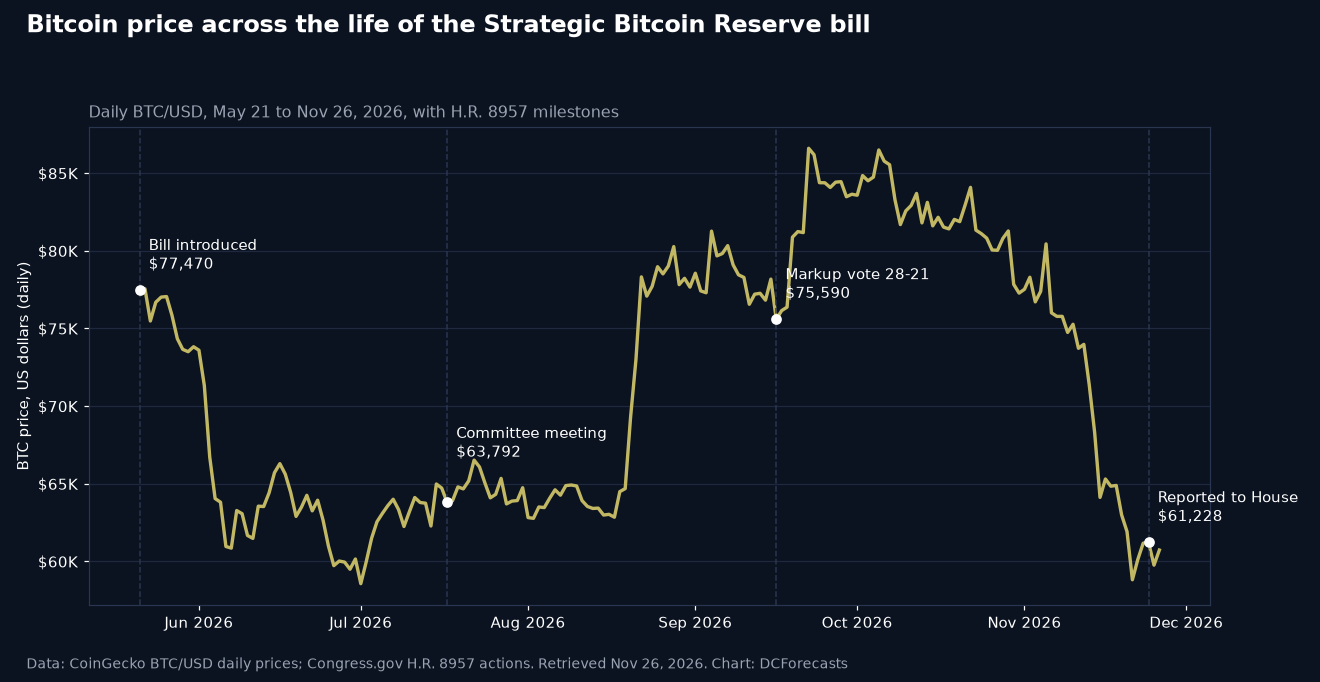
Bitcoin Price Across the Bill’s 187 Days
Bitcoin closed around $77,470 on May 21, the day H.R. 8957 was introduced, according to CoinGecko daily data. It was near $75,590 on the September 16 markup day and peaked around $86,597 on September 22.
By November 24, when the report was filed, the price was about $61,228, and it traded near $60,700 on Thursday morning. That is roughly 22% below the introduction-day level.
We read that gap constructively. The legislative track kept advancing while prices reset, which tells us support for a Bitcoin reserve in Congress is not just a bull-market reflex.
To be clear, the bill orders no new purchases, so it is not a direct buying catalyst. Its value lies in locking up existing holdings.
Can the US Bitcoin Reserve Bill Beat the Calendar?
Placement on the Union Calendar makes a floor vote possible, not scheduled. Congress.gov shows no floor action yet.
Even if the House passes the bill, the Senate would still have to act, and the president would have to sign before January 3. Bills not enacted by the end of a Congress expire and must be reintroduced.
The bill now lists 23 cosponsors: 22 Republicans and one Democrat, Rep. Jared Golden of Maine, according to Congress.gov.
We would watch three things: whether leadership schedules H.R. 8957 in December, whether a Senate companion moves, and how Treasury reports on federal holdings in the meantime.
Whatever the timing, the direction is encouraging. A 21 million coin supply cap, growing state and institutional custody, and a bill built around never dumping federal coins all point the same way.
The coming weeks will reveal whether the Strategic Bitcoin Reserve moves from an executive order into law, or returns next Congress with this text as its base.
DC Forecasts is a leader in many crypto news categories, striving for the highest journalistic standards and abiding by a strict set of editorial policies. If you are interested to offer your expertise or contribute to our news website, feel free to contact us at [email protected]












Discussion about this post