



The NovaTech founders who fled the United States now face a $1.37 billion New York judgment that the state calls historic, closing the main chapter of a long-running crypto Ponzi scheme case.
Justice Anar Rathod Patel of the New York State Supreme Court signed the order on November 24, and Attorney General Letitia James announced it a day later.
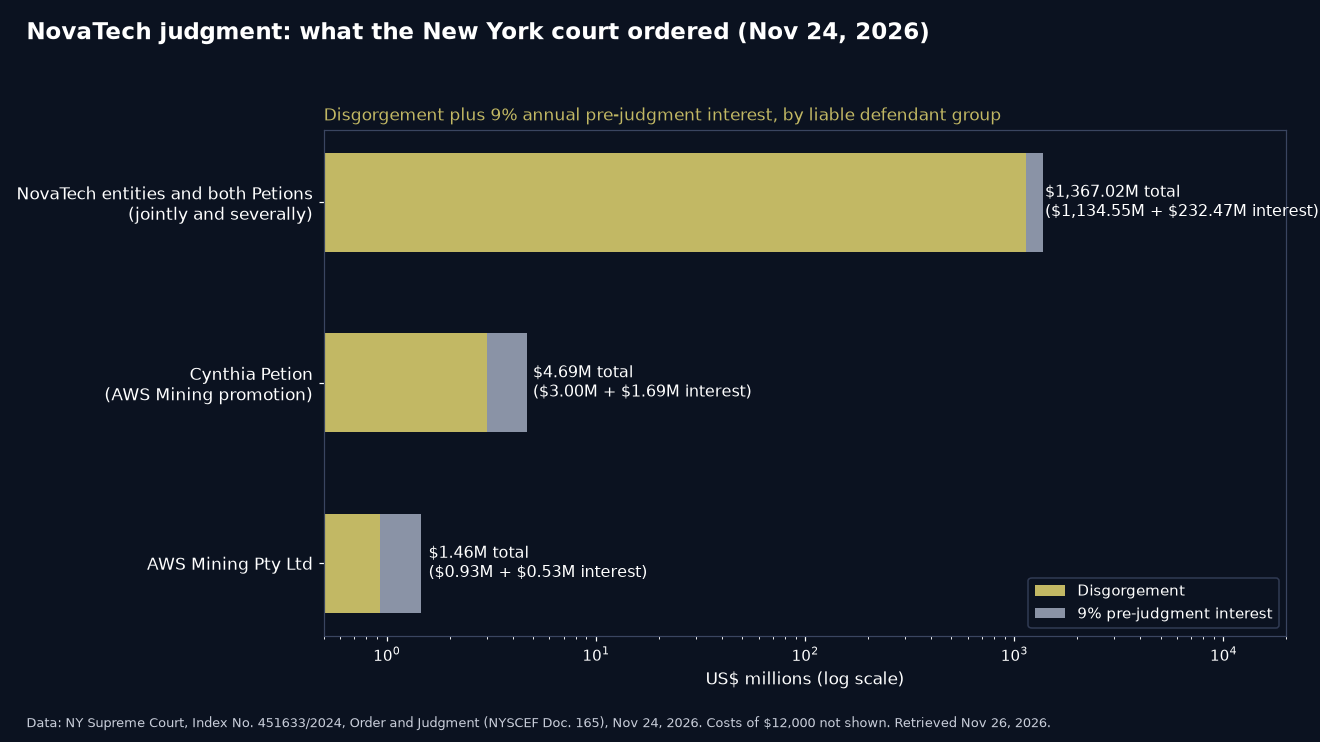
The exact figure is $1,367,023,585, owed jointly by Cynthia and Eddy Petion and their NovaTech companies.
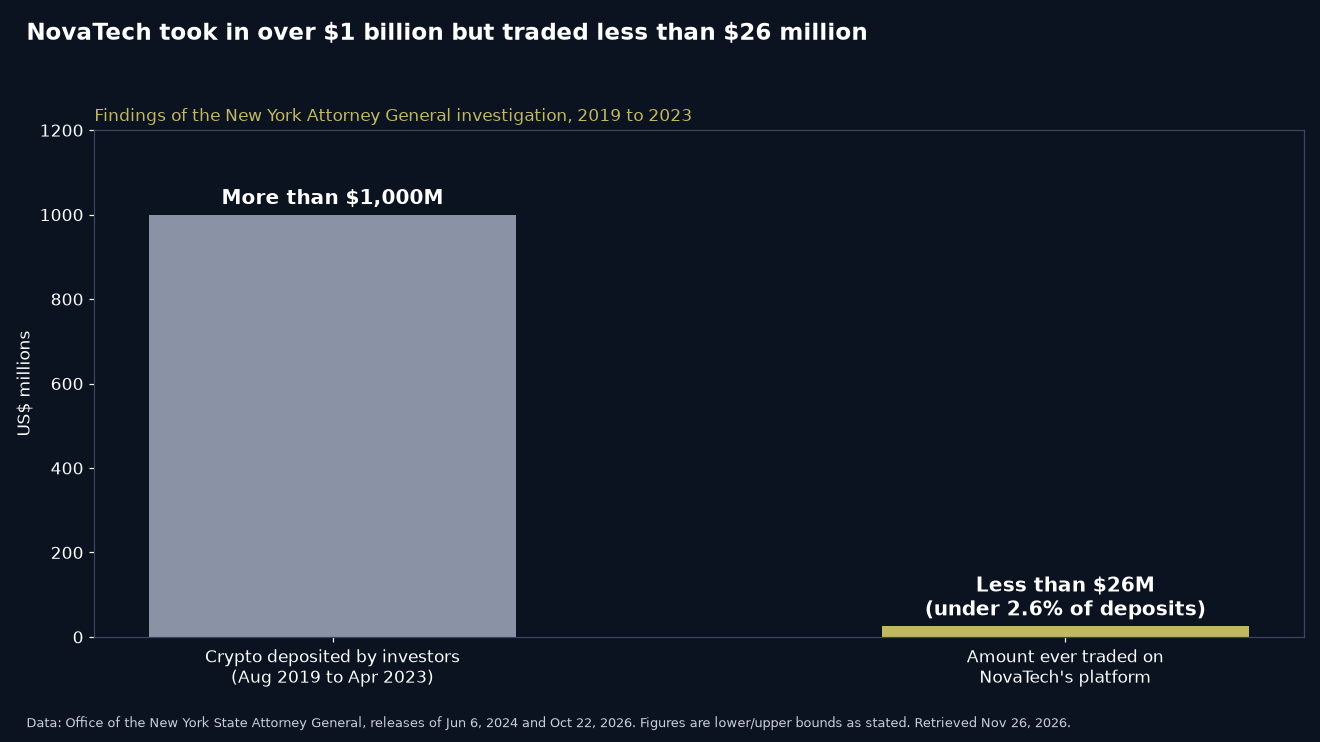
For Bitcoin holders, the most striking number is a different one: less than $26 million of the more than $1 billion investors handed over was ever traded.
The bigger question is how much of this award victims can actually recover from defendants who are no longer in the country.
What the NovaTech Judgment Orders
The five-page order splits the money into clear pieces.
NovaTech Ltd, NovaTech Advisors, NovaPay and both Petions owe $1,134,549,691 in disgorgement. On top of that sits $232,473,894 in 9% annual pre-judgment interest, counted from June 1, 2023 through September 10, 2025.
Interest alone makes up about 17% of the headline total.
The court also ordered AWS Mining, an earlier scheme, to disgorge $930,195 plus interest, for $1,455,666 in all. Cynthia Petion separately owes $4,694,712 for promoting AWS Mining.

None of this was contested. The defendants never answered the June 2024 complaint, and a default judgment followed in August 2025.
That earlier ruling found them liable under New York’s Martin Act and banned them from the securities, commodities and cryptocurrency industries. They were also ordered to produce a full accounting of investor payments within 30 days, and the new order notes they never did.
How a Crypto Ponzi Scheme Reached 11,000 New Yorkers
According to the attorney general, the Petions first promoted AWS Mining, which promised 15% to 20% monthly returns and 200% within 15 months. It collapsed in 2019.
They then launched NovaTech and advertised trading profits of roughly 2% to 4% per week.
Recruiting ran through prayer groups, WhatsApp chats and ads in Haitian Creole. The firm falsely presented itself as a registered hedge fund broker licensed to trade crypto in the U.S.
“NovaTech cruelly targeted immigrant families through faith and community groups with the promise of a better life while robbing them of their life savings,” James said on Wednesday.
Investors deposited more than $1 billion in crypto from August 2019 through April 2023. NovaTech collapsed in May 2023, and tens of thousands of people could not withdraw.
Why the Promised Returns Were the Biggest Red Flag
The arithmetic was never going to work.
A steady 2% a week compounds to about 180% a year. At 4% a week, $1,000 would grow to nearly $7,700 in twelve months.
No real trading strategy delivers that without fail. Yet the state says NovaTech announced weekly profits regardless of market conditions, paying them out of newer investors’ money.
We believe that smoothness is the clearest warning sign of all. Real markets, Bitcoin included, move in both directions, and honest products show it.
The pattern echoes the case we covered when Backward Hat Capital claimed it never had a losing month. Different people, same tell.
Can Victims Recover the $1.37 Billion?
A judgment is not a refund.
The order lets the state docket it as a money judgment and seek execution, and the court keeps jurisdiction to enforce it. But the Petions left the country before the default ruling, and the order itself gives no recovery estimate.
Some money is already moving. In October, four top promoters settled with the attorney general for a combined $5,975,861 in disgorgement for victims, including $2.9 million from Martin Zizi and $2.05 million from Frantz Ciceron. All four accepted permanent industry bans.
A parallel federal case adds pressure. In August 2024 the SEC charged NovaTech and the Petions in Florida federal court, alleging the scheme raised more than $650 million in crypto from over 200,000 investors worldwide.
We would watch that federal case and any asset tracing closely. Crypto moved on public ledgers can often be followed long after the promoters disappear.
Regulators have leaned on that kind of recovery work, as we noted when the SEC nearly tripled what it returned to investors in fiscal 2026.
What NovaTech Teaches Bitcoin Investors
NovaTech was not a Bitcoin failure. It was an old-fashioned affinity fraud that used crypto as packaging.
Victims did not lose money because Bitcoin broke. They lost it because they handed control of their coins to promoters who promised a fixed yield and then stopped paying.
That distinction matters. Bitcoin itself promises no return at all. Its supply schedule is fixed, its ledger is public, and holders can keep their own keys instead of trusting a middleman.
For us, the key takeaway is simple: be wary of any product offering weekly profits on someone else’s platform, and favor transparency you can verify yourself.
We also see a constructive trend in cases like this one. State and federal enforcers are treating crypto fraud like any other securities fraud, which strengthens the case for regulated, transparent access to Bitcoin.
The coming months will show how much of the $1.37 billion can be traced and returned. Either way, a court has now put a firm number on what this scheme cost the people who trusted it.
DC Forecasts is a leader in many crypto news categories, striving for the highest journalistic standards and abiding by a strict set of editorial policies. If you are interested to offer your expertise or contribute to our news website, feel free to contact us at [email protected]












Discussion about this post