



Japan’s Financial Services Agency has put the self-custody wallet on its regulatory agenda, and a survey it cited shows a habit that may put users at more risk than any rule.
On November 26, the FSA’s study group on digital and decentralized finance met for the third time this administrative year and reviewed a 52-page staff paper on DeFi and unhosted wallets.
According to a Nomura Research Institute survey for Japan’s Digital Agency quoted in that paper, 38.3% of Japanese unhosted wallet users keep their seed phrase or keys in a notes app or file on a PC or phone, screenshots included.
For Bitcoin holders, the more important point is what the FSA did not propose: there is no ban and no license for wallet software.
The bigger question now is whether Tokyo protects users through better tools and education, or through friction at the exchange door.
What the FSA Put on the Table on November 26
The study group is part of a growth strategy the FSA published on July 21, 2026, which aims for an interim summary in early 2027 on “on-chain finance”.
The paper itself sets out discussion points, not new rules.
On wallets, the FSA asks members how they view the benefits, use cases and risks of unhosted wallets, and what could protect users who manage keys in risky ways.
It also asks whether further anti-money laundering steps are needed.

On DeFi, it asks who should be treated as the regulated party when a protocol has no clear operator, and whether front-end providers should face rules at all.
One option it floats is to work through the regulated businesses that touch DeFi, such as stablecoin issuers, on- and off-ramp providers and financial institutions.
The Japan Cryptoasset Business Association also presented to the group.
How Japan’s Self-Custody Wallet Users Store Their Keys
The survey data are the most revealing part of the paper.
Among 3,709 crypto and NFT holders surveyed, 812 people, or 21.9%, used an unhosted wallet.
After notes apps and files, 32.1% wrote keys on paper, 25.7% used a password manager and 16.5% relied on cloud backup.
Only 7.7% used a hardware wallet, 7.5% used multisig and 8.6% split keys with MPC. Another 15.2% said they did nothing in particular or did not remember.
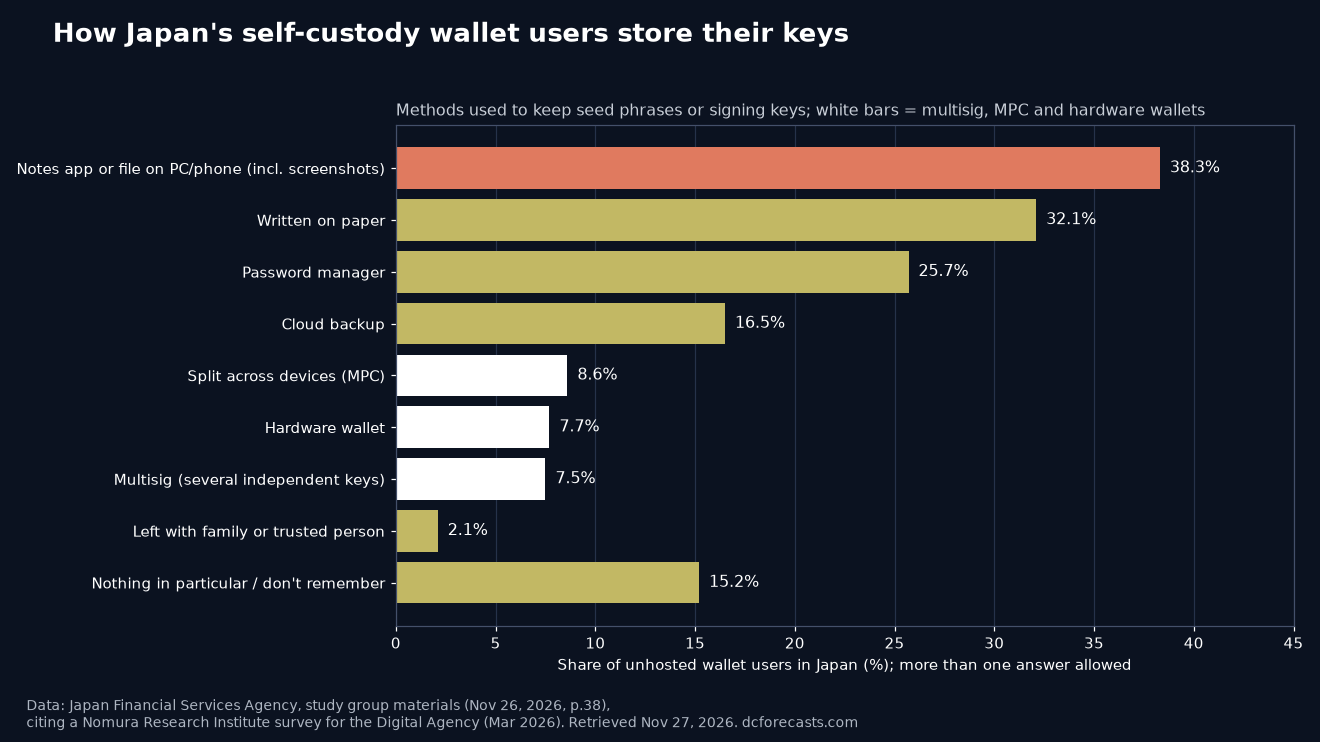
The FSA itself points to multisig, MPC and smart contract wallets as ways to cut the risk of lost or leaked keys.
We believe that is the constructive reading. Seed phrase storage is a skills gap, and the fix is already in the market.
We saw the same threat from the other side when iPhone malware hunted seed phrases through 480 ad domains.
Why Most Japanese Wallets Still Connect to Exchanges
The use-case data show that self-custody in Japan is mostly a companion to regulated exchanges, not a replacement for them.
Some 59.4% of unhosted wallet users said they move funds to or from exchanges. Rewards came next at 30.7%, then in-wallet purchases at 25.6% and staking at 21.9%.
DeFi was a smaller 13.1%, and paying for goods and services just 7.7%.
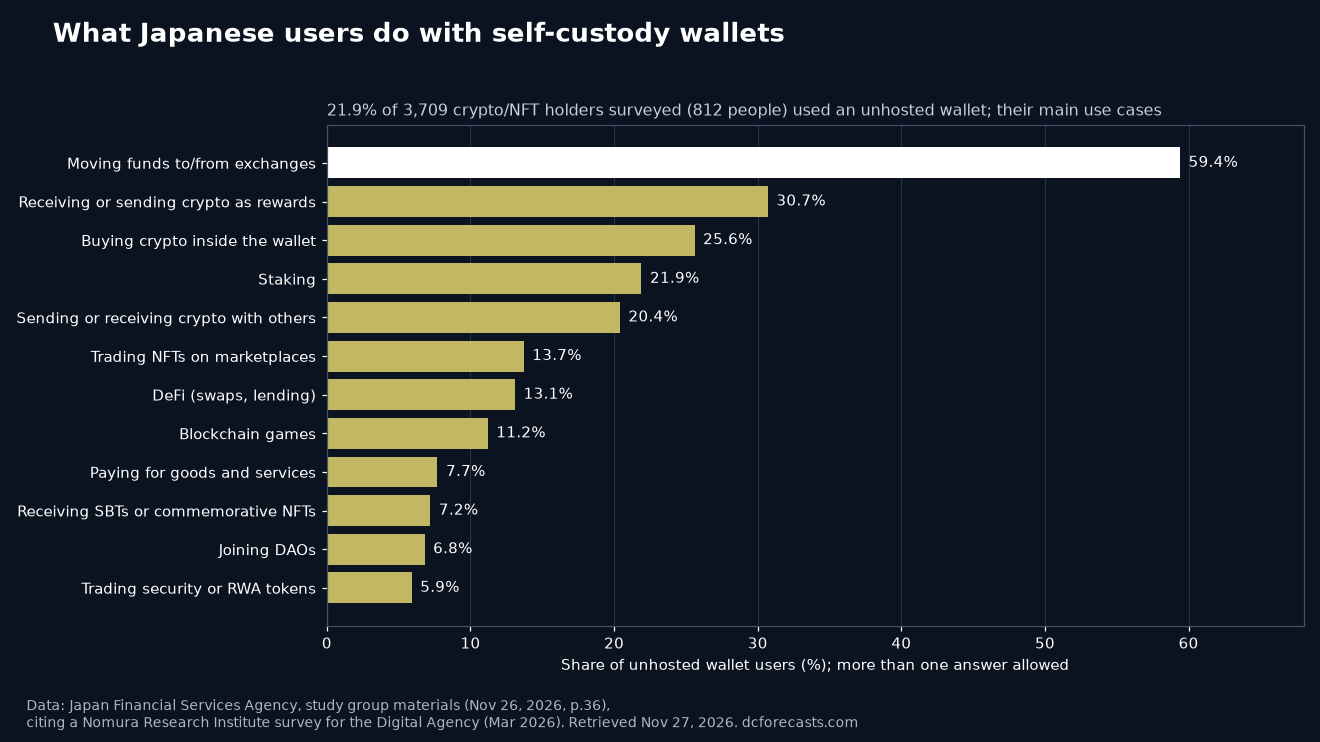
That matters for policy. The FSA notes that individuals still mainly use hosted wallets run by domestic exchanges.
It repeats the earlier conclusion of its crypto working group that there is little need to regulate non-custodial wallet providers right away, while keeping it as a future issue.
The base keeps growing too: Japan reached a record 14.74 million crypto accounts, as we covered when BITPOINT announced its December 23 closure.
Where Japan Already Draws Lines on Unhosted Wallets
Japan is not starting from zero.
Under the Act on Prevention of Transfer of Criminal Proceeds, domestic exchanges that deal with unhosted wallets already must keep records and collect information on those transfers.
The 2026 amendments to the Financial Instruments and Exchange Act and the Payment Services Act also add prior notification and system safety duties for firms that supply exchanges with critical custody systems.
The firmest new step is aimed at fraud. Through a Cabinet Office ordinance, the FSA plans to require measures such as a cooling-off period that blocks transfers to unhosted wallets right after a new exchange account is opened.
The working group report it cites also calls for fraud warnings, checks on the purpose of a transfer and monitoring when coins leave for unhosted wallets or unregistered platforms.
We see that as targeted friction against investment scams, not a limit on holding your own keys.
Is a Light Touch the Right Model for a Non-Custodial Wallet?
The FSA’s own research points that way.
The paper says direct regulation of unhosted wallet use, or of firms that only develop or sell wallet software or hardware, is not widely seen internationally.
It cites FATF guidance from October 2021 that such providers are usually not virtual asset service providers, and an April 13, 2026 SEC staff statement on when wallet interfaces are not broker-dealers.
It also notes that the Nomura survey found no country with direct rules for unhosted wallets.
The paper accepts that using such a wallet with an understanding of the risks can be seen as the user’s own responsibility, while anti-money laundering goals must still be met.
That stance contrasts with France’s proposed €100,000 self-custody wallet declaration, which targeted holders directly.
What Bitcoin Holders Should Watch Before 2027
Bitcoin traded near $61,576 on Friday, up about 1.6% in 24 hours, according to CoinGecko data retrieved November 27.
For long-term holders, Japan’s choice may matter more than the daily price.
We would watch three things: whether the on-chain finance review due in early 2027 keeps wallet software outside licensing, how long any cooling-off period runs, and whether DeFi rules land on front ends.
A non-custodial wallet is how Bitcoin’s fixed supply becomes property its owner fully controls.
If Japan keeps building tools and education around that right instead of fences, we believe the 7.7% hardware wallet share has plenty of room to grow.
DC Forecasts is a leader in many crypto news categories, striving for the highest journalistic standards and abiding by a strict set of editorial policies. If you are interested to offer your expertise or contribute to our news website, feel free to contact us at [email protected]







Discussion about this post