



Binance Brasil now holds a license to operate in Brazil’s foreign exchange market, a step that could let the exchange raise its cap on international crypto transfers fivefold.
The Central Bank of Brazil approved the request on Nov. 23, and the decision appeared in the country’s Official Gazette the next day.
Binance called it its third license in Brazil when it announced the approval on Nov. 27.
For Bitcoin holders, the interesting part is not the logo on the license. It is what the license unlocks: bigger, regulated crypto pipes in and out of Latin America’s largest economy.
The bigger question now is how quickly that capacity reaches customers, because one more approval still sits in the queue.
What the Central Bank of Brazil Approved
The approval came in a list of decisions by the central bank’s Department of Organization of the Financial System, published in Section 3 of the Official Gazette on Nov. 24.
Under case 311129, Binance Brasil Corretora de Câmbio e Valores Mobiliários S.A. received authorization “to operate in the foreign exchange market.” The department head signed the decision on Nov. 23.
The entity is the brokerage formerly known as Sim;paul, which Binance acquired. It already held licenses as a securities broker and an electronic money issuer, which is why Binance counts this as license number three.
The same notice also authorized Foxbit Investimentos, a securities distributor linked to the Brazilian exchange Foxbit, to start operating with R$5.5 million in capital and an e-money license.

That matters. Two crypto-native groups cleared central bank hurdles on the same day.
Why Binance Forex Approval Matters: $100,000 vs. $500,000
The real story sits in Resolution BCB 521, which the central bank issued on Nov. 10, 2025. From Feb. 2, 2026, it placed international payments and transfers made with crypto inside Brazil’s foreign exchange rules.
The resolution sets two ceilings for a cross-border crypto payment or transfer when the counterparty abroad is not authorized to operate in Brazil’s FX market.
- A standalone virtual asset service provider, known locally as an SPSAV, is capped at the equivalent of $100,000.
- A brokerage authorized for FX that also acts as a virtual asset service provider can go up to $500,000.
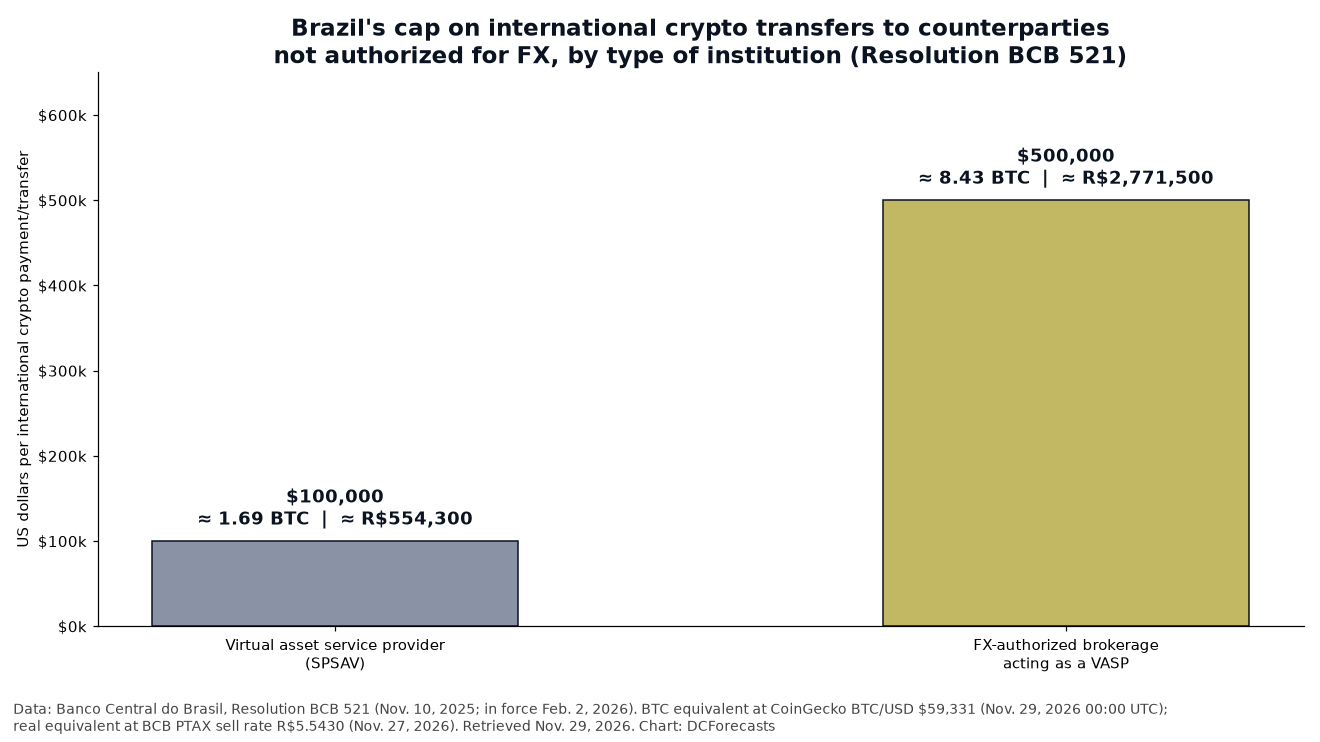
At Bitcoin’s price early on Nov. 29, the lower cap equals about 1.69 BTC. The higher one equals about 8.43 BTC.
Thiago Sarandy, Binance’s general manager in Brazil, said the company would use the new license soon to raise international transfer limits, adding that the change matters most for institutional investors. He did not give a date.
We believe that caution is right. The resolution ties the $500,000 lane to institutions acting as virtual asset service providers “in the form of the regulation,” so the FX license alone does not switch it on.
The Second Approval Binance Brasil Still Needs
Binance runs its crypto services in Brazil through a separate company, BBrasil Sociedade Prestadora de Serviços de Ativos Virtuais. Its application for a crypto service provider license is still under review.
Brazil’s rulebook for those firms, Resolution BCB 520, gave providers already operating 270 days from Feb. 2 to apply. That window closed on Oct. 30.
As we reported when the Brazil crypto license queue reached 120 firms, applicants can keep serving customers while the central bank reviews each file.
So Binance has built the FX side first. The crypto side of the structure is waiting on the same regulator.
Brazil Crypto Regulation Now Reaches Self-Custody Wallets
Resolution 521 does more than set caps. It also brings transfers to and from self-custody wallets, plus trades in fiat-referenced tokens such as dollar stablecoins, under FX reporting.
Providers must identify the owner of a self-custody wallet and document where the assets come from and go. Buying or selling crypto against foreign currency is banned outright.
Some users will see paperwork. We see recognition. The resolution defines a self-custody wallet as one whose owner controls the private key and can move the assets without a provider, and it keeps those transfers legal.
For Bitcoin, that is a meaningful line in a major market. Holding your own keys is treated as a normal activity to report, not a loophole to close.
A Volatile Real Shows Why Cross-Border Rails Matter
The timing is striking. On Nov. 23, the day Binance’s FX approval was signed, the central bank’s PTAX reference rate hit R$5.9708 per dollar, its highest level of 2026.
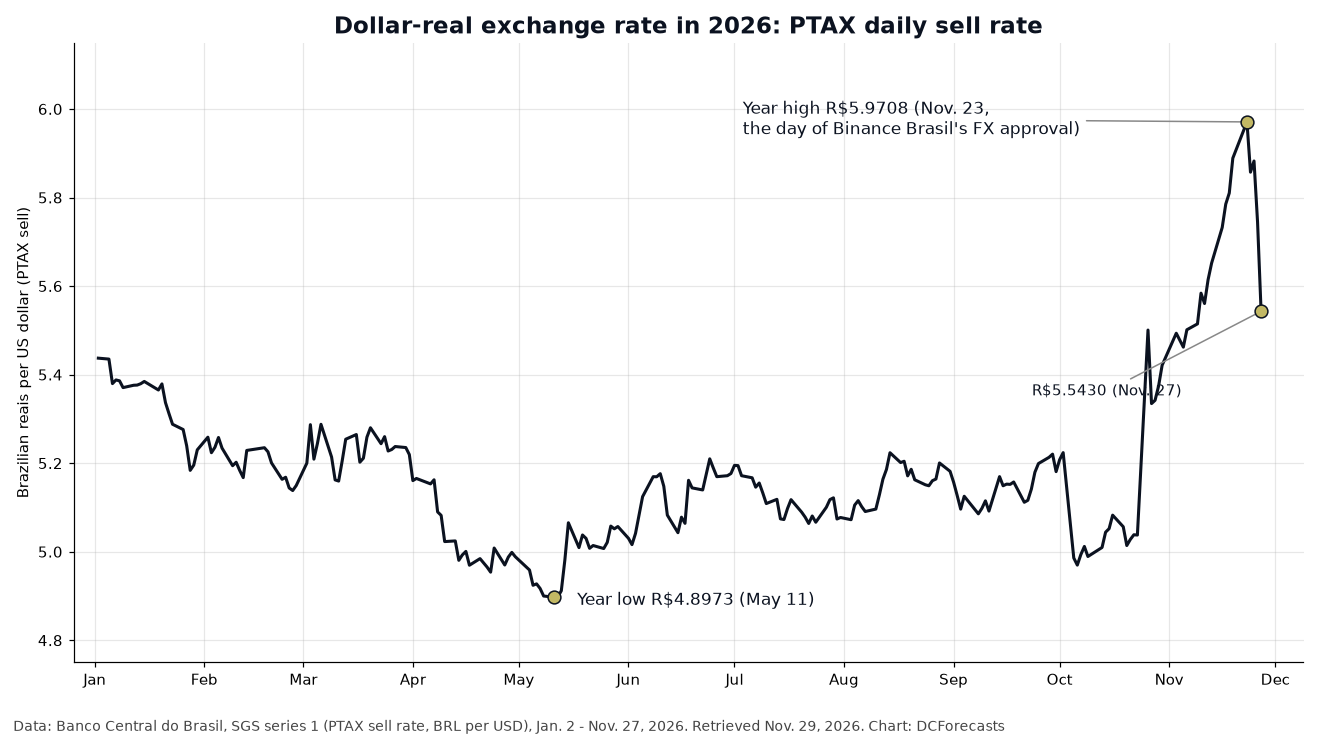
The rate stood at R$5.0377 on Oct. 23, so the real lost about 16% of its dollar value in a month. It then recovered sharply, with PTAX back at R$5.5430 by Nov. 27.
Brazilians have already shown they want dollar exposure on crypto rails. As we noted when B3 and six banks unveiled a real-based stablecoin, reais make up a tiny share of stablecoin trading.
Larger, supervised transfer limits give that demand a regulated outlet instead of informal channels.
What Comes Next for Binance Brasil and Bitcoin
We would watch three things: a decision on the BBrasil application, the date Binance actually lifts its limits, and whether other exchanges seek FX licenses to match.
None of these is guaranteed.
Still, the direction is clear. Brazil is wiring crypto into its formal FX system rather than walling it off, and global exchanges are paying the cost of compliance to stay.
We believe that is constructive for Bitcoin. A scarce, borderless asset with a fixed 21 million supply tends to gain when large economies give it clear legal channels.
The coming months will show whether that $500,000 lane opens, and how much Brazilian capital chooses to use it.
DC Forecasts is a leader in many crypto news categories, striving for the highest journalistic standards and abiding by a strict set of editorial policies. If you are interested to offer your expertise or contribute to our news website, feel free to contact us at [email protected]










Discussion about this post