


The SafePal wallet data incident first disclosed in August is bigger than buyers were told, and some of the newly affected customers will never get a warning email.
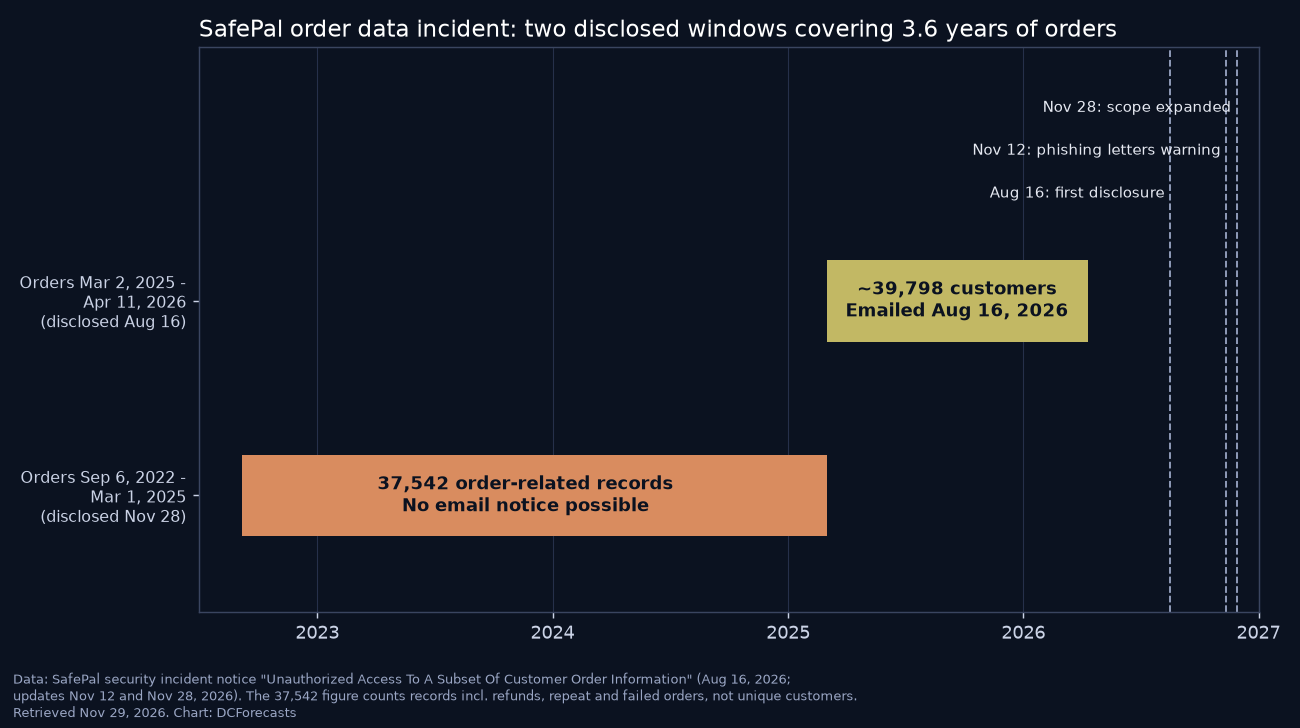
In a Nov. 28 update to its incident notice, SafePal said it had found 37,542 more crypto payment order records exposed in the same incident, covering orders placed between Sept. 6, 2022 and March 1, 2025.
The company says the records it would need to identify and email those buyers were deleted under its data policy and remediation work.
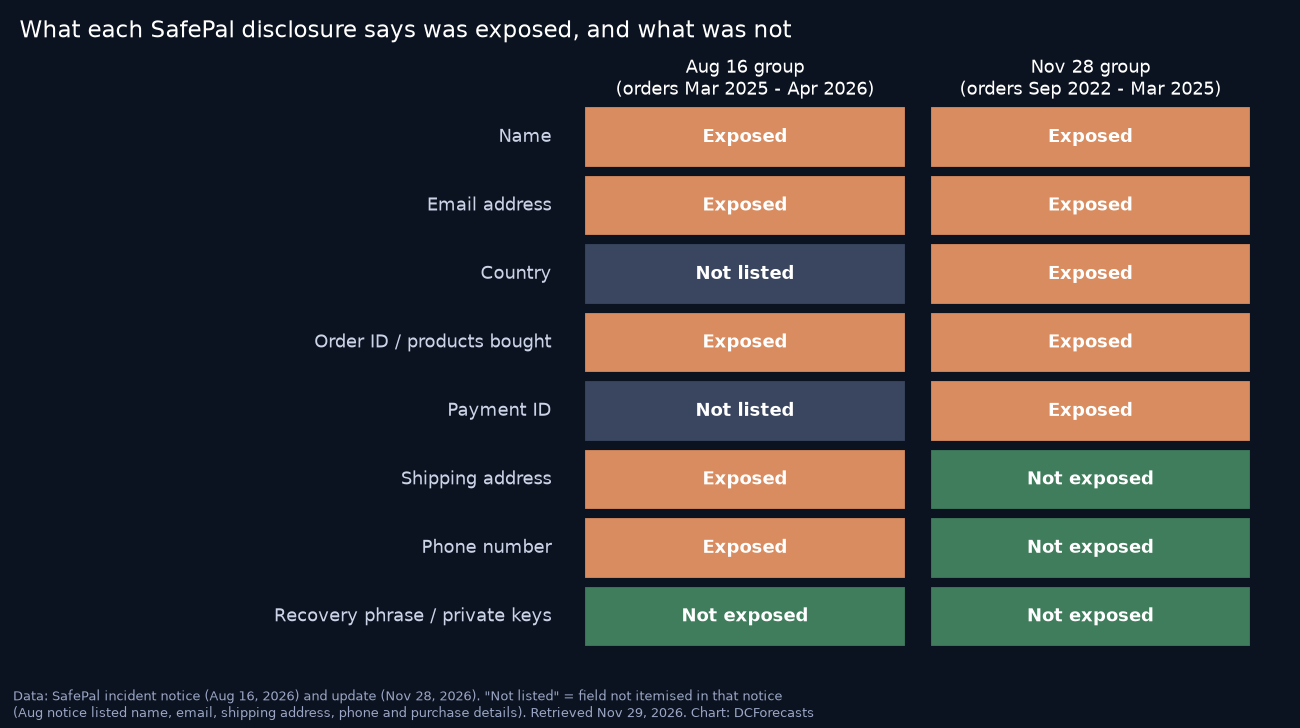
For Bitcoin holders, the key detail is what did not leak: no recovery phrases, private keys or wallet passwords.
The bigger question is how long old purchase data keeps giving scammers a script, even after the hole that exposed it is closed.
What SafePal Added to Its Breach Notice
The trigger was not an internal audit. SafePal said that on Nov. 25 it received reports of phishing emails aimed at customers whose orders fell outside the period it had disclosed on Aug. 16.
Its follow-up investigation traced the problem to crypto payment and e-commerce records that were stored separately but could be linked through a shared payment ID.
The new group’s exposed fields are names, email addresses, countries, order IDs, products purchased and payment IDs.
SafePal stressed that 37,542 is a count of records, including refunds, repeat orders and failed orders. It is not a count of unique customers.

Shipping addresses, phone numbers, card or bank details and crypto wallet payment addresses were not part of this group, the company said.
“We sincerely regret that this additional scope was not identified during our initial investigation,” SafePal wrote.
Why the SafePal Wallet Buyers From 2022 Get No Email
The August notice described an authorization flaw in an order-tracking plug-in. It exposed details for about 39,798 customers who ordered between March 2, 2025 and April 11, 2026.
That earlier group had more sensitive data taken, including shipping addresses and phone numbers. SafePal said it emailed every one of them on Aug. 16.
Part of its fix was a tighter rule: personal data in the order system is now kept for 90 days, subject to legal requirements.
Data deletion now cuts the other way. With the linking records gone, SafePal says it is “unable to send individual email notifications” to the 2022-2025 buyers.
Instead, it asks anyone who ordered in that window to treat their information as potentially affected.
We have seen this tension before. When a Trezor shipping partner was hit this month, Trezor could not email a small group of buyers because its own copy of their data had already been anonymized.
We believe that is the uncomfortable lesson for every wallet seller: deleting data limits future leaks, but it also deletes the address book you need when an old leak resurfaces.
Phishing Letters, QR Codes and Fake Firmware
The data is already being used. On Nov. 12, SafePal warned of a wave of physical phishing letters sent to customers from the August group.
Those letters mostly described firmware security problems and asked readers to scan a QR code that led to a phishing site.
Switzerland’s National Cyber Security Centre described a similar tactic in its Week 33 review in August. It reported letters sent in the name of various crypto wallet providers that urged a “quantum resistance” update through a QR code.
The NCSC noted one clever detail: a deadline more than two weeks away, which makes the letter feel less like a scam.
The end goal never changes. Every one of these campaigns ends by asking for the seed phrase.
What Leaked Data Cannot Do to a Bitcoin Wallet
A name, an email and a product order cannot sign a Bitcoin transaction. Only the private keys can, and those never sat in SafePal’s order system.
That is the design working as intended. Bitcoin self-custody puts control in one place, the recovery phrase, and keeps it away from shops, couriers and plug-ins.
SafePal also said an independent audit by Cure53, completed in October, found no remaining vulnerabilities in its e-commerce systems. It has taken down more than 30 fraudulent websites and brought in anti-phishing providers.
The weak point is human. A convincing message that quotes a real order ID is far more persuasive than a generic scam.
That is why the habits matter more than the headlines. As Japan’s regulator found when it reviewed how self-custody users store their keys, the real exposure is often how people handle their recovery words.
A Short Checklist for Hardware Wallet Owners
SafePal’s own guidance lines up with what we would tell any self-custody user, whatever device they own:
- No legitimate company will ask for your recovery phrase, private key or wallet password.
- Do not scan QR codes in unsolicited letters, and do not follow firmware instructions from emails.
- Type the maker’s web address yourself instead of clicking links.
- Update firmware only through the official app or device.
- If you already entered your recovery phrase somewhere, move funds to a new wallet with a fresh phrase.
SafePal says anyone who bought between September 2022 and March 2025 should assume their details may be in circulation and stay alert.
We believe the bigger picture is reassuring for Bitcoin. Two disclosures, two windows and 3.6 years of order data, and still no path to anyone’s coins without the holder’s help.
The coming weeks will show whether phishing tied to these records fades or spreads. Either way, the fix sits in the holder’s hands: keep the phrase offline and never type it into a stranger’s website.
DC Forecasts is a leader in many crypto news categories, striving for the highest journalistic standards and abiding by a strict set of editorial policies. If you are interested to offer your expertise or contribute to our news website, feel free to contact us at [email protected]










Discussion about this post