



Binary KPI options are spreading across U.S. options exchanges, and one Bitcoin miner has landed more tradable metrics on the list than Apple, Nvidia or Tesla.
Notices published in the Federal Register on Nov. 20 show that Miami International Securities Exchange (MIAX) and MEMX filed on Nov. 9 to list the same all-or-nothing contracts that Cboe won SEC approval for on Oct. 13.
Each contract pays a fixed $1 if a company’s reported number clears a set level, and nothing if it does not.
For Bitcoin investors, the striking detail is MARA. Five of its seven eligible metrics are Bitcoin numbers, from blocks won to total BTC holdings.
The bigger question is whether Wall Street is ready to price Bitcoin mining output the way it prices iPhone sales.
What the New Filings Allow
The MIAX notice, filed as SR-MIAX-2026-45, describes binary KPI options as European-style, cash-settled options on “a specific financial or operating metric” that a company reports in an earnings-related filing with the SEC.
MIAX says its proposal is “substantively identical” to the Cboe rules. NYSE Arca and NYSE American refiled similar proposals on Nov. 4, and the SEC published those notices on Nov. 18.
The contract design is simple. A call pays $1 if the reported figure is at or above the strike. A put pays $1 if it comes in below.
Settlement uses the number in the company’s SEC filing, not its press release. If a figure is later restated, the payout does not change.

Exchanges may list expirations up to 12 months out, with no more than two open at once. Position limits equal 25,000 standard option contracts per expiration, and 100 binary contracts count as one. That works out to 2.5 million binary contracts, or $2.5 million of maximum payout.
Both filings took effect immediately, but cannot become operative until 30 days after filing unless the SEC shortens that wait. The agency can also suspend them within 60 days.
Why MARA Tops the Binary KPI Options List
The MIAX table names 23 companies and 116 metrics. MARA appears under its former name, Marathon Digital Holdings, with seven: diluted earnings per share, revenues, number of blocks won, energized hashrate, total Bitcoin holdings, BTC produced and BTC purchased.
No other company has more than six. Coinbase gets five, including total trading volume and transaction revenue. Robinhood also has five.
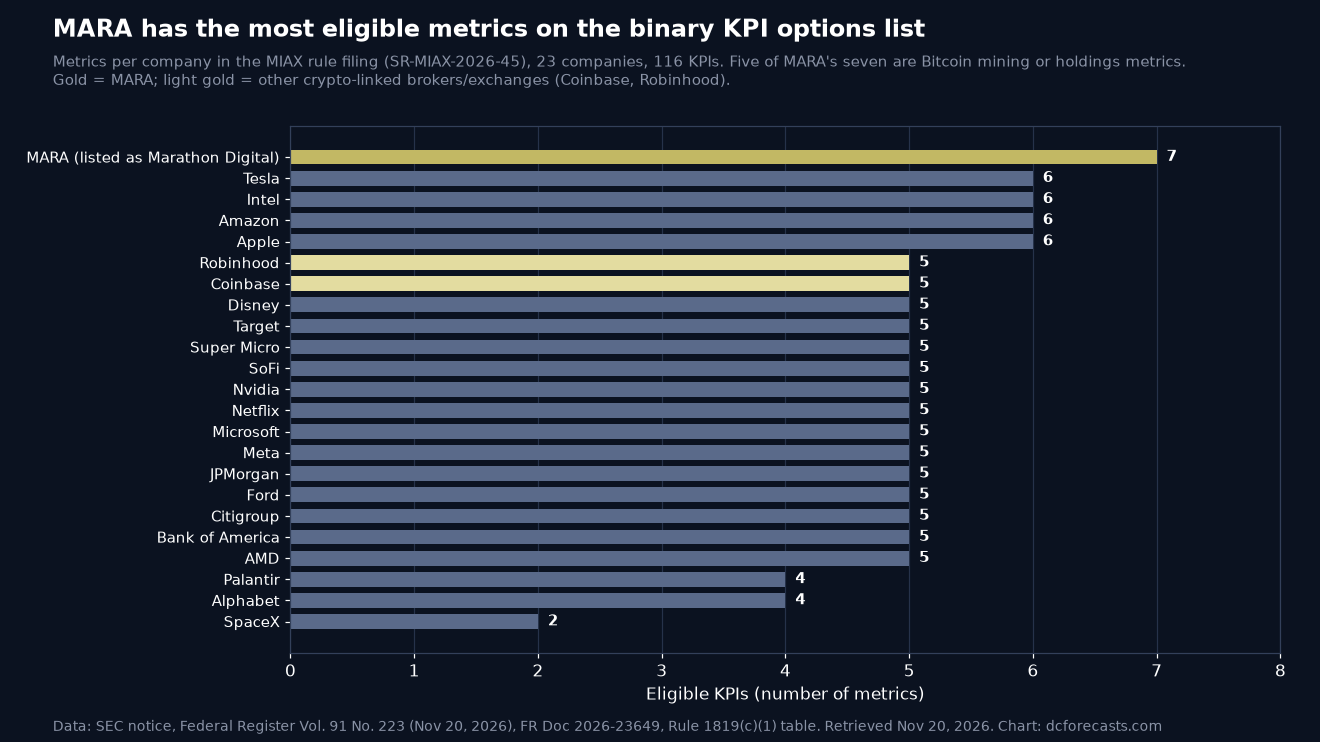
We think this matters more than the count suggests. Blocks won, hashrate and BTC produced are measured in Bitcoin’s own units, not in dollars.
That puts Bitcoin network output on the same regulated menu as Amazon’s cloud sales.
What the MARA Numbers Look Like Today
MARA’s latest shareholder letter, filed with the SEC on Nov. 9, hints at where strikes might sit.
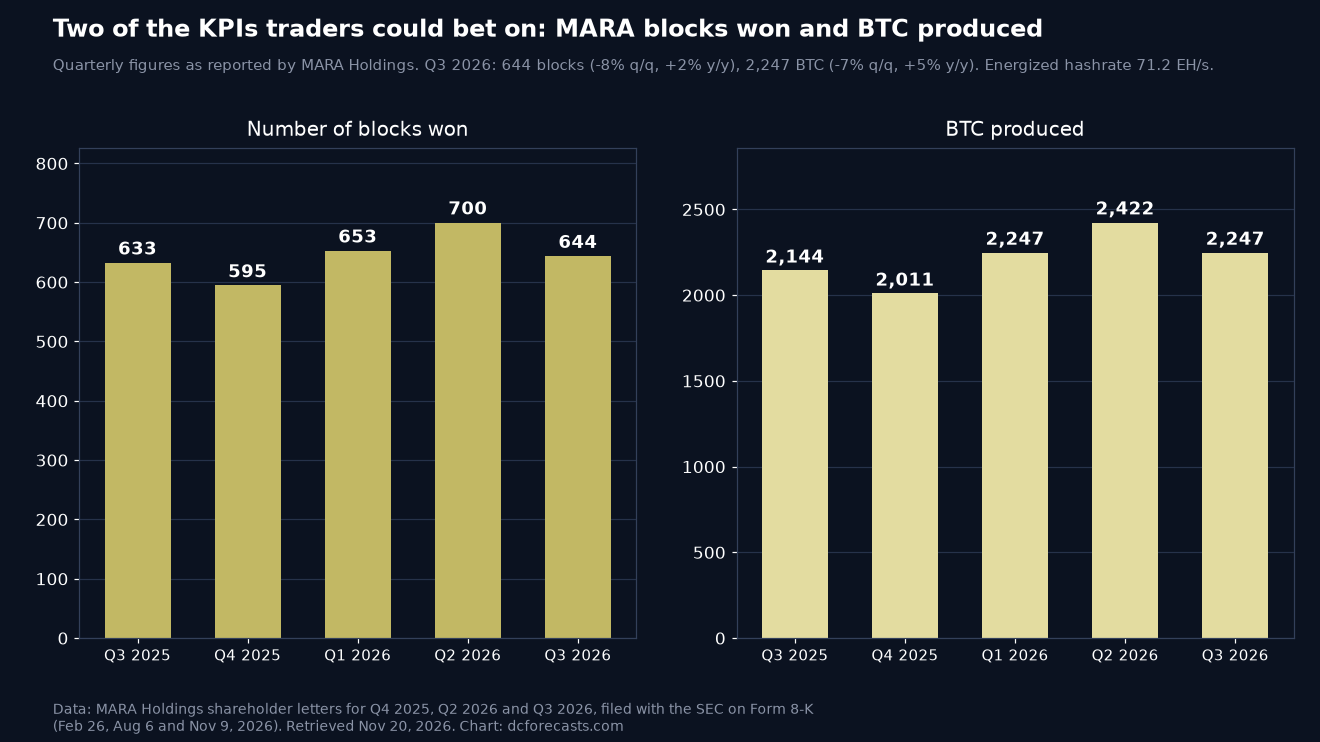
The company won 644 blocks in the third quarter, down 8% from 700 in the second quarter but up 2% from a year earlier. It produced 2,247 BTC, and its energized hashrate reached 71.2 EH/s, up 18% year on year.
MARA said it earned 5.4% of all available miner rewards in the quarter, up from 5.0% a year earlier.
The holdings and purchase metrics tell a different story. MARA held 34,012 BTC on Sept. 30 and bought none during the quarter.
After the quarter ended, it sold 13,597 BTC at about $81,039 and used $750 million of the proceeds to fully repay its Bitcoin-backed loans, as we covered in our report on MARA’s results. Those sales were part of a wider shift we tracked when MARA and Riot sold 60,845 BTC in 2026.
A contract on MARA’s year-end holdings would therefore be a live view on its treasury policy, not just on its mining fleet.
Prediction Markets Move Onto Securities Rails
Bets on company metrics already exist. Cboe’s Nov. 10 research note said they trade mainly on CFTC-regulated venues geared toward retail users.
Cboe is taking a different route. Its KPI binary options are SEC-regulated securities options, built on the listed-options framework that banks and funds already use.
That contrast is sharp right now. Event-contract venues are under heavy scrutiny, including the CFTC’s recent move against Kalshi’s Trump mention markets.
The exchanges also argue that large companies make poor targets for manipulation. MIAX says any attempt to distort a big issuer’s reported metric would cost far more than the fixed $1 payout.
Bitcoin adds its own safeguard. Every block sits on a public ledger, so a miner’s block count can be cross-checked against on-chain data.
Could Bitcoin Metrics Become a Standard Wall Street Hedge?
The appeal is easy to see. A fund could hedge a miss in MARA’s production without taking on the full swing in MARA’s stock, which also moves with Bitcoin’s price, power costs and its AI data center plans.
Contract prices could also work as a live market estimate of a miner’s output.
Real risks remain. Volume could stay thin at first, and strikes on an issuer with only quarterly disclosure leave long gaps between data points.
Still, the paperwork sends a clear signal. Five U.S. options exchanges have now won approval for, or filed, rules covering contracts that pay out on how many Bitcoin blocks one miner finds.
For an asset that began as a whitepaper in 2008, that is a meaningful step into the core of regulated finance. The next MARA earnings filing could be the first real test of how much Wall Street is willing to wager on Bitcoin’s block clock.
DC Forecasts is a leader in many crypto news categories, striving for the highest journalistic standards and abiding by a strict set of editorial policies. If you are interested to offer your expertise or contribute to our news website, feel free to contact us at [email protected]












Discussion about this post