



BitFuFu earnings for the third quarter landed on Friday, Nov. 20, with a split result: revenue collapsed 79%, yet net income more than doubled to $24.9 million.
The Nasdaq-listed Bitcoin miner booked $37.7 million in revenue for the three months to Sept. 30, down from $180.7 million a year earlier, according to its unaudited results furnished to the SEC.
Net income rose to $24.9 million from $11.6 million, or 14 cents a share against 7 cents.
The bridge between those two numbers is Bitcoin itself. BitFuFu recorded a $34.7 million gain on the fair value of its digital assets as BTC climbed through the quarter.
The bigger question for anyone watching Bitcoin mining stocks is what is left once that price effect is stripped out, and what happens when it runs the other way.
What BitFuFu Earnings Show Under the Headline
Start with the operating line. Cost of revenue was $39.7 million, about $2.0 million more than revenue, so BitFuFu posted a gross loss for the quarter.
A year earlier the same line showed a $7.2 million gross profit.
Operating expenses were small by comparison: $1.1 million for sales and marketing, $2.1 million for general and administrative costs and $0.6 million for research and development.
The company also took a $2.6 million credit loss provision. Of that, $2.05 million covers half of a prepayment tied to a pending purchase of a Bitcoin mining facility in Ethiopia, which BitFuFu said reflects uncertainty around the deal.

Then came the swing factor. Changes in the fair value of digital assets added $34.7 million, and related receivables and payables added another $1.8 million.
That is how a quarter with a gross loss turned into a $27.9 million pre-tax profit. Adjusted EBITDA, a non-GAAP measure, reached $35.0 million against $22.1 million a year ago.
We think that is worth stating plainly. This quarter’s profit was earned mainly by holding Bitcoin, not by selling hashrate.
Cloud Mining Shrinks While Self-Mining Grows
The revenue mix has flipped in twelve months.
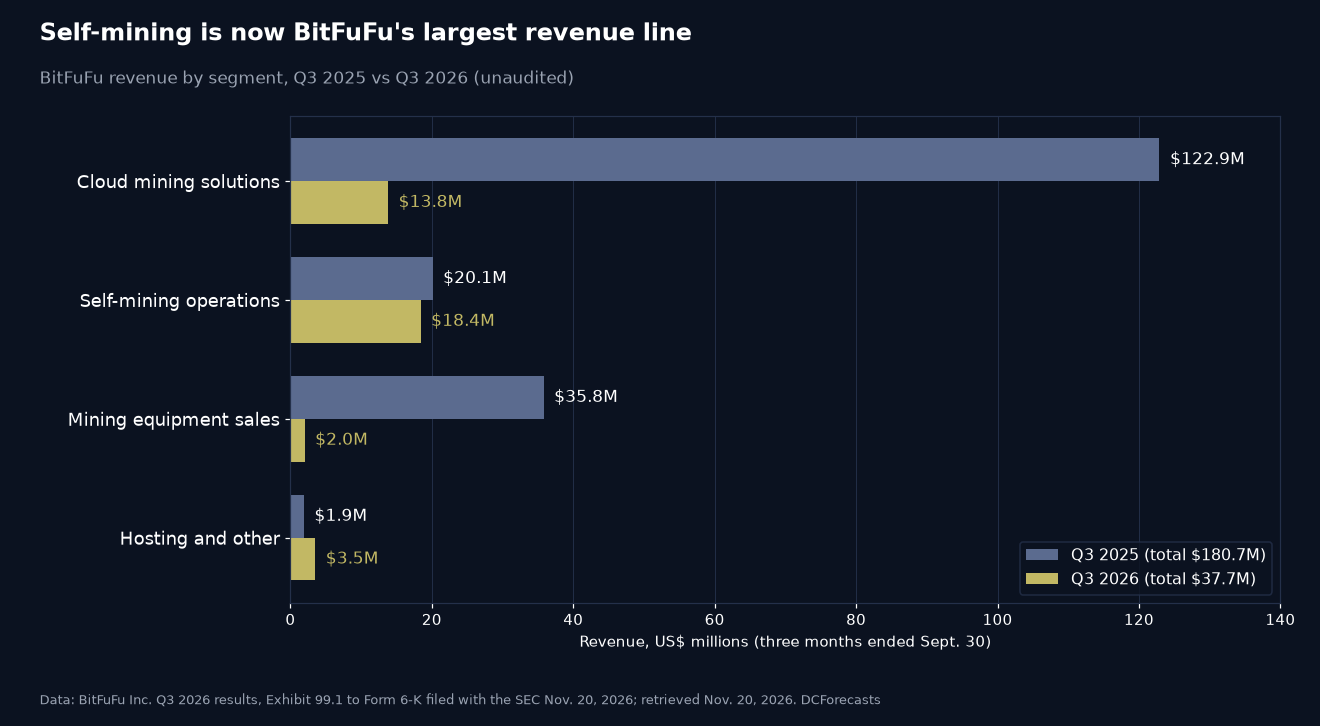
Cloud mining, where customers rent hashrate from BitFuFu, brought in $13.8 million, down 88.8% from $122.9 million. The company blamed lower selling prices tied to weaker Bitcoin prices year over year, plus softer demand.
Mining equipment sales dropped to $2.0 million from $35.8 million.
Self-mining held up far better. Revenue from BitFuFu’s own rigs was $18.4 million, close to last year’s $20.1 million, and it is now the company’s biggest revenue line at 48.8% of the total.
Output is the more encouraging number. BitFuFu mined 258 BTC for its own account, up 48.3% from 174 BTC, after lifting the average hashrate allocated to self-mining by 50.9%.
Cloud customers, by contrast, produced 195 BTC, down from 1,033 BTC.
Chairman and CEO Leo Lu said the company stayed “focused on adapting our operations to market conditions” amid “continued pressure on mining economics,” and pointed to next-generation S21 XP machines and a search for power in Central Asia, Southeast Asia and Latin America.
Why Bitcoin’s Q3 Rally Did the Heavy Lifting
The fair-value gain lines up with the market.
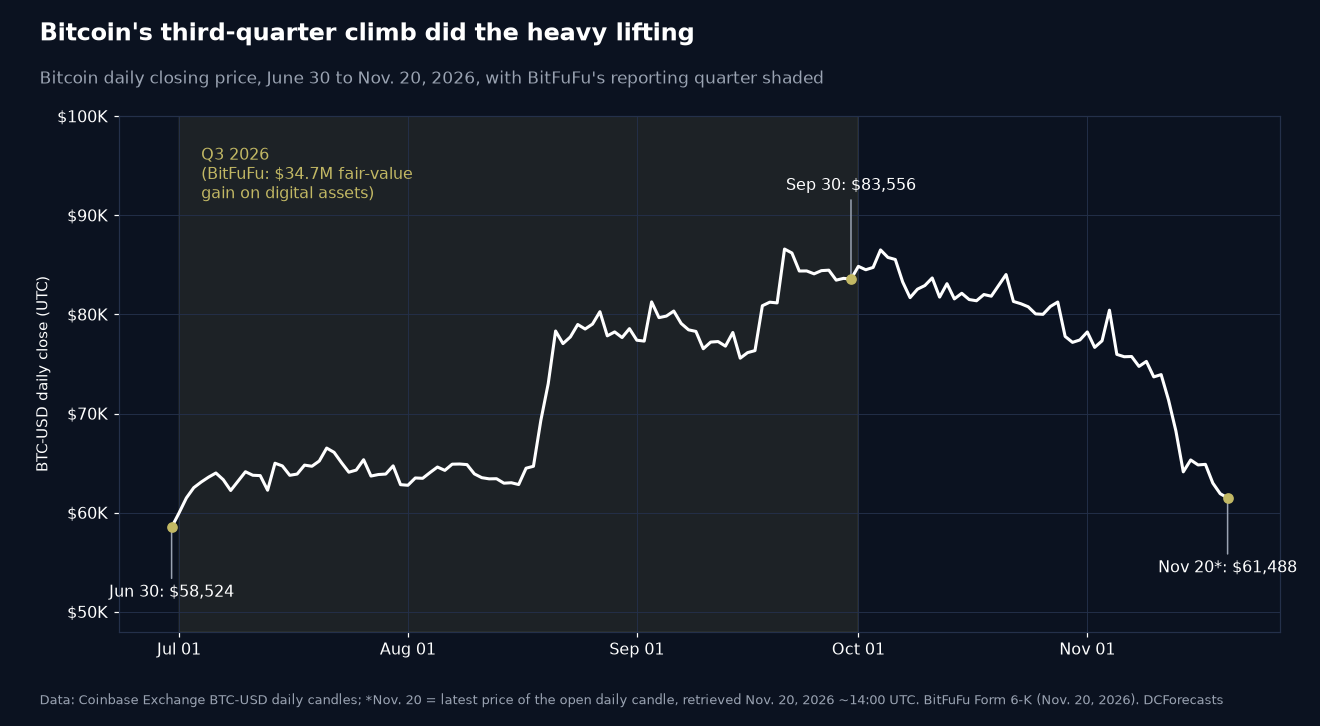
On Coinbase, Bitcoin closed June 30 at $58,524 and Sept. 30 at $83,556, a gain of about 42.8% across the quarter.
The average daily close over those three months was about $71,000, matching the average price BitFuFu cited. A year earlier that average was $114,500, and the company tied the slump in cloud mining revenue mainly to lower selling prices driven by that gap.
The honest flip side is that Bitcoin traded near $61,450 on Friday afternoon, roughly 26% below the Sept. 30 close.
If prices stay around there through Dec. 31, the same accounting line would subtract from fourth-quarter results rather than add to them. That is arithmetic, not a forecast.
The nine-month figures already show that sensitivity. BitFuFu reported a $30.6 million net loss for January to September, compared with $41.8 million of net income a year earlier.
A Smaller Stack, a Cleaner Balance Sheet
BitFuFu held 1,388 BTC at Sept. 30, down 29.3% from 1,962 BTC a year earlier. The company said it sold coins to support operations and to buy hashrate.
The stack has started rebuilding since then. As we covered when BitFuFu lifted its holdings to 1,454 BTC in October, the miner added 66 BTC in a single month.
Liabilities are lighter too. Net repayments of Bitcoin-backed loans came to $11.5 million during the quarter, and total liabilities fell to $148.6 million from $208.0 million at the end of 2025.
Cash plus digital assets stood at $145.3 million, up from $119.5 million at June 30 but below $177.1 million at the end of 2025.
The trade-off is scale. Hashrate under management fell 46.1% to 19.4 EH/s and power capacity dropped to 324 MW from 624 MW.
What FUFU Stock Holders Should Watch Next
BitFuFu is not alone in leaning harder on its own machines and its own coins. Other miners have taken different paths, from Bitdeer’s push into AI hosting to the 60,845 BTC that MARA and Riot sold this year to fund power and AI projects.
For FUFU stock, we would track three things: whether self-mining output keeps rising as difficulty adjusts, whether cloud mining demand stabilises, and whether the Ethiopia deal is resolved.
We believe the clearest takeaway is how directly this business now moves with BTC. When the coin rallied, a gross loss became a doubled profit.
That link cuts both ways in the short run. Over the long run, a miner that keeps producing and holding a fixed-supply asset is positioned to benefit if Bitcoin’s adoption keeps widening.
The next monthly production update will show whether the October rebuild continued into November.
DC Forecasts is a leader in many crypto news categories, striving for the highest journalistic standards and abiding by a strict set of editorial policies. If you are interested to offer your expertise or contribute to our news website, feel free to contact us at [email protected]












Discussion about this post