



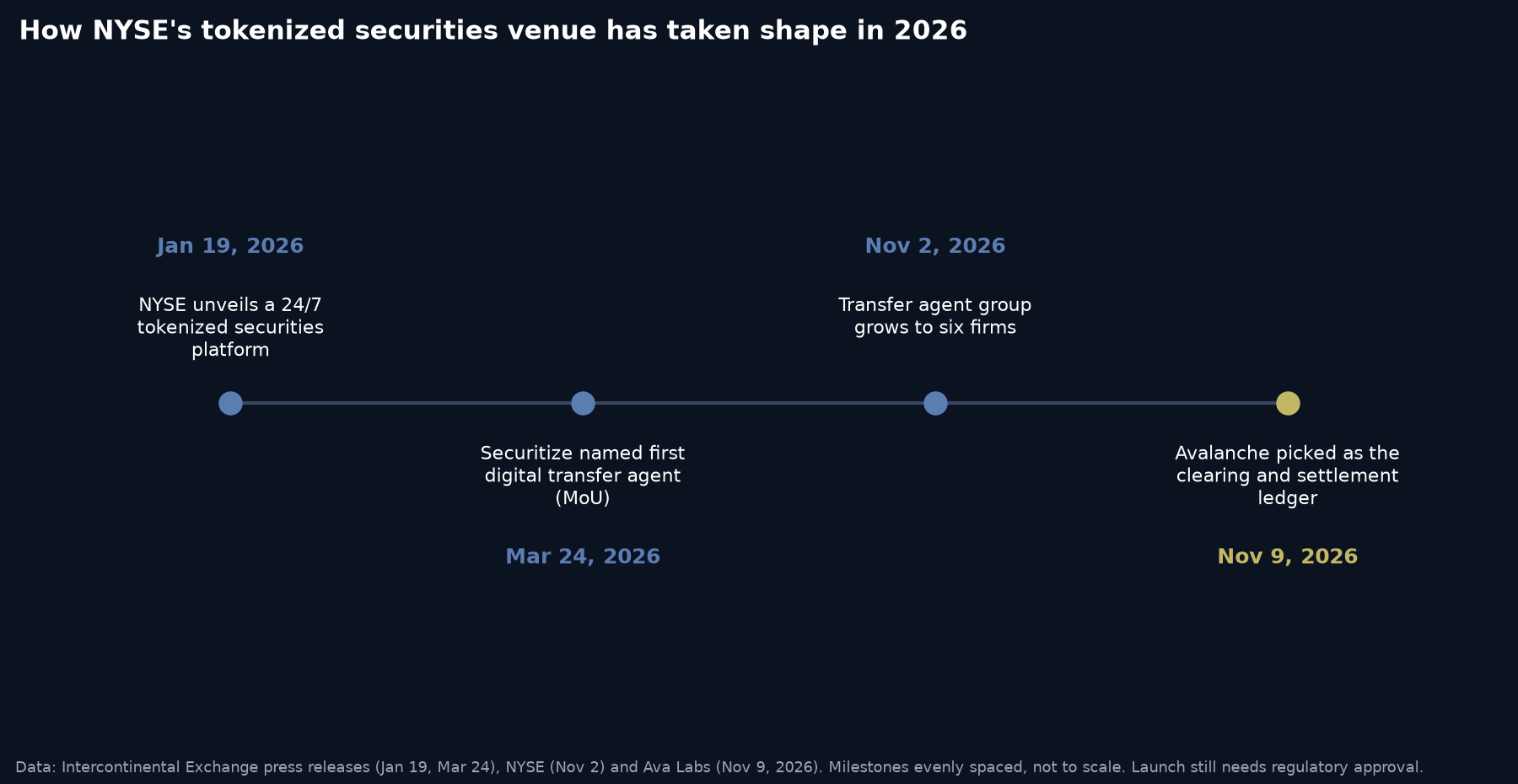
The New York Stock Exchange has chosen the blockchain that will keep the books for its planned tokenized securities venue. Ava Labs said on Monday, November 9, that Avalanche will provide the core ledger technology for the clearing firm behind the NYSE-affiliated digital trading platform.
That ledger will record and settle trades. The venue itself, still awaiting regulatory approval, is designed to run 24 hours a day, seven days a week, and to accept shares issued on several different blockchains.
The announcement went out at 8:00 a.m. New York time. Within hours, AVAX was trading near $8.72, up about 6.7% on the day according to CoinGecko, while bitcoin held close to $74,970.
What Avalanche Will Actually Do
The role is narrower, and more important, than a simple listing. NYSE is not moving stock trading onto a public chain. Orders will still be matched by Pillar, the engine that already runs the exchange group’s equity and options markets.
What changes is what happens after a trade. The clearing firm, which the Ava Labs release did not name, will use Avalanche-based infrastructure to record who owns what and to settle the deal.
Dennis Lee, NYSE’s head of digital issuance, explained the choice in the release. “The upcoming digital trading platform will support equities listed on a range of blockchains, though the ledger that records and settles trades needs to be fast and reliable, let us control who can take part, keep costs predictable, and have a large community of developers behind it,” he said. “Avalanche meets all those needs.”
Ava Labs chief executive Emin Gün Sirer said the platform’s “24/7 atomic settlement needs” would be served by dedicated infrastructure with “predictable performance and costs.” Atomic settlement means the shares and the payment change hands in one step, so neither side is left waiting.
Tokenized Securities Have Been a Year in the Making at NYSE
Monday’s news is the latest step in a plan that parent company Intercontinental Exchange laid out on January 19. That first release promised 24/7 trading, instant settlement, orders sized in dollars rather than shares, and funding with stablecoins.
ICE also said tokenized shareholders would keep normal dividend and voting rights, and that tokenized shares could be fungible with traditionally issued stock. In other words, a tokenized share is meant to be the same share, held in a new way.

On March 24, NYSE signed a memorandum of understanding with Securitize, naming it the first digital transfer agent eligible to mint blockchain-native securities on the venue. By November 2, NYSE listed six transfer agent partners: Securitize, tZERO, Superstate, Broadridge, Computershare and Equiniti.
NYSE noted that Computershare, Equiniti and Broadridge together serve close to 5,000 publicly listed companies, including nearly 99% of the S&P 500. That is the plumbing a real market needs before the first tokenized trade ever clears.
The selection also follows roughly a year of testing. At the Avalanche Summit in New York in September, Ava Labs president Charley Cooper said the exchange had studied both the technology and the business case. ICE’s head of strategic initiatives, Michael Blaugrund, said at the same event that Avalanche met many of the company’s requirements, without confirming a choice at the time.
How the Market Reacted
Traders moved quickly. AVAX had been down about 6% for the week shortly before the release, according to CoinGecko hourly data, and swung to a gain of roughly 4% by late afternoon UTC.
Bitcoin moved differently. It was down about 3.2% over the same seven days and roughly 1% on the day, still trading in the mid-$70,000 range with a market value above $1.5 trillion.
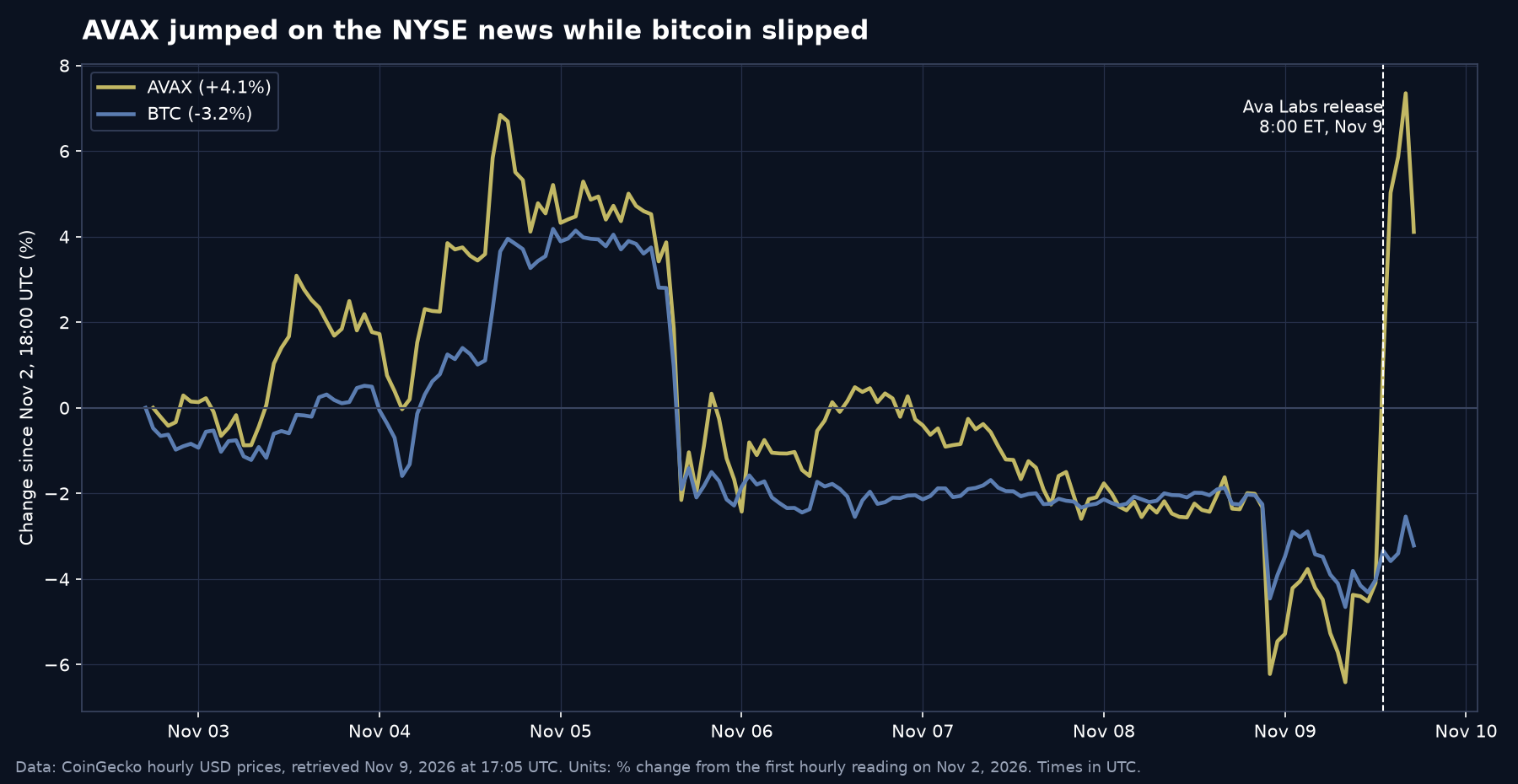
We believe the split makes sense. The NYSE news is specific to Avalanche’s business, while bitcoin is trading on broader forces such as liquidity and interest rate expectations. One headline does not change that picture overnight.
Why the 24/7 Design Matters for Bitcoin Holders
There is still a clear thread back to bitcoin. Round-the-clock trading, final settlement in minutes and money that moves outside bank hours are features Bitcoin has offered since 2009.
Now the world’s largest stock exchange is building those same features into its own venue. We see that as a strong endorsement of the model Bitcoin introduced, even if the NYSE version runs on a private, permissioned ledger.
The venue will also be funded with stablecoins, and ICE is working with BNY and Citi on tokenized deposits for its clearinghouses. As more traditional money learns to move on blockchain rails at any hour, the distance between brokerage accounts and digital assets keeps shrinking.
The same trend is showing up elsewhere. A rival tokenized securities venue is launching on Solana, Schwab has added Avalanche and other coins to its crypto lineup, and European regulators are drafting a common rulebook for tokenized assets.
What Still Has to Happen
Several key details are still missing. The platform needs regulatory approval before it can open. Ava Labs gave no launch date, and the clearing firm has not been publicly named.
It is also worth being clear about scope. Lee said the venue will support shares issued on a range of blockchains. Avalanche wins the settlement ledger, not exclusive rights to every tokenized share that trades there.
Still, we believe this is one of the clearest signs yet that tokenized securities are moving from pilot projects into core market infrastructure. The exchange that defined how Americans trade stocks is now choosing which blockchain settles them.
For bitcoin, the lesson is the long-term one. Wall Street is adopting the always-on design Bitcoin made normal, and every step in that direction makes digital assets feel less like an outsider and more like part of the financial system.
DC Forecasts is a leader in many crypto news categories, striving for the highest journalistic standards and abiding by a strict set of editorial policies. If you are interested to offer your expertise or contribute to our news website, feel free to contact us at [email protected]












Discussion about this post