


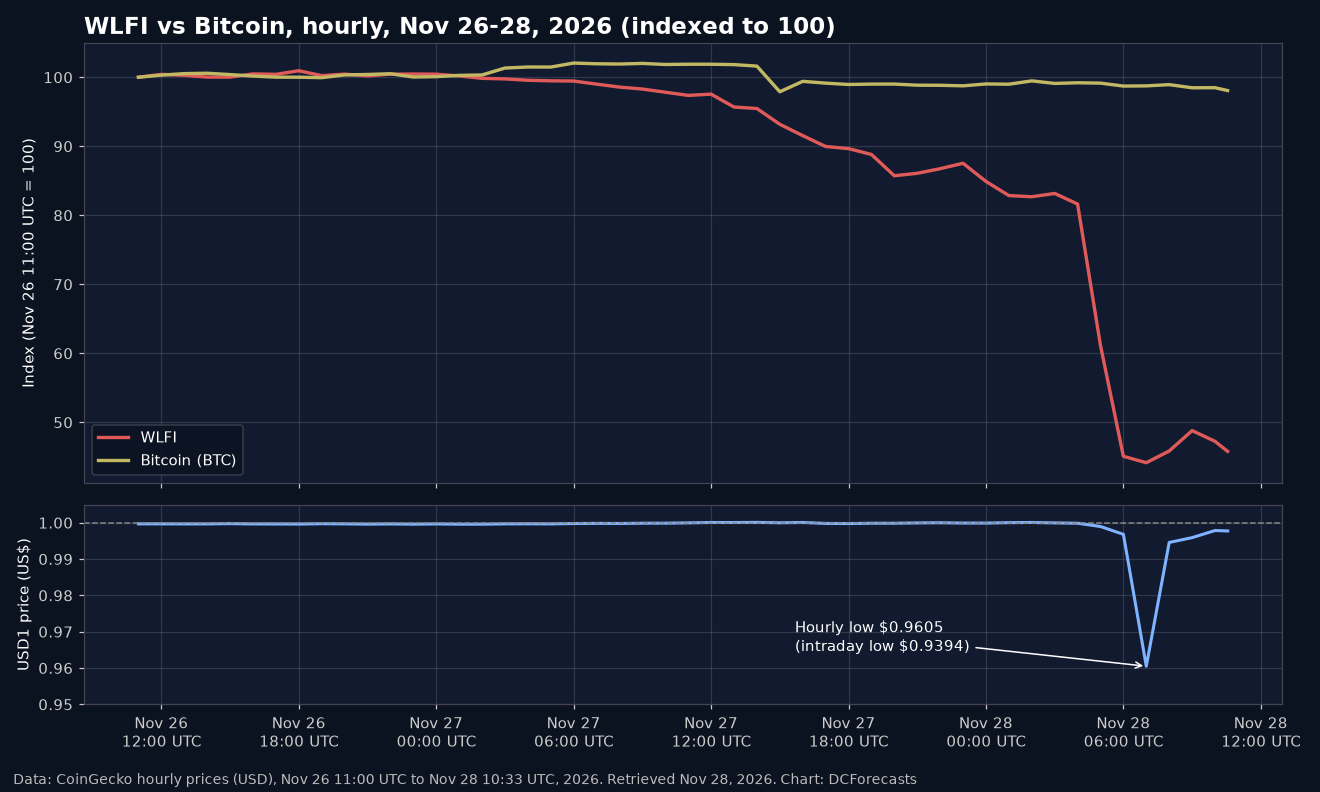
The WLFI token lost more than half its value in 24 hours on Saturday, sinking to a record low while USD1, the dollar stablecoin from the same World Liberty Financial project, briefly slipped to 94 cents.
CoinGecko data shows WLFI trading near $0.0193 at 10:32 UTC on November 28, down 53.2% from a day earlier.
The token printed an all-time low of $0.01668 at 05:46 UTC, roughly 95% below its September 2025 peak of $0.3313.
For Bitcoin holders, the most striking detail is the gap: BTC slipped 3.8% over the same 24 hours and held near $59,300.
The bigger question now is whether USD1 can keep its dollar peg as its supply keeps shrinking.
How Fast Did the WLFI Token Fall?
The slide began well before Saturday’s crash.
Hourly CoinGecko prices show WLFI drifting from about $0.0423 on November 26 to $0.0344 by 04:00 UTC on November 28, a loss of roughly 19% in two days.
Then the floor gave way. Within two hours, the WLFI price dropped to about $0.019.
Trading activity exploded with it. CoinGecko counted about $505 million in 24-hour WLFI volume, close to the token’s entire $610 million market value.

The token is now down 62% over 30 days and about 88% from its level a year ago.
What the On-Chain Record Shows
Hours before the crash, a large treasury sale drew attention.
Ethereum transaction records for a Safe multisig wallet ending in 7dBB, which blockchain trackers label as a World Liberty treasury, show a burst of swaps between 20:09 and 20:48 UTC on November 27.
In those 39 minutes, the wallet sent 10,600 wrapped ether and 1,378 mETH to the CoW Protocol settlement contract.
It received about 17.58 million USDC and 2.49 million USD1 in return, or roughly $20 million in stablecoins.
The records show 16.59 million USDC leaving the wallet soon after, along with 2.5 million USD1 sent to a router contract.
We want to separate evidence from interpretation here. The swaps are verifiable. Whether they caused the crash nine hours later is not.
Justin Sun Calls for Delistings
The selloff quickly turned into a public fight.
Tron founder Justin Sun, an early WLFI investor whose tokens World Liberty froze in 2025, posted on X at 07:23 UTC that “today’s WLFI episode is just another rerun of insider circular lending to cash out” and “unauthorized insider selling.”
He urged major exchanges, regulators, judicial authorities and courts to act against both WLFI and USD1.
Those are allegations, not findings. His post did not include wallet addresses or loan records tying them to Saturday’s move, and we could not find a public response from World Liberty at the time of writing.
Sun’s dispute with the project is not new. As we covered when World Liberty announced a WLFI buyback earlier this month, the token has struggled to hold value despite that support effort.
Why the USD1 Stablecoin Matters More
A governance token can fall 50% and remain a trading story. A stablecoin losing its peg is a different matter.
CoinGecko recorded a USD1 low of $0.9394 at 07:05 UTC, about 6% under its dollar target. By 10:32 UTC it had recovered to $0.9978.
The quick rebound is encouraging. The longer trend is harder to ignore.
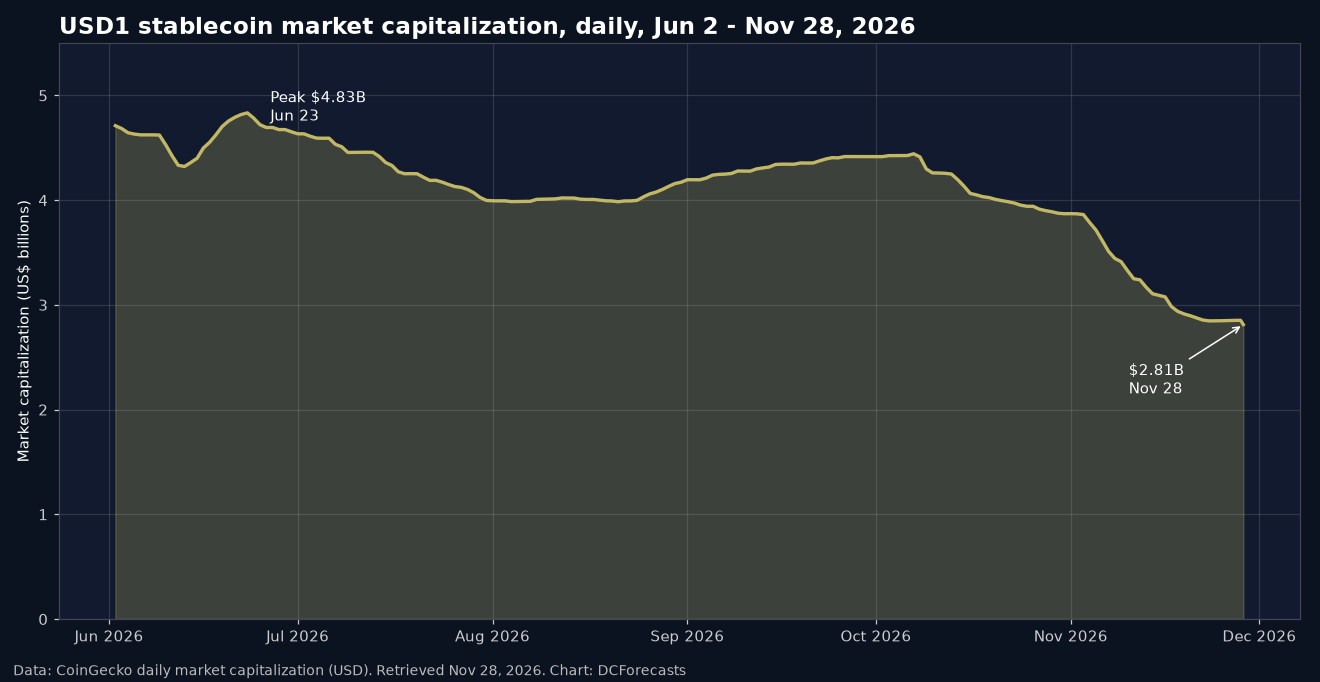
USD1’s market capitalization peaked at $4.83 billion on June 23. It stood at $2.81 billion on Saturday, a 42% decline, with $1.05 billion of that drop coming since November 3 alone.
That shrinkage came during a weak month for stablecoins in general, a backdrop we tracked in our look at how Ripple’s stablecoin grew while the market lost $17 billion.
We believe redemption data will be the real test. A stablecoin that keeps paying out a dollar per token during stress earns trust. One that wobbles repeatedly loses it.
Supply Overhang Versus Bitcoin’s Fixed Schedule
There is also a structural issue behind the WLFI token’s weakness.
CoinGecko lists about 31.7 billion WLFI in circulation against a total supply of 96.6 billion. Roughly two-thirds of the tokens are not yet trading.
Holders have to price in future unlocks, treasury decisions and governance votes made by a small group of insiders.
Bitcoin works differently. About 20.12 million BTC are already in circulation, nearly 96% of the 21 million that will ever exist, and no team, foundation or treasury wallet can sell a reserve into a falling market.
That does not make Bitcoin immune to drawdowns. It is down 26% over 30 days and trades 53% below its October 2025 record of $126,080.
But Saturday showed the difference in kind. Bitcoin’s move was a market move. WLFI’s was a crisis of confidence in the people running it.
What We Are Watching Next
For us, three signals matter in the coming days.
- Whether USD1 holds within a cent of $1 as redemptions continue.
- Whether World Liberty explains the November 27 treasury swaps.
- Whether major exchanges change WLFI or USD1 trading after Sun’s call.
We believe episodes like this tend to push capital back toward assets with transparent, predictable supply.
The WLFI token now has to rebuild trust from a record low. Bitcoin, meanwhile, spent the same day doing what it usually does in a storm: wobbling, then holding.
DC Forecasts is a leader in many crypto news categories, striving for the highest journalistic standards and abiding by a strict set of editorial policies. If you are interested to offer your expertise or contribute to our news website, feel free to contact us at [email protected]











Discussion about this post