



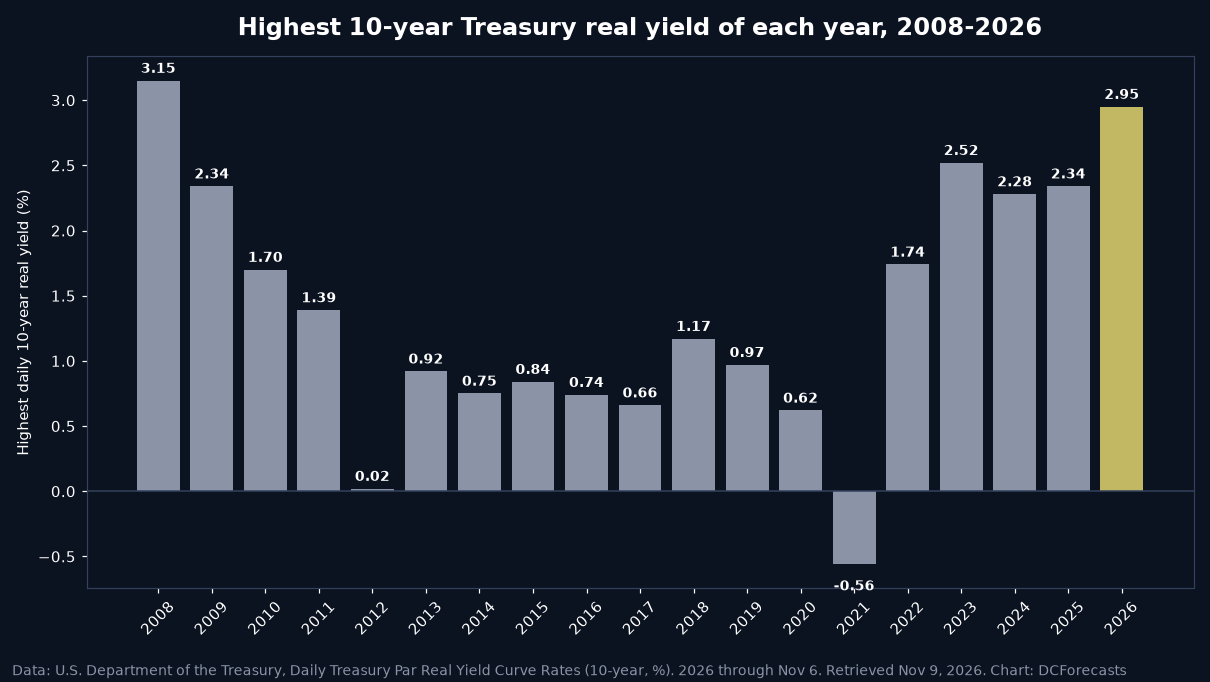
The 10-year Treasury yield, measured after inflation, climbed to 2.95% on October 5, its highest close since November 2008.
That is the rate investors could lock in on 10-year Treasury Inflation-Protected Securities, and it sat near 1.72% as recently as February 27.
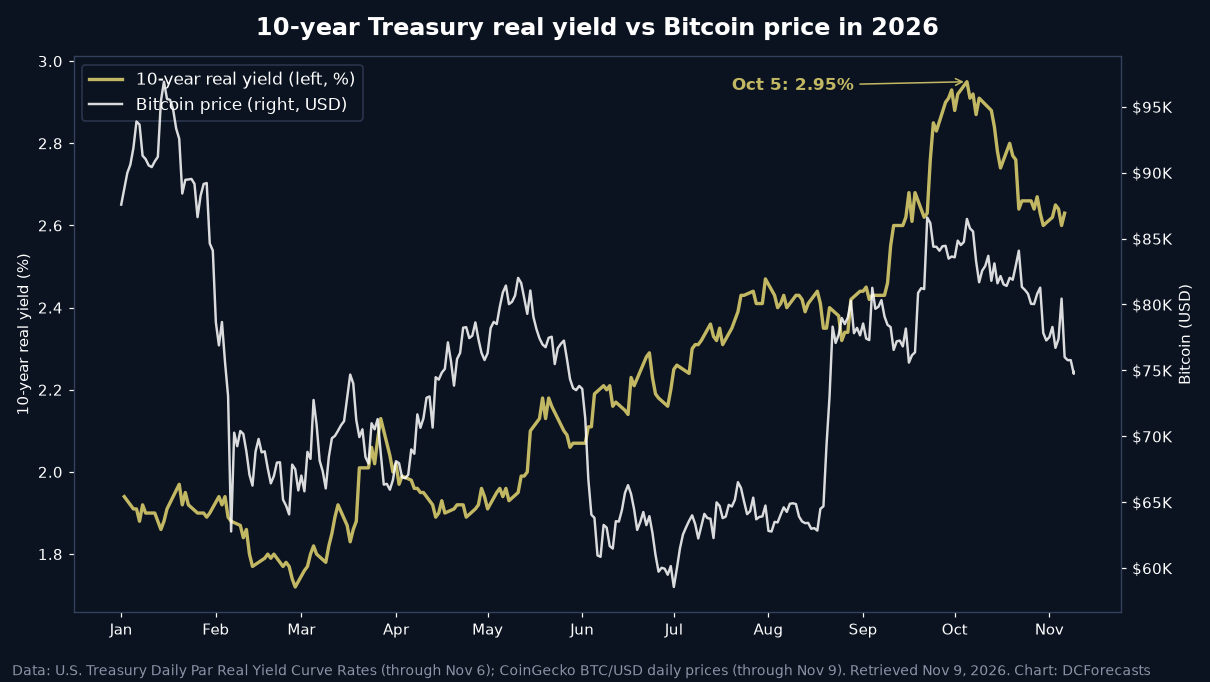
Over the same summer and autumn, Bitcoin climbed about 48%, from roughly $58,570 on July 1 to about $86,490 on October 5, according to CoinGecko daily prices.
For Bitcoin investors, that is the striking part: the toughest real-rate backdrop since 2008 did not stop Bitcoin’s biggest rally of the year.
The bigger question now is what happens as that pressure starts to ease.
What Did the 10-Year Treasury Yield Do in 2026?
We pulled every daily reading from the U.S. Treasury’s real yield curve data on November 9.
The nominal 10-year Treasury yield started 2026 at 4.19% and reached 5.31% on October 5.
The real yield, which strips out expected inflation, rose from 1.94% on January 2 to the same-day peak of 2.95%.
By November 6, the latest reading, the nominal yield had eased to 4.86% and the real yield to 2.63%.

That is a pullback of about 32 basis points in the real yield in a month.
It still leaves real rates high by the standards of the past two decades, and we think it is important to say so.
Why Real Yields Matter More Than the Headline Rate
A real yield is the return an investor earns after inflation.
When it rises, holding cash or government bonds pays more in real terms, so assets that pay no income, such as gold and Bitcoin, face tougher competition for capital.
That is why many macro traders treat the TIPS yield as a gravity gauge for scarce assets.
This year, the rise came almost entirely from real rates rather than from inflation fears.
The gap between the nominal and real 10-year yields, a rough market gauge of expected inflation, stayed in a narrow band between about 2.18% and 2.50% all year.
It was 2.25% in early January and 2.23% on November 6.
In other words, bond investors were not pricing runaway inflation, even with energy prices running hot, as we noted in our preview of Tuesday’s CPI release.
They were demanding a higher real return for lending to the government for a decade.
How Did Bitcoin Trade Against Real Interest Rates?
The 2026 record is a useful reminder that real interest rates do not set Bitcoin’s direction day to day.
From January 2 to February 27, BTC fell from about $88,760 to roughly $67,500, even though the real yield slipped from 1.94% to 1.72%.
Then, from the July 1 low to early October, Bitcoin rallied close to 48% while the real yield rose by nearly a full percentage point.
Measured week by week, we found almost no relationship at all.
The correlation between weekly changes in the 10-year real yield and Bitcoin’s weekly returns across 2026 came to about -0.03, which is effectively zero.
That cuts both ways, and we want to be clear about it.
Since October 5, real yields have eased, yet Bitcoin has also slipped about 13% to near $74,880 on November 9.
So falling yields alone are not a buy signal.
We believe the more useful read is that demand for Bitcoin has been strong enough to absorb a real-rate shock that, by this measure, matched late 2008.
Is the Real Yield Headwind Starting to Fade?
The direction has turned, at least for now.
After peaking at 2.95%, the 10-year real yield has held between 2.60% and 2.67% on every trading day since October 22.
The 30-year real yield has followed the same path, easing from 3.37% on October 5 to 3.07% on November 6.
For a non-yielding asset, a lower real return on bonds means a slightly lower cost of holding it instead.
The timing is also interesting because Bitcoin’s positioning has become lighter.
As our report on falling CME Bitcoin futures shorts showed, leveraged bets against BTC have shrunk to multi-year lows, while BTC is still trading above its 200-day moving average, near $73,180 by our calculation from CoinGecko data.
We believe that mix of easing real yields and lighter positioning gives Bitcoin a cleaner setup than it had in early October, without guaranteeing any particular outcome.
What Should Investors Watch Next?
We would keep an eye on three signals in the coming weeks:
- The TIPS yield: a move back below about 2.5% would extend the easing, while a return above 2.9% would revive the October headwind.
- The inflation gap: if the gap between nominal and real yields stays near 2.2% to 2.3% after Tuesday’s CPI data, the bond market is still treating inflation as contained.
- Bitcoin’s reaction: whether BTC can recover ground toward the $80,000 area as real rates cool, which would suggest demand is returning.
For us, the key takeaway is that Bitcoin climbed nearly 48% through the highest real yields since 2008.
An asset with a fixed supply of 21 million coins, growing institutional access and a network that keeps adding security has already shown it can rise through expensive money.
The coming weeks will reveal whether cheaper real money gives it a fresh push.
DC Forecasts is a leader in many crypto news categories, striving for the highest journalistic standards and abiding by a strict set of editorial policies. If you are interested to offer your expertise or contribute to our news website, feel free to contact us at [email protected]












Discussion about this post