


The Coldcard vulnerability now has an official paper trail. Coinkite has published an 18-page postmortem on the seed-generation flaw that let attackers drain Bitcoin from some of its hardware wallets.
The report, dated November 23 and released on the company blog on November 24, says Coinkite has logged about 300 loss-related support tickets tied to 242 customer accounts.
That is roughly 0.21% of its estimated user base. But three of its 15 safety recommendations are still open, including any decision on compensation.
For Bitcoin holders, the most useful part is what the document rules out. Bitcoin’s cryptography was never broken, and no device was taken over remotely.
The bigger question is whether self-custody tools can now prove where their randomness comes from, rather than simply trusting that it is there.
What the Coldcard Postmortem Adds
Coinkite modeled the document on an NTSB accident report. Facts sit in one section, its own analysis in another, then findings and recommendations.
The core facts match what we reported in our earlier look at the Coldcard exploit and the 15 reviews that missed it.
From March 29, 2021, to July 30, 2026, Coldcard firmware created seeds with MicroPython’s Yasmarang software generator instead of the device’s STM32 hardware random-number generator.
The new detail is the precise root cause. Coinkite says nothing in its release process verified which random-number implementation the shipping seed-generation code actually reached.

The hardware code was present in the firmware. Tests confirmed it existed and that seed words came out well formed. They never confirmed the seed path used it.
The report adds that the statistical health tests reviewed by auditor Keylabs could not tell the weak generator apart from a properly seeded one.
How Many Coldcard Users Were Hit?
Nobody knows for sure, and the postmortem says so plainly. It lists four counts that measure different things.
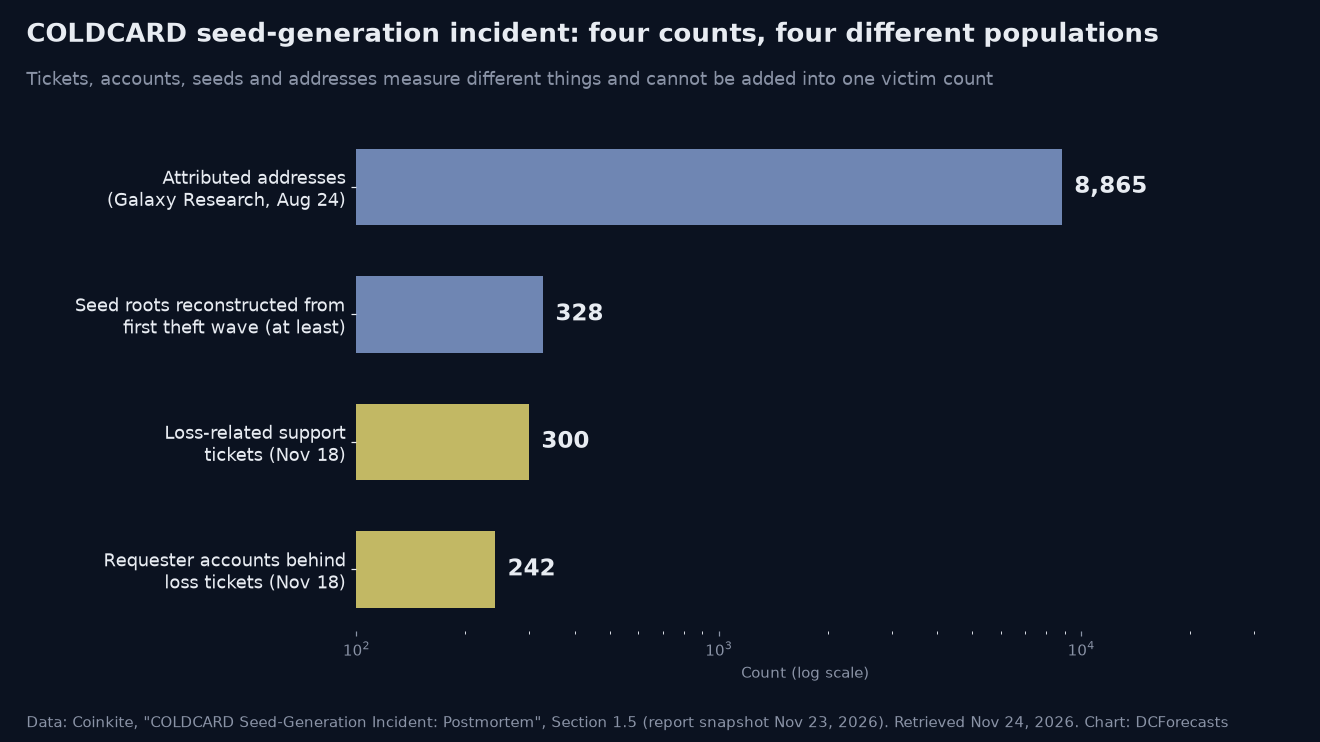
Coinkite’s support review found 300 tickets from 242 requester accounts as of November 18. Its blog post announcing the report gives a slightly lower 236 accounts.
A public analysis of the first theft wave rebuilt at least 328 seed roots. Galaxy Research attributed 8,865 addresses as of August 24.
Galaxy Research had earlier estimated 1,778.84 BTC stolen. At Bitcoin’s price near $59,800 on Coinbase on November 24, that is roughly $106 million.
Coinkite warns that the true number of victims is likely higher, because not every loss gets reported. Coldcard is non-custodial, so it can only count what customers tell it.
Why the Coldcard Vulnerability Stayed Hidden for Five Years
The report lists at least 15 review and research efforts between 2021 and 2026, including paid third-party reviews in 2022 and 2024. The firmware source was public, with 54 contributors.
A review by Nick Farrow dated June 17, 2026, explicitly covered weak randomness and concluded the path was sound. An AI-assisted review by Rob Hamilton from May to June produced 85 candidate findings but missed this one.
Coinkite also notes that developer James O’Beirne raised general quality concerns about the libNgU library in May 2025, without identifying the specific defect.
The most striking passage concerns timing. Kimi K3’s full model weights were released on July 27. The first thefts began two days later.
Coinkite calls AI-assisted discovery “a plausible hypothesis,” not an attribution. Who found and exploited the flaw remains unknown, and law enforcement is investigating.
The Canadian Centre for Cyber Security also has a separate open case, according to the report.
A Fix in One Day, and an Audit That Followed
Here is where the record is more encouraging. Coinkite identified the defect on July 30, the day thefts were reported, and shipped fixed firmware on all supported tracks on July 31.
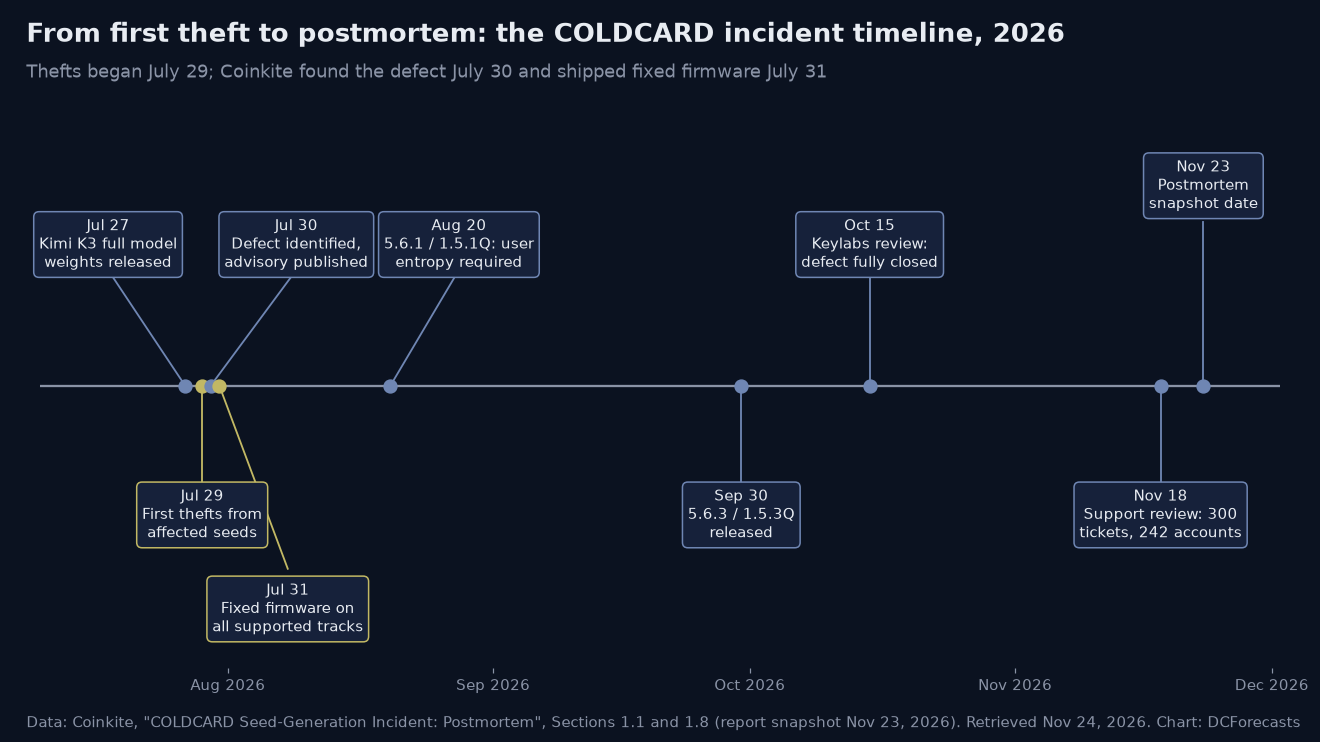
Firmware 5.6.1 in August went further. Every new seed now requires user input, such as 50 dice rolls, 128 coin flips or 65 timed key presses.
That input is mixed with output from the hardware generator and both secure elements. At boot, the device also checks that it is calling the correct hardware path, and stops if it is not.
Keylabs published an independent review on October 15. Within its stated scope, it found the July defect fully closed in Mk5 5.6.3 and 5.6.2 and Q 1.5.3Q and 1.5.2Q.
Edge releases were outside that review. Commissioning further artifact-specific audits remains one of the three open items, alongside restoring control of the company’s X account and deciding on compensation.
What Coldcard Owners and Bitcoin Holders Should Take Away
The most important line for affected users is blunt: a firmware update does not repair a seed created on affected firmware. Those funds need to move to a new seed.
Seeds generated with at least 50 fair, private dice rolls were not weakened. Coinkite also points to strong BIP-39 passphrases and multisig as extra protection for material amounts.
We believe this is the real lesson. The failure sat in one vendor’s build process, not in Bitcoin itself. The postmortem states that libsecp256k1, the cryptographic library from Bitcoin Core, was not involved.
A 128-bit seed remains far beyond brute force. The attack worked only because affected seeds had about 40 bits of real entropy on Mk2 and Mk3 devices, and an estimated 72 bits on newer models.
We also see a wider upside. After disclosure, the Bitcoin Red Team ran a 108-hour, multi-model review that produced 7,958 candidate findings across 501 projects, with 24.7% backed by reproducible proofs of concept.
For us, that pressure is healthy. As we noted when Ledger Flex drains hit users in Berlin and Dubai, wallet security is being tested harder than ever.
Verified randomness, user-supplied entropy and published audits are becoming the standard. The coming months will show whether Coinkite closes its last three recommendations, and whether the stolen coins ever move.
DC Forecasts is a leader in many crypto news categories, striving for the highest journalistic standards and abiding by a strict set of editorial policies. If you are interested to offer your expertise or contribute to our news website, feel free to contact us at [email protected]










Discussion about this post