



The world’s biggest banks have put a price on their entry into stablecoins. Goldman Sachs, Citigroup, Santander, Deutsche Bank and other financial firms have committed around $270 million to fund a joint stablecoin company for its first five years, Bloomberg reported on November 10, citing people familiar with the matter.
The money is meant to cover operating costs at the new company, which will issue a dollar-denominated stablecoin and is expected to be incorporated in the United States. The venture has reportedly been working under the name Project Faro.
It is the clearest sign yet that the 21-institution group announced in September is moving from a press release to a funded business. It also shows how seriously traditional finance now takes a market that crypto built.
From ten banks to twenty-one
The project started small. In October 2025, an initial group of ten banks said it was exploring a 1:1 reserve-backed form of digital money that would be available on public blockchains.
On September 1, 2026, the group announced it had grown to twenty-one institutions and committed to set up a new company in the second half of 2026, subject to closing conditions.
According to that announcement, the members are Bank of America, Capital One, Citi, Fidelity Investments, Goldman Sachs, PNC Financial Services, Scotiabank, TD Bank Group, Wells Fargo and WisdomTree in North America; Banco Santander, BBVA, Commerzbank, Crédit Agricole, Deutsche Bank, Lloyds Banking Group, Rabobank and UBS in Europe; MUFG Bank in East Asia; Sirius International Holding in the Middle East; and Standard Bank in Africa.
The group said its first product will be a U.S. dollar stablecoin, with a longer-term plan to issue tokens in other G7 currencies, starting with the euro. It is aiming to go to market in the first half of 2027 and intends to comply with the U.S. GENIUS Act and Europe’s MiCA rules where they apply.
What $270 million buys
Spread evenly, $270 million over five years works out to about $54 million a year. That is a meaningful operating budget for a single issuer, covering compliance, reserve management, technology and distribution.
Bloomberg did not report how the commitment is split among members. Reporting on the venture also said the group is searching for a chief executive to lead the company towards launch.

The planned use cases are broad. The September announcement listed wholesale, institutional and retail markets, including cross-border payments and the settlement of digital asset trades.
A market dominated by two crypto-native issuers
The banks are entering a market where two companies already hold most of the ground.
DefiLlama data shows about $293.4 billion in dollar-pegged stablecoins in circulation on November 10. Tether’s USDT accounts for $176.3 billion, or 60.1%, and Circle’s USDC for $70.1 billion, or 23.9%. Together, they hold about 84% of the market.
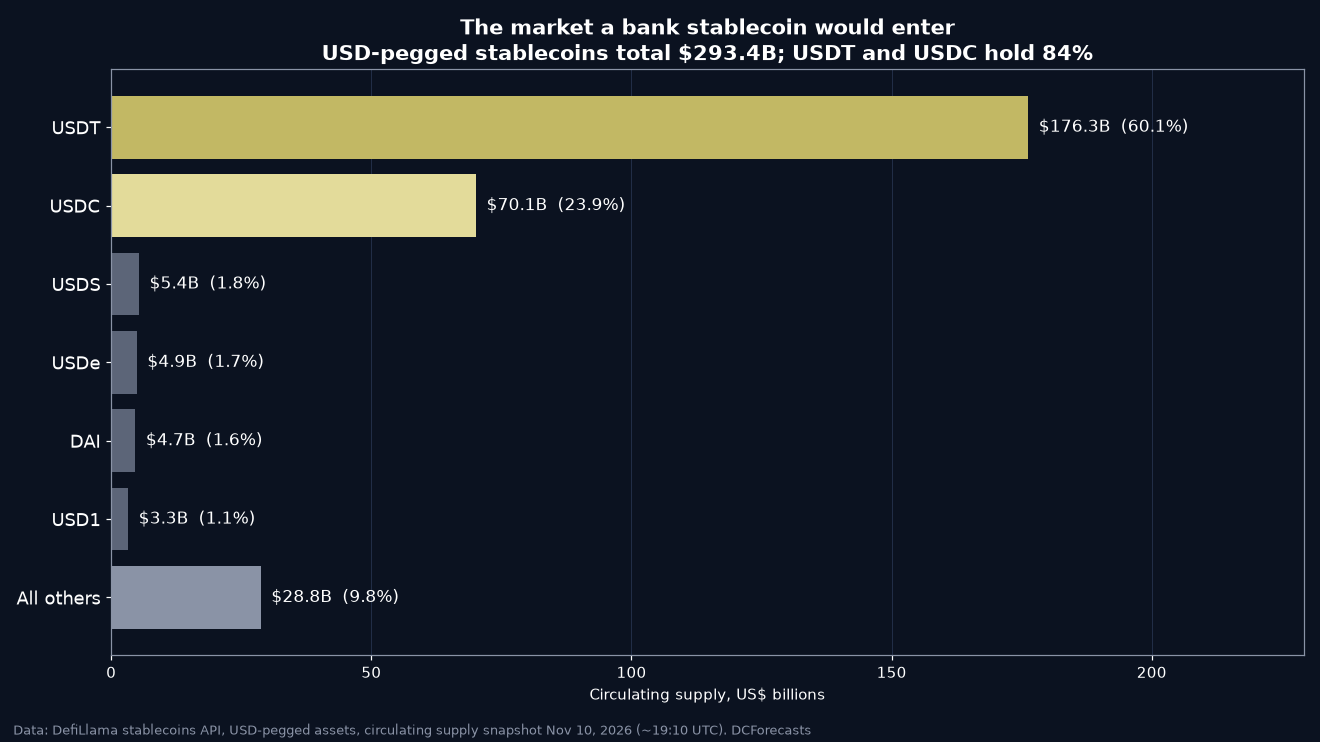
No other dollar stablecoin holds more than 2%. That gap tells you how hard it is to break into this business, and why a group with the combined customer base of the world’s largest banks believes it can do it.
The banks’ main advantage is distribution. Their existing corporate and retail clients, payment networks and compliance systems could give a new token a ready-made user base on day one.
Supply has held around $300 billion
The timing is interesting. Total stablecoin supply has hovered around the $300 billion mark for more than a year, according to DefiLlama.
It stood at about $296 billion on October 1, 2025, peaked at about $315.5 billion on May 17, 2026, and has eased back to about $292 billion as of November 10.
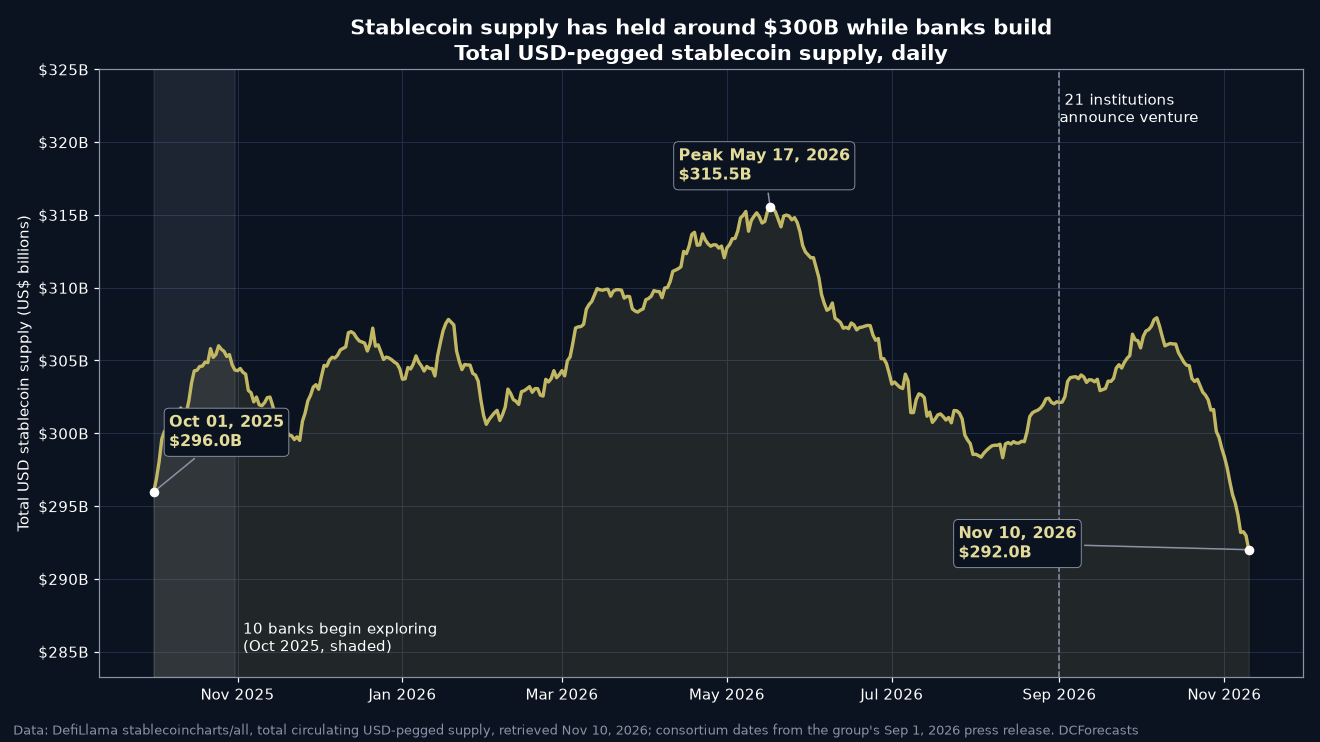
A flat market means a bank token would most likely win share by taking business from existing issuers or by opening new uses, such as bank-to-bank settlement, rather than simply riding overall growth.
Why this matters for crypto
Big banks spent years treating crypto as a risk to be managed. Now twenty-one of them are funding a company to issue tokens on public blockchains, the same networks that carry Bitcoin, Ether and the rest of the digital asset market.
The planned use for digital asset settlement is notable. A bank-issued dollar token on public chains would give institutions another regulated way to move cash in and out of crypto markets, including Bitcoin, at any hour.
The move follows a run of bank and payments activity around stablecoins. A group of 37 European banks is building a euro stablecoin to close the gap with dollar tokens, and Visa has pushed its stablecoin settlement run rate above $25 billion.
The incumbents are not standing still either. USDT’s supply on Tron alone has reached $92.3 billion across more than 413 million accounts, a reminder of how deep the network effects already are.
What to watch
The next milestones are the formal incorporation of the company, the appointment of a chief executive, and details on which blockchains the token will launch on. The group is still aiming for a first-half 2027 launch.
Whether it takes meaningful share from Tether and Circle or mainly opens new markets, a funded, bank-backed issuer adds another layer of regulated dollar liquidity on public blockchains, and that is a structural positive for the crypto market as a whole.
DC Forecasts is a leader in many crypto news categories, striving for the highest journalistic standards and abiding by a strict set of editorial policies. If you are interested to offer your expertise or contribute to our news website, feel free to contact us at [email protected]












Discussion about this post