


South Korea’s police no longer keep seized crypto on their own hardware wallets. From November 9, every investigative unit of the Korean National Police Agency sends confiscated digital assets to Upbit Custody, the custody service run by Dunamu, the company behind the Upbit exchange.
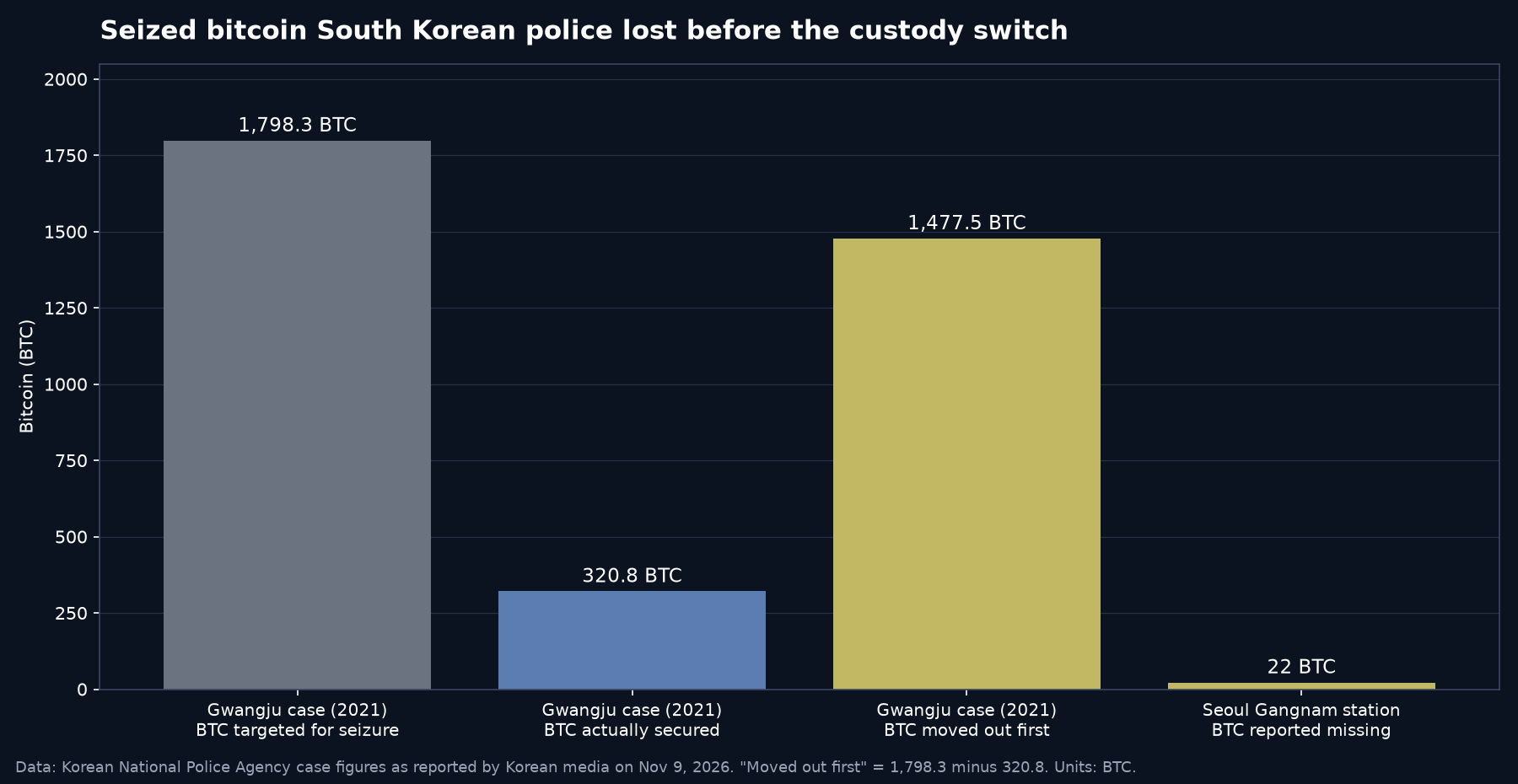
The change follows a run of losses that embarrassed the force. In one 2021 case in Gwangju, police set out to seize 1,798.3 bitcoin from an illegal gambling operation but secured only 320.8. The rest, 1,477.5 BTC, was moved out by someone who used the wallet’s recovery phrase before the transfer finished. At a bitcoin price of about $74,981, that gap is worth roughly $110.8 million today.
How the New System Works
Under the new process, seized assets go to Upbit Custody and stay in cold wallets, which are kept offline, until they are returned to their owner, provisionally released or sent on with the case file. When a case is referred for prosecution, the assets move to an account linked to the prosecution service.
According to Korean media reports of the police plan, the cold wallets use multi-party computation and distributed key generation. Both techniques split control of the keys so no single person can move the funds. The physical devices are kept in a separate secure room at Dunamu.
Dunamu will guide officers on how to move each asset over its own network, cover transfer fees and offer support around the clock, including for seizures at night. If any assets are lost while in its custody, Dunamu will cover 100% of the loss.
The police agency has sent a system manual to all investigative units, and training for officers began on November 6.
The Losses Behind the Switch
Until now, each investigative unit bought its own hardware wallets and stored seized coins itself. Officers did not always secure the recovery phrase, the string of words that can restore a wallet on any device. Anyone holding that phrase can move the coins.
The Gwangju case shows the risk. The coins that slipped away were taken during the seizure itself. The prosecutors who later received the remaining bitcoin also lost them to a phishing site before recovering them.
In Seoul, 22 bitcoin that the Gangnam police station had held in a hardware wallet were later found to have been moved out, even though the device was still in storage. Investigators handling transfers alone has also led to disciplinary action against officers and their managers.

A Long Road to an Outside Custodian
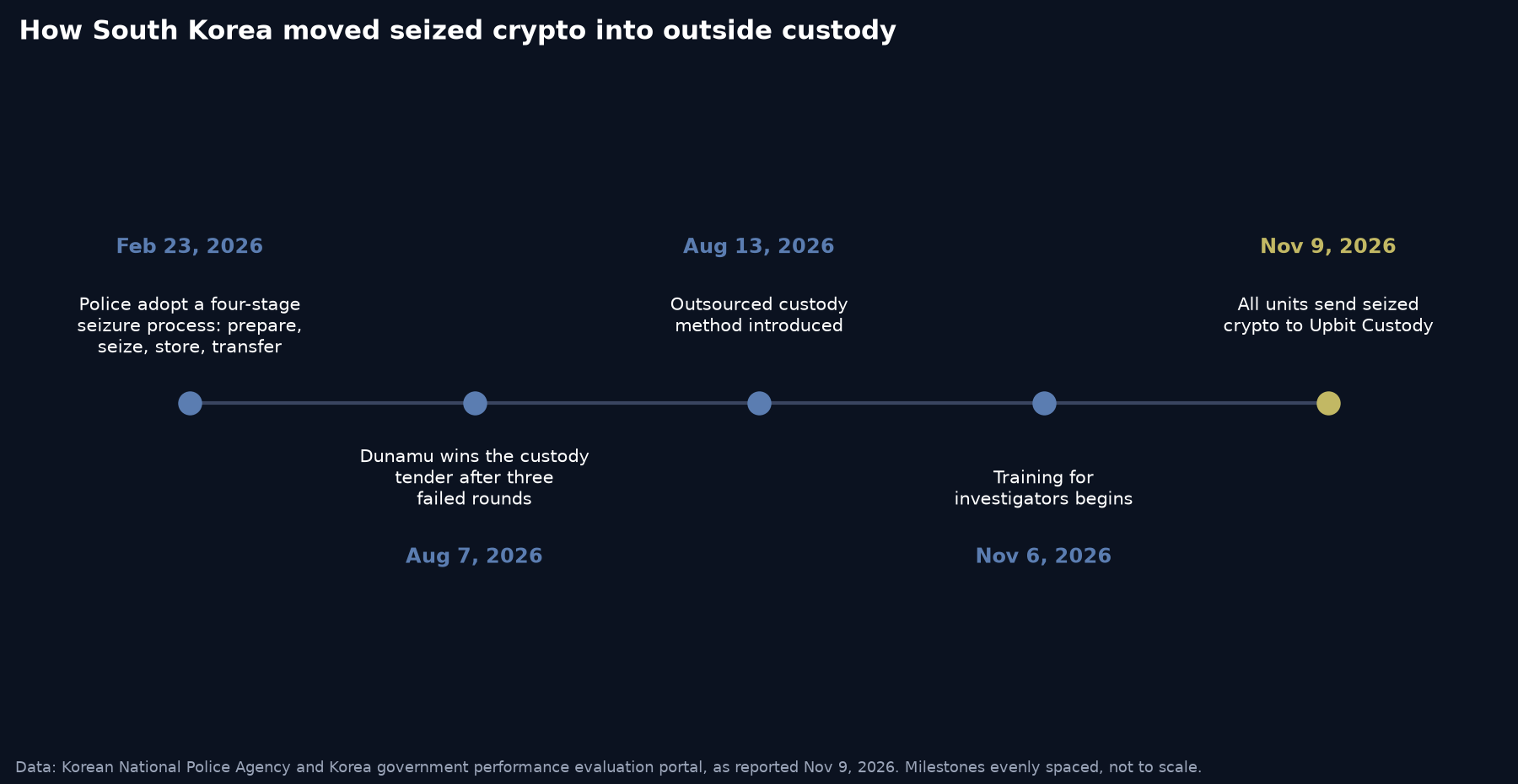
The police tried to hire a custodian three times before, and each tender failed. A fresh tender this year succeeded. Dunamu was named the winning bidder on August 7, with the top technical score of 94.14 in the government procurement review, for a one-year contract.
Korea’s government performance evaluation portal records that the police began running seizures in four stages on February 23, 2026: preparation, seizure, storage and transfer. It also records that outsourced custody was introduced on August 13. The November 9 rollout extends it to every investigative unit in the country.
What Stays Outside the Vault
Not every coin can be handed over. Privacy coins such as Monero cannot be held under the custody arrangement, so police will keep using hardware wallets for those.
The police also plan to share more information with domestic and foreign agencies on hacking and cyberterrorism. They are working toward joining the Budapest Convention, the international treaty on cybercrime, and are considering rebuilding dedicated cyber and forensic science units.
Why It Matters for Bitcoin
Governments worldwide now hold large amounts of seized bitcoin, and how they store it has become a real question. The U.S. case covered in our report on 127,271 seized bitcoin awaiting a final ruling shows how big these holdings can get. Losses have also come from inside agencies, as our report on an ex-FBI agent who admitted taking crypto from investigations showed.
Korea’s answer is the same one large holders have reached: keep keys offline, split control and require several sign-offs. That echoes the basics in our explainer on Bitcoin cold storage. When a national police force treats bitcoin with professional custody standards, it is treating it as a lasting asset class rather than a curiosity.
The compensation clause matters too. Until now, a lost coin was a loss for the state and for anyone owed those assets once a case ended. Under the new contract, the custodian carries that risk, which gives it a direct financial reason to keep the keys safe and the transfer process tight.
The next test is practical. If seized coins stop going missing from Korean evidence rooms, the Upbit Custody model could become a template for other agencies still relying on hardware wallets in a drawer.
DC Forecasts is a leader in many crypto news categories, striving for the highest journalistic standards and abiding by a strict set of editorial policies. If you are interested to offer your expertise or contribute to our news website, feel free to contact us at [email protected]












Discussion about this post