



Bitcoin lending has a new home. Hashi, the Bitcoin finance layer built for the Sui blockchain, went live on mainnet on November 19 with more than 20 custody, lending and DeFi partners lined up behind it.
The first product is simple. Holders bring BTC onto Sui as hBTC, a 1:1 Bitcoin-backed token, and post it as collateral on the Fluid lending protocol to borrow USDC.
The coins themselves stay on the Bitcoin network. Only the token representing them moves onto Sui.
For Bitcoin investors, the most interesting part is the pitch behind it: borrowing against BTC instead of selling it. The bigger question now is how much Bitcoin will actually make the trip.
What Hashi Actually Launched
According to the Sui Foundation’s launch post, Hashi keeps deposited Bitcoin on its native chain and mints the same amount of hBTC on Sui. That token can then serve as collateral for lending, borrowing and other on-chain products.
The foundation describes Hashi as decentralized by design, secured by validators rather than a single entity.
The partner list spans custody, trading and DeFi. Sui says the coalition is still growing, with the vault provider Upshift, the strategy partner HoneyB, the rewards platform Merkl and the lending protocol Current among the latest names to join.
Hashi first ran on testnet in July. In October, Sui named Anchorage Digital as a launch partner and said participants had made more than $500 million in capital commitments. Those were pledges, not Bitcoin already deposited.
The launch post also cites the law firm Fenwick as saying Hashi’s deposit and redemption mechanics should not constitute taxable events under U.S. tax law. That is a legal view, not an IRS ruling, but it removes one obvious worry for American holders.

Fluid Opens With USDC Loans Against hBTC
Fluid is the first lender in the spotlight. Its lending protocol is live on Sui, starting with Bitcoin-backed stablecoin loans in USDC, with more borrowing options promised.
“Bitcoin is the largest pool of idle capital in crypto,” said Samyak Jain, Fluid’s founder and CEO. “With Hashi, it can now power deep, capital-efficient credit markets on Fluid.”
The vault layer launches alongside it. Upshift’s vaults are live now, and HoneyB, a BTC-focused strategy partner, is offering one hBTC vault and one USDC vault on Upshift. Ember’s vaults are due later this year.
Lenders get an extra incentive. The rewards platform Merkl says USDC supplied to Fluid on Sui earns SUI token rewards on top of the lending rate.
Sui says other protocols, including Bluefin, Cetus, Current, Suilend and Blueprint Finance’s Concrete, will add Bitcoin-backed lending and yield products through the end of 2026 and into 2027.
How Much Bitcoin Already Works Off-Chain?
Hashi enters a market that already exists but remains small relative to Bitcoin itself.
CoinGecko data on November 19 showed the six largest tracked Bitcoin tokens on other chains, led by WBTC at about 116,100 BTC and cbBTC at about 107,600 BTC, representing roughly 252,000 BTC combined.
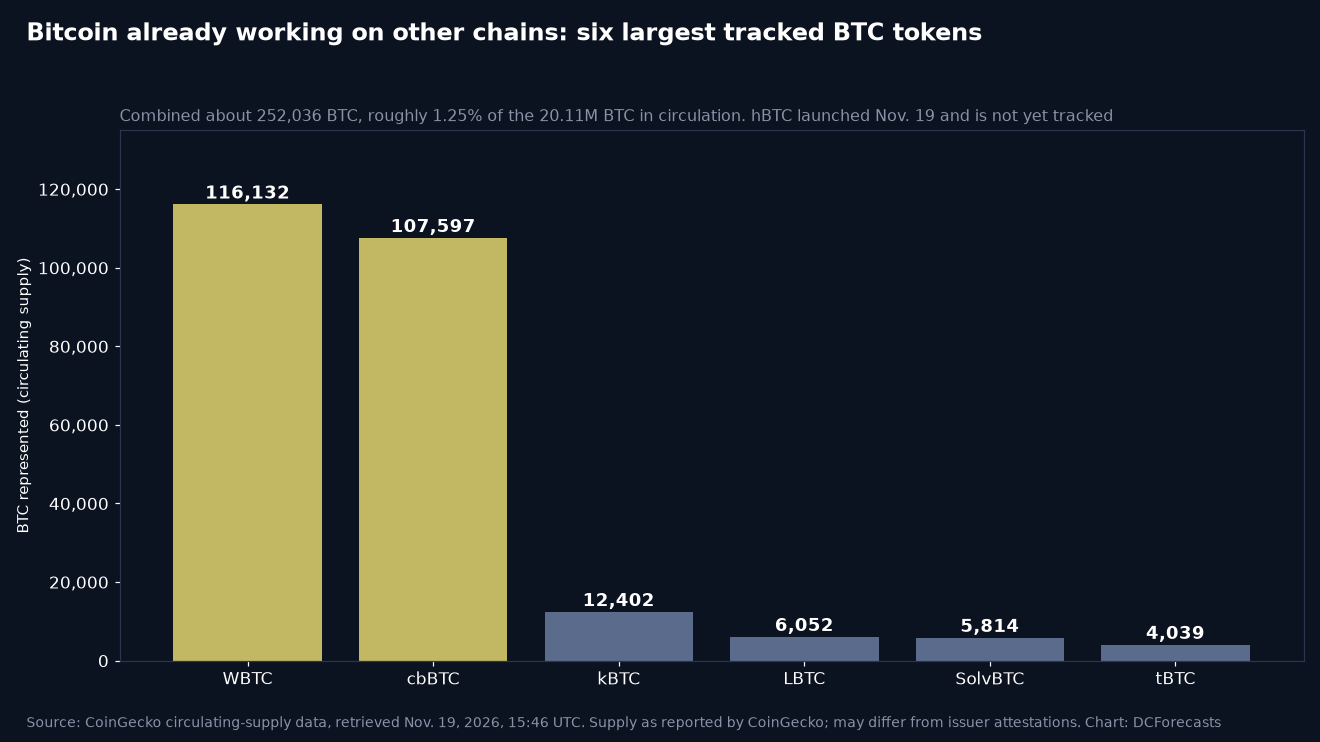
That is about 1.25% of the roughly 20.11 million BTC in circulation.
We believe that small share is the real opportunity. Nearly all Bitcoin still sits on its own chain, held as long-term savings. Even a modest shift toward collateral use would make Bitcoin-backed credit a far larger market.
It also fits a broader trend. As we reported when Bitcoin loan collateral hit a record 40,871 BTC, more holders are choosing to borrow against their coins rather than sell them.
Sui Needs the Collateral as Much as Bitcoin Holders Need the Credit
The launch arrives at a useful moment for Sui. According to DefiLlama, total value locked across Sui DeFi was about $364 million on November 19, down from about $1.14 billion a year earlier.
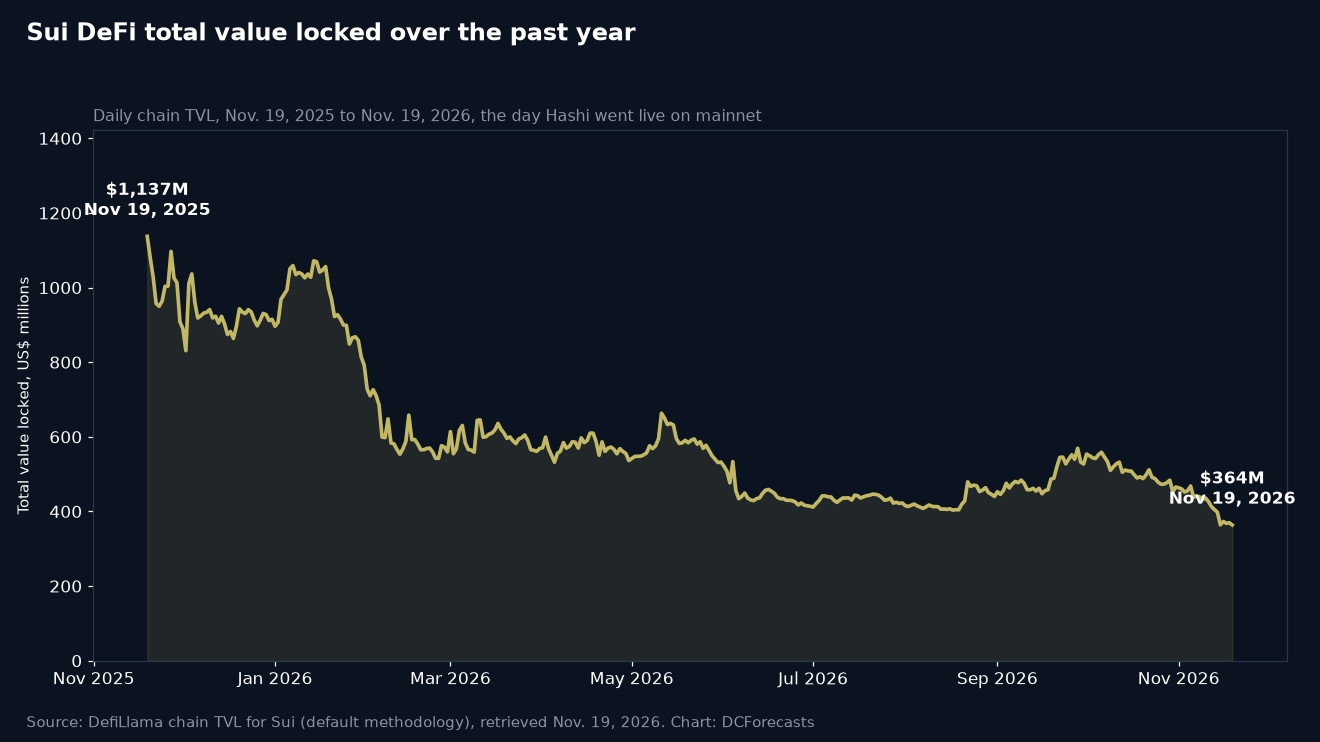
That decline is a fair caveat. New lending markets need deep liquidity, and Sui’s DeFi base is smaller than it was a year ago.
It also explains the push. Bitcoin is the deepest pool of collateral in crypto, and chains that can attract even a small slice of it gain a steady anchor for their lending markets.
Users should weigh the trade-offs honestly. Holding hBTC adds bridge, signer and smart-contract risk that plain self-custody does not carry, and borrowing against a volatile asset brings liquidation risk if prices fall.
Institutions Get the Custody They Asked For
The institutional side may matter most. Institutions can access hBTC and selected Fluid strategies through Porto, Anchorage Digital’s self-custody wallet.
“Hashi gives our institutional clients a new way to access Bitcoin finance on Sui, with their BTC held in custody at Anchorage Digital Bank,” said Nathan McCauley, Anchorage Digital’s CEO and co-founder.
BitGo access, tri-party settlement and more integrations are slated for early 2027. Cumberland and Wave Digital Assets are named as early liquidity providers. Anchorage’s role is growing quickly, as shown when its vaults began margining Kalshi perpetual futures with Bitcoin.
With Bitcoin trading near $62,800 on CoinGecko data, many long-term holders face a familiar choice between selling to raise cash and sitting tight. Bitcoin lending offers a third path.
The coming months will show whether those $500 million in pledges turn into real hBTC deposits. If they do, Bitcoin’s role as the base collateral of digital finance will only grow stronger.
DC Forecasts is a leader in many crypto news categories, striving for the highest journalistic standards and abiding by a strict set of editorial policies. If you are interested to offer your expertise or contribute to our news website, feel free to contact us at [email protected]












Discussion about this post