


Hong Kong’s Securities and Futures Commission has added Hyperliquid to its public list of suspicious virtual asset trading platforms. The entry, dated Nov. 18, 2026, names “Hyperliquid / Hyperliquid Hong Kong” and lists the web address of the venue’s trading app.
The listing is a public warning, not a court order or a fine. Still, it gives Hong Kong investors a clear signal from the city’s markets regulator about where it believes the licensing line sits for crypto trading. It also lands while Hyperliquid is one of the busiest on-chain derivatives venues, and Bitcoin is easily its largest market.
What the SFC Entry Says
The SFC alert entry places Hyperliquid in the “Suspicious virtual asset trading platforms” category. The address field is blank, and the only website listed is the platform’s trading page.
The remarks state that the platform “is not licensed by the SFC and is suspected of operating, or holding itself out as operating, a virtual asset trading platform in Hong Kong and/or actively marketing its services to the Hong Kong public.”
That wording covers two separate ideas. One is running an unlicensed trading venue in the city. The other is marketing to Hong Kong users from elsewhere. Either can bring a platform onto the list, and the entry doesn’t say which one the SFC had in mind.
The regulator also repeats its standard caution for this category. It warns that people who trade on unlicensed platforms could lose their whole investment, and that getting money back can be hard if something goes wrong.
A Busy List This Autumn
Hyperliquid isn’t the only name the SFC has added recently. Its alert list shows BTCC was added on Oct. 22, 2026, and a platform called Vebit on Sept. 22.
The difference this time is Hyperliquid’s size. It runs a fully on-chain order book for perpetual futures, and it has become one of the main places where traders take leveraged positions on crypto prices without a central exchange holding their funds.
That design is exactly what makes it hard to fit into a licensing system built for centralized exchanges. Hong Kong licenses virtual asset trading platforms that hold client assets and run order books under SFC supervision. A decentralized venue that users reach through a web app doesn’t fit that template, and the SFC has now said publicly that it sees a problem.

Bitcoin Dominates Hyperliquid’s Trading
A snapshot of Hyperliquid’s public market data shows how central Bitcoin is to the platform. At 18:08 UTC on Nov. 19, the venue listed 235 perpetual futures markets. Their combined open interest was about $6.66 billion, and 24-hour trading volume was about $5.84 billion.
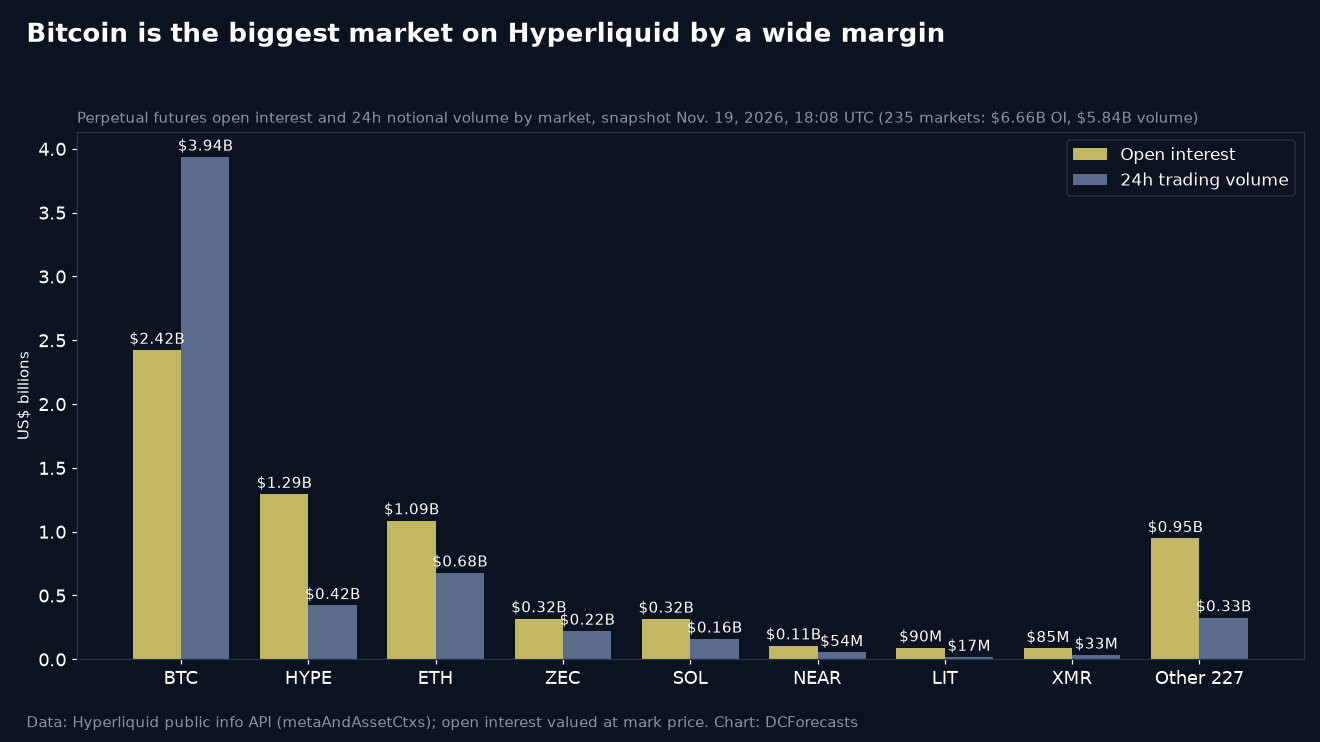
Bitcoin accounted for roughly $2.42 billion of the open interest, or about 36%. Its daily volume was about $3.94 billion, about 67% of everything traded on the venue in the past 24 hours.
The next largest market by open interest was HYPE, the platform’s own token, at about $1.29 billion. Ether followed at about $1.09 billion. Zcash and Solana were each near $0.32 billion. All of the 227 smaller markets combined held about $0.95 billion.
Even on a venue with hundreds of listings, the biggest share of money and trading still goes to Bitcoin.
What Changes for Hong Kong Traders
The alert list doesn’t block a website on its own, and it doesn’t freeze anyone’s funds. It is the SFC’s way of telling the public that a platform hasn’t got a licence and that the regulator is concerned about it.
For Hong Kong residents, the practical message is that the SFC wants them to use licensed platforms. The regulator publishes a register of licensed virtual asset trading platforms on its website, and those firms can offer Bitcoin trading under local rules on custody, client asset segregation and conduct.
That regulated route has been growing. Hong Kong has spent the past few years building a framework for digital assets, including the round-the-clock tokenized deposit settlement that went live with a dozen banks. The SFC’s warnings about unlicensed venues are part of the same push to bring crypto activity inside the rules.
For Bitcoin, that is a positive trend. A city that licenses Bitcoin trading, publishes who is allowed to offer it and warns the public about everyone else is treating the asset as a market worth protecting, not one to push away.
A Wider Policy Question for Hyperliquid
The Hong Kong warning comes as Hyperliquid deals with policy questions in other places too. Its policy group recently asked the US derivatives regulator to draw a clear line between event contracts and gambling. The platform was also part of a recent case in which a former Robinhood engineer admitted trading Hyperliquid perps ahead of coin listings.
Regulators are working out how to apply investor protection rules to trading that happens on a blockchain. Hong Kong’s answer, for now, is to name the platform and steer residents toward licensed firms.
The SFC hasn’t announced any further action against Hyperliquid, and the alert entry is the only official statement so far.
The Bottom Line
Hong Kong’s markets regulator has formally flagged Hyperliquid as a suspicious, unlicensed trading platform. The step is a warning, not a penalty, but it makes the SFC’s position clear: crypto trading aimed at Hong Kong residents should go through licensed venues.
Meanwhile, Hyperliquid’s own data shows Bitcoin carrying two-thirds of the platform’s daily volume. Whether traders use licensed exchanges in Hong Kong or decentralized venues elsewhere, Bitcoin remains the market at the center of it all.
DC Forecasts is a leader in many crypto news categories, striving for the highest journalistic standards and abiding by a strict set of editorial policies. If you are interested to offer your expertise or contribute to our news website, feel free to contact us at [email protected]












Discussion about this post