


Thanksgiving falls on Thursday, Nov. 26 this year, according to the U.S. Office of Personnel Management’s federal holiday calendar. Bitcoin heads into it on a rough patch, down 19.7% so far in November.
So is the holiday week a turning point or a trap? We pulled Coinbase daily closing prices for every Thanksgiving since 2015 to find out. The answer is that the week itself has been a coin flip. What came after has mostly been kinder to holders.
Bitcoin was higher 90 days after seven of the last 11 Thanksgivings, with a median gain of 20.2%.
Bitcoin’s Thanksgiving Week Record Since 2015
We measured two windows. The first is the full Thanksgiving week, from the Friday close before the holiday to the Black Friday close. The second is the long-weekend stretch, from the Wednesday close to the close on Cyber Monday, when U.S. desks are thin.
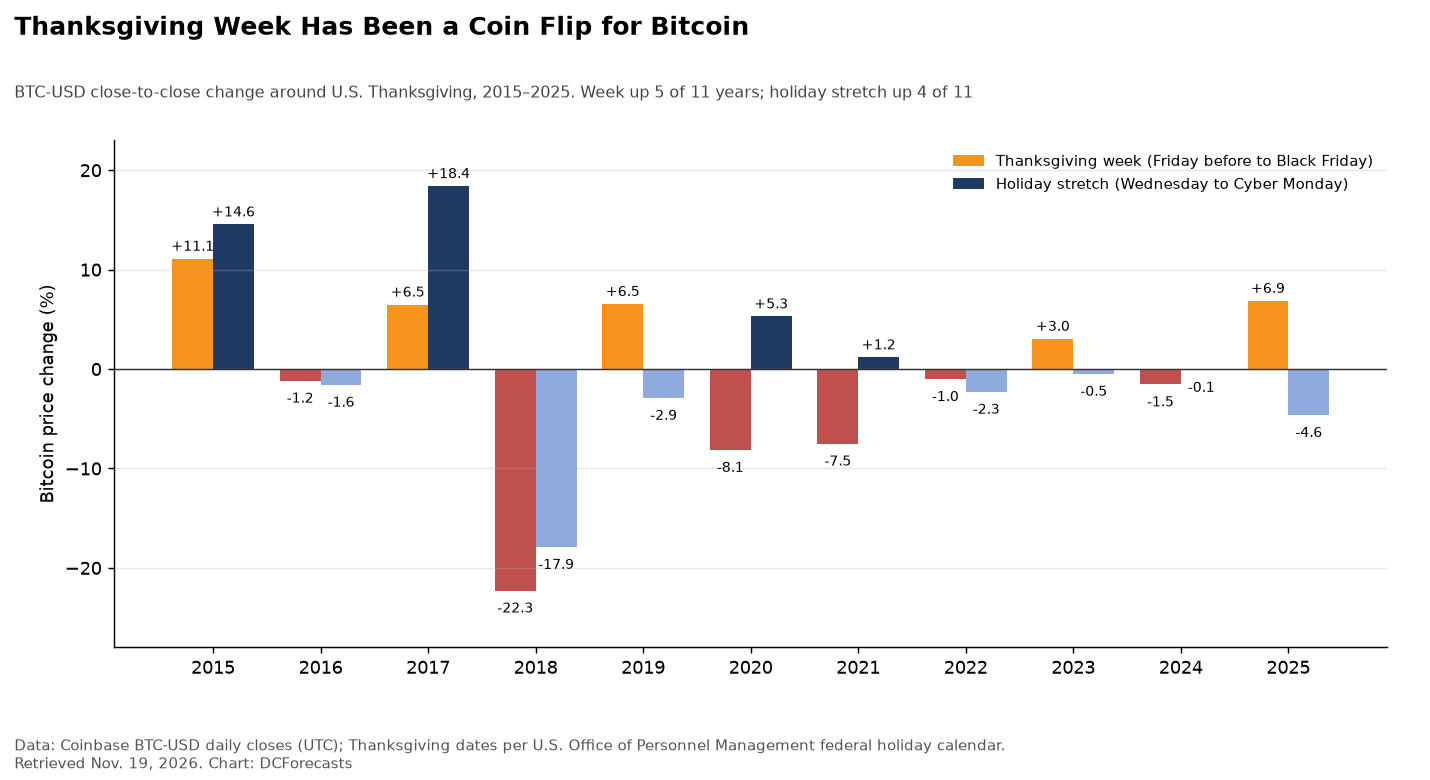
Thanksgiving week was positive in five of 11 years. The median move was -1.0% and the average -0.7%. The holiday stretch was positive in only four years, with a median of -0.5% and an average of +0.9%.
In other words, there is no reliable holiday rally and no reliable holiday slump. Most years the move was small. In six of the 11 years, the long-weekend stretch moved less than 3% in either direction. With U.S. stock markets closed on Thanksgiving Day and closing early on Black Friday, Bitcoin often drifts while traditional markets are away.
The Big Holiday Moves Came in Trending Markets
The outliers tell a clearer story. They tended to amplify whatever trend was already in place.
In 2017, Bitcoin closed at $8,250 the day before Thanksgiving and $9,768.71 on Cyber Monday, an 18.4% jump in five days. It kept running to a close of $19,378.99 on Dec. 17 that year. In 2015, a quieter bull phase, the holiday stretch added 14.6%, lifting the price from $328.98 to $376.86.
The worst case was 2018, in the middle of that year’s bear market. Bitcoin fell from $5,512.24 on the Friday before Thanksgiving to $4,283.80 on Black Friday, a 22.3% drop. Even then, the low was close. The cycle bottom came on Dec. 15, 2018, as we noted in our latest cycle check.

2020 showed how fast holiday sentiment can flip. Bitcoin slid to $17,170 on Thanksgiving Day, then recovered to $19,713.94 by Nov. 30. That was the start of the run that took it above $49,000 by late February 2021.
What Happened in the 90 Days After Thanksgiving
Stretch the window out and the picture tilts in Bitcoin’s favor.
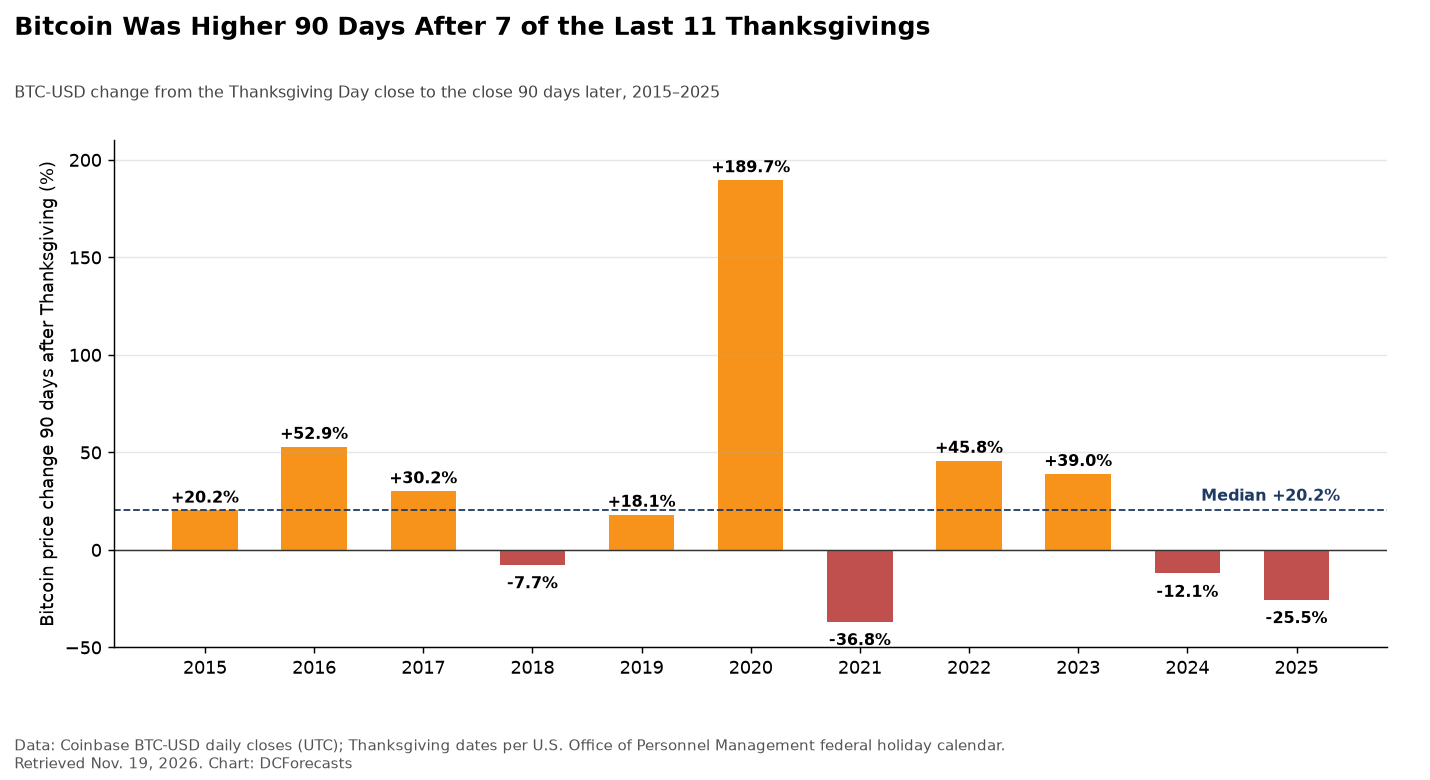
Bitcoin was higher 90 days after Thanksgiving in seven of 11 years. The median gain was 20.2%, and the average was 28.5%. The best result came in 2020, at 189.7%. The 2016, 2022 and 2023 holidays were each followed by gains of 39% or more.
The 30-day window was closer to even. Bitcoin rose in six of 11 years, with a median move of +1.5%, but an average of +15.7% thanks to big Decembers in 2017 and 2020.
The four losing 90-day windows were 2018, 2021, 2024 and 2025. In 2021, the holiday came just over two weeks after the November peak, and Bitcoin was 36.8% lower by late February. The 2024 and 2025 cases were milder, at -12.1% and -25.5%.
What the Record Says About 2026
This year’s setup looks more like the stressed holidays than the euphoric ones. Bitcoin closed at $62,175.62 on Nov. 18 and traded near $62,728 early on Nov. 19, down about 2.6% over 24 hours, according to CoinGecko.
That matters because the strongest post-holiday rebounds often started from beaten-down levels. The 2022 holiday arrived three days after that cycle’s low at $15,760. Bitcoin then gained 45.8% over the next 90 days. In 2019, after an 18.9% slide from the end of October to Thanksgiving, the following 90 days still delivered an 18.1% gain.
A weak November does not guarantee a weak winter. Of the five years when Bitcoin entered Thanksgiving below its Oct. 31 close, two produced 90-day gains, but the one-year results were stronger. Three of the four with a full year of data, 2018, 2019 and 2022, ended the following 12 months up 70% or more.
The usual caveat applies. Eleven holidays is a small sample, and the calendar alone does not move markets. Technical signals still matter, including the death cross we flagged for December. So does where the selling is coming from, as our look at Bitcoin’s Asian-hours sell-off showed.
Patience Has Paid More Than Holiday Timing
Across all 10 Thanksgivings with a full year of data, Bitcoin was higher 12 months later seven times, with a median gain of 118.7%. That lines up with our study showing no four-year Bitcoin hold since 2015 has lost money.
The takeaway for the holiday is simple. Trying to time the long weekend has been a guessing game, with gains and losses split almost evenly. Holding through the season has been a far better bet. With Bitcoin about 50% below its October 2025 peak, history suggests the more useful question is not what happens by Cyber Monday, but where the price sits by spring.
DC Forecasts is a leader in many crypto news categories, striving for the highest journalistic standards and abiding by a strict set of editorial policies. If you are interested to offer your expertise or contribute to our news website, feel free to contact us at [email protected]












Discussion about this post