


Institutional clients of Anchorage Digital can now post bitcoin held at the bank as margin for Kalshi perpetual futures, without selling it, wiring it or moving it to a new custodian.
The two firms announced the tie-up on Nov. 17.
Under the deal, Kalshi Prime, a CFTC-registered futures commission merchant, accepts bitcoin and stablecoins that stay locked inside a client’s vault at Anchorage Digital Bank.
For Bitcoin holders, the important change is simple: the coins keep working as long-term savings while they back a trade.
The bigger question is whether models like this can pull more of that idle bitcoin into U.S.-regulated markets, at a time when those markets have shrunk.
How Anchorage Digital’s HODL Margining Works
The setup is a tri-party arrangement between the client, Kalshi Prime and Anchorage Digital Bank.
The client pledges bitcoin or stablecoins. Anchorage locks that amount in a segregated account so it cannot be withdrawn while a position is open. Kalshi Prime then counts the locked assets as margin.
According to Anchorage, the client keeps title to the collateral throughout. Kalshi Prime’s rights over it are set out in a tri-party agreement.
Once a position closes or exposure falls, the client can withdraw the unlocked amount to any destination.

“Institutions should not have to choose between holding Bitcoin and trading with it,” Anchorage Digital CEO Nathan McCauley said in the announcement. He described the model as “no wire, no sale, and no change of custodian.”
Kalshi Prime CEO Jeff Bandman said clients want “the ability to post their core assets as margin without giving them up.”
Neither company published fees, minimums or a full list of eligible assets. The program is open only to Anchorage’s institutional clients.
Why Direct Pledging Changes Margin for Kalshi Perpetual Futures
This is the second custodian on Kalshi Prime’s HODL Margining network, and the structure is different from the first.
When the network launched with BitGo on Oct. 22, customers borrowed U.S. dollars from Kalshi Katalyst, a Kalshi Prime lending affiliate, against crypto held at BitGo Bank & Trust. The loan proceeds funded the margin.
In the Anchorage version, there is no loan in the middle. The custodied bitcoin itself counts as margin.
We believe that difference matters more than it looks.
A loan adds a second contract, interest and a lender’s claim. Direct pledging keeps the chain shorter: one asset, one custodian and one set of controls that risk teams already know.
It also fits how many long-term holders think. Selling bitcoin to raise cash can trigger a tax bill and gives up exposure. Pledging it from a bank vault avoids both.
As we covered when bitcoin pledged as loan collateral hit a record 40,871 BTC, holders increasingly want liquidity without letting go of their coins. Crypto margin trading on regulated venues is the next step on that path.
The CFTC Rules Behind Bitcoin Margin
None of this would be possible without a shift at the Commodity Futures Trading Commission over the past 14 months.
In September 2025, the agency launched a tokenized collateral initiative. On Dec. 8, 2025, it opened a digital assets pilot program that lets futures commission merchants accept bitcoin, ether and USDC as customer margin.
The pilot came with guardrails. For the first three months of relying on it, an FCM was limited to those three assets and had to report weekly how much of each it held in customer accounts.
The CFTC also withdrew a 2020 staff advisory that had restricted how FCMs could accept virtual currencies into segregated customer accounts.
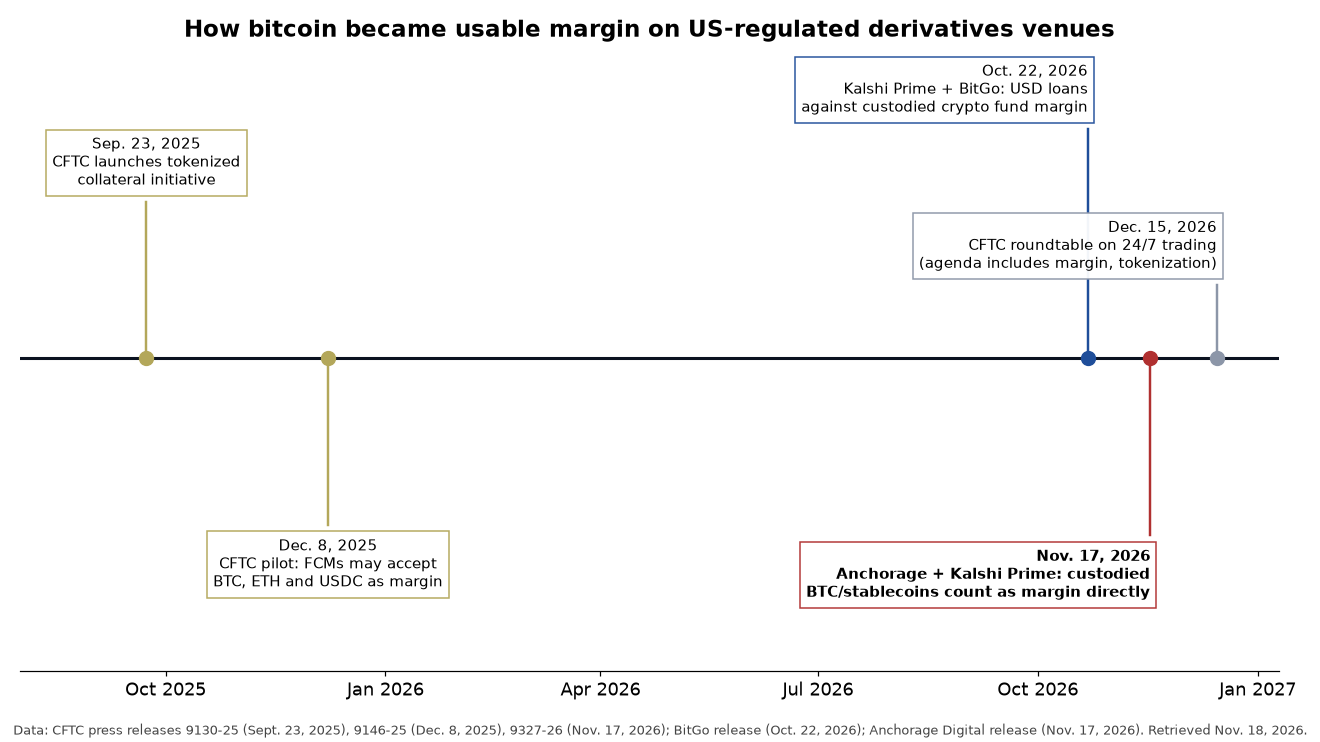
The policy work is still moving. The CFTC will hold a roundtable on 24/7 trading on Dec. 15, and its agenda lists tokenization and margin among the topics.
We looked at that agenda in detail when the CFTC asked which markets are ready for round-the-clock trading. A market that trades every day needs collateral that can move every day, and bitcoin already does.
A Smaller Regulated Futures Market Needs New Collateral
The timing is notable, because U.S.-regulated bitcoin futures have been shrinking.
CFTC data show open interest in CME’s Bitcoin and Micro Bitcoin futures stood at about 98,819 BTC on Nov. 10. That is 54.8% below the record of 218,722 BTC set on Dec. 17, 2024.
Asset managers’ long positions fell to about 19,921 BTC, from roughly 57,485 BTC at that peak. Leveraged funds’ shorts dropped to about 39,638 BTC from 138,996 BTC, a sign that the cash-and-carry trade has largely unwound.
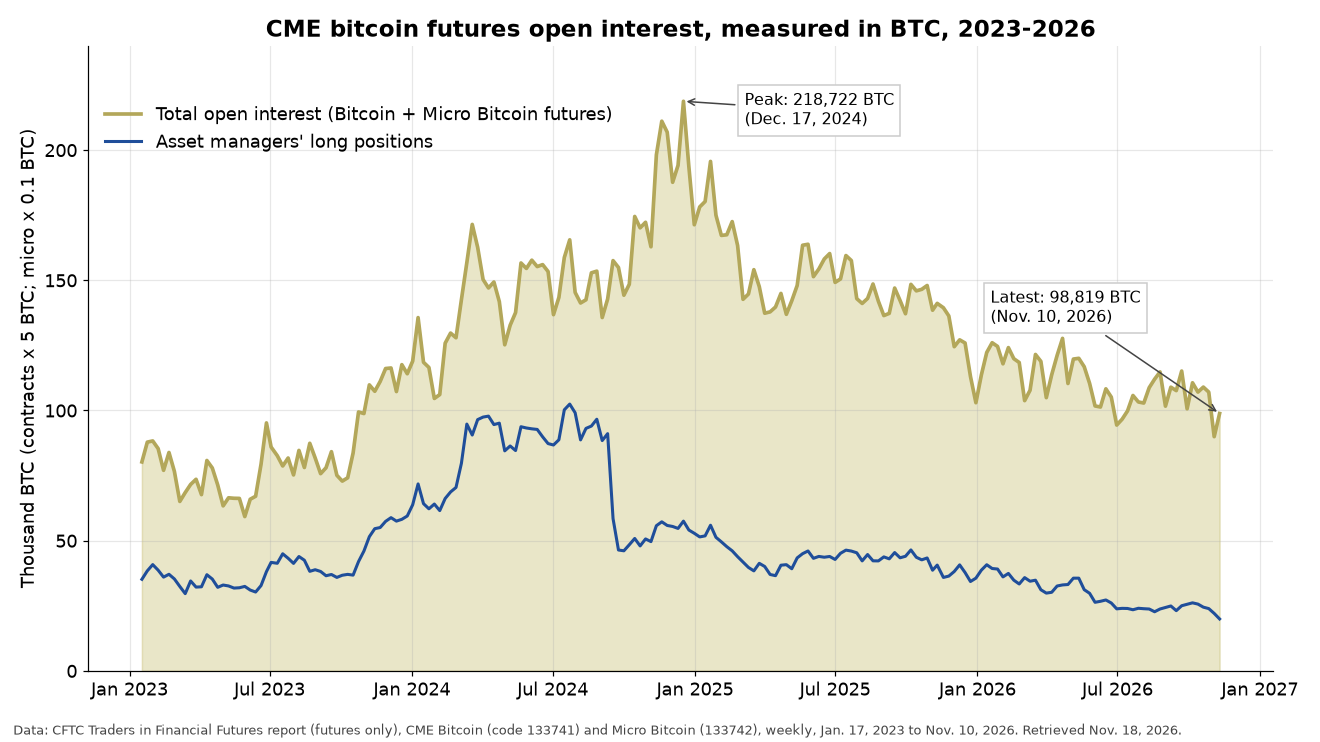
That is real weakness, and we do not want to dress it up.
But it also shows where the opportunity sits. As Anchorage notes, posting margin on a regulated venue has typically meant wiring dollars or stablecoins, or selling digital assets to raise cash.
Letting those coins count as margin, without leaving the vault, lowers the cost of taking part. The field of regulated venues is widening too, with newcomers such as the Backpack exchange approved for U.S. perpetual futures.
Can Custodied Bitcoin Become Everyday Collateral?
Bitcoin traded near $64,200 on Wednesday afternoon, according to CoinGecko data, after dipping to about $62,600 on Sunday, Nov. 15.
That is exactly the kind of market in which holders are least willing to sell.
For us, the watch list is clear. We would track whether more custodians join HODL Margining, whether Anchorage or Kalshi disclose volumes, and what the CFTC signals on margin at its Dec. 15 roundtable.
The CME positioning data is worth watching too. A recovery in asset managers’ longs would suggest the institutional bid is returning to regulated venues.
The longer-term case is straightforward. Bitcoin’s supply is fixed at 21 million coins, and the infrastructure built around it keeps maturing, from federally chartered custody to CFTC-registered venues that now accept it as margin.
Each step makes bitcoin more useful without asking anyone to give it up.
And if institutions start treating custodied bitcoin as everyday collateral, the coins sitting in vaults may become one of the most productive assets in regulated markets.
DC Forecasts is a leader in many crypto news categories, striving for the highest journalistic standards and abiding by a strict set of editorial policies. If you are interested to offer your expertise or contribute to our news website, feel free to contact us at [email protected]












Discussion about this post