



The European Commission stepped up its DAC8 enforcement on Nov. 19, giving Spain and Czechia two months to finish putting the EU’s crypto tax reporting rules into national law.
Both countries received reasoned opinions, the second formal stage of an EU infringement procedure. If they do not act, Brussels may take them to the Court of Justice of the European Union and ask for financial sanctions.
The more striking number is what did not happen. In January, the Commission warned 12 member states over DAC8. Ten months later, only two were escalated.
For Bitcoin investors in Europe, that points to a reporting regime that is nearly in place across the bloc, bringing the kind of predictable rules that institutions have long asked for.
The bigger question now is whether Madrid and Prague close the gap before the first cross-border data exchange in 2027.
What Is DAC8 and Why Does It Matter?
DAC8 is the eighth update to the EU’s Directive on Administrative Cooperation in taxation. It extends automatic information exchange between tax authorities to crypto-assets.
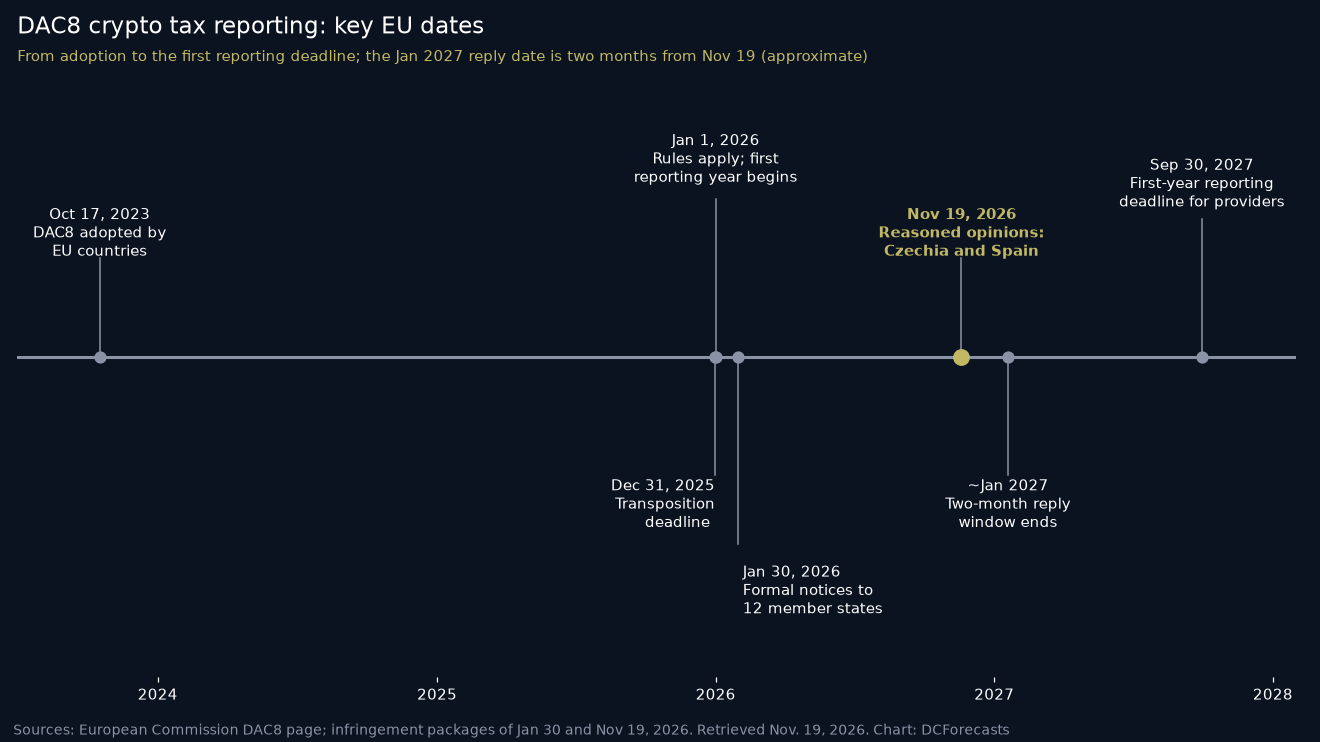
According to the Commission’s DAC8 page, EU countries adopted the directive on Oct. 17, 2023. They had to transpose it by Dec. 31, 2025, and apply it from Jan. 1, 2026.
Crypto-asset service providers must collect data on reportable transactions by all EU-resident users from Jan. 1, 2026, including residents of the country where the provider is established.
The first year’s reports are due within nine months of year-end, between Jan. 1 and Sept. 30, 2027. National tax authorities then exchange that information automatically with the other EU countries where users live.

The data is detailed. The Commission says it is broken down by each reportable crypto-asset and includes figures such as the aggregate gross amounts paid or received when buying or selling against fiat or other crypto-assets.
Providers that operate in the EU without a MiCA authorization must also register in a single member state, so one EU country oversees their reporting.
The scope is broad. The Commission says it covers stablecoins, e-money tokens, crypto-assets issued in a decentralized manner and certain NFTs.
From 12 Warnings to 2 Reasoned Opinions
On Jan. 30, 2026, the Commission sent letters of formal notice to 12 member states: Belgium, Bulgaria, Czechia, Estonia, Greece, Spain, Cyprus, Luxembourg, Malta, the Netherlands, Poland and Portugal.
In its November infringement package, it said Spain and Czechia “continue to fail fully implementing the DAC8 directive.” The case numbers are INFR(2026)0032 for Czechia and INFR(2026)0060 for Spain.
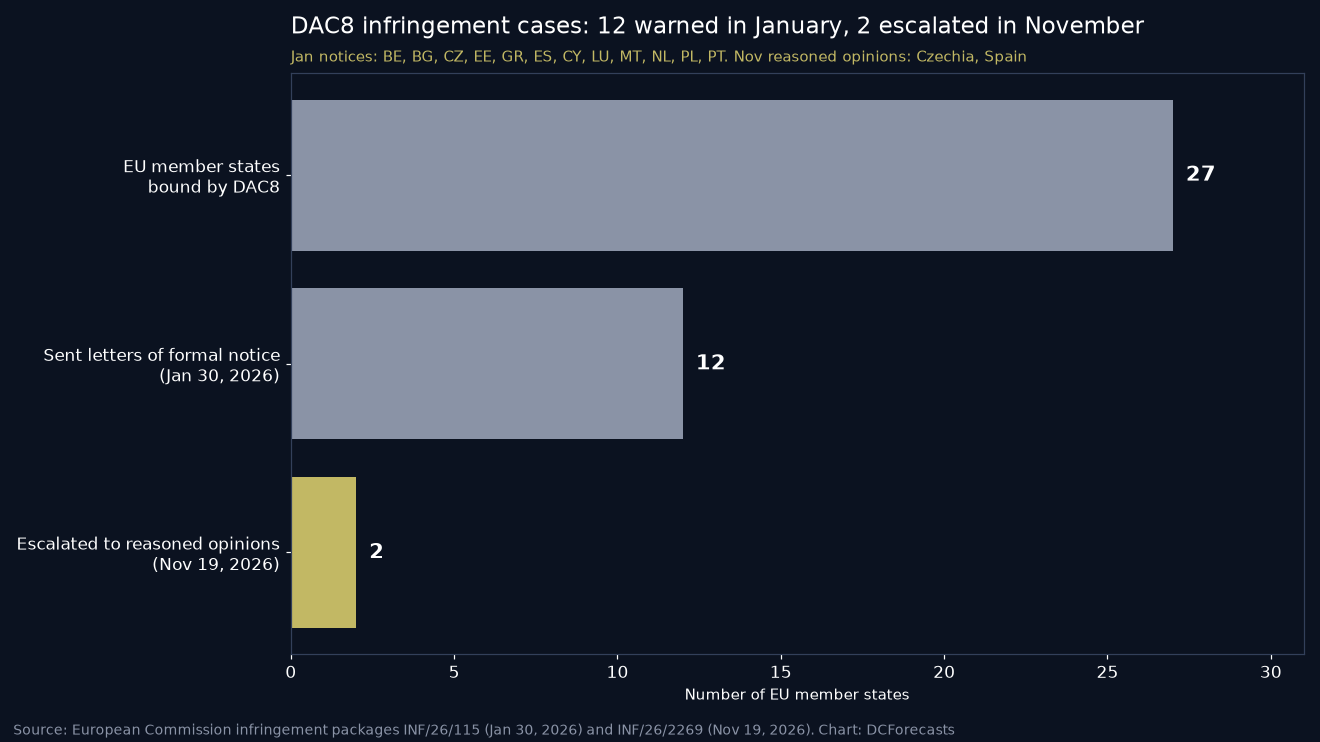
The Commission did not list the status of the other 10 cases in Thursday’s package, and not being escalated does not by itself confirm that a country has fully transposed the directive. Still, none of them moved to the next stage.
Each of those 10 countries had the same two-month window to reply in early 2026, and the Commission chose not to escalate any of them this round.
We read that as steady progress. Most of Europe appears to have done the work or is close, which means crypto users and providers face a far more uniform rulebook than a year ago.
Spain Also Faces a MiCA Case
Spain drew a second crypto-related action on the same day.
The Commission opened a separate infringement procedure, INFR(2026)2153, for failing to fully transpose a change to the Fifth Capital Requirements Directive introduced by the Markets in Crypto-Assets (MiCA) Regulation.
That amendment adds e-money issuance, including e-money tokens, asset-referenced token issuance and crypto-asset services to the list of activities subject to mutual recognition across the EU. Its transposition deadline was Dec. 30, 2024.
The Commission also said Spain had not notified implementing measures for various MiCA articles, which were due by June 30, 2025.
Portugal received a reasoned opinion over the same capital requirements change and a related whistleblower directive amendment. That follows a letter of formal notice in May 2025.
MiCA’s passporting rules have already reshaped the market, as we saw when Binance set a Dec. 31 deadline after missing a MiCA license.
The Global Picture Behind EU Crypto Tax Rules
DAC8 is the EU version of the OECD’s Crypto-Asset Reporting Framework, or CARF, published in July 2023.
The Commission notes that 76 Global Forum members had announced plans to start CARF exchanges as of March 2026, most of them by 2027.
In other words, Europe is not acting alone. Crypto tax reporting is becoming a global standard, much like the bank account reporting rules that came before it.
We believe that is a net positive for Bitcoin’s long-term adoption. Clear tax treatment lowers the compliance risk for banks, wealth managers and pension funds that want exposure.
What Happens Next for Spain and Czechia?
Both countries now have two months to respond and take the necessary measures, putting the next checkpoint in January 2027.
Most infringement cases are settled before they reach court, so the likeliest outcome is that Madrid and Prague complete their laws.
Europe’s crypto economy is already large, as our look at Western Europe’s $2.08 trillion crypto market showed. With MiCA licensing and DAC8 reporting settling into place, the region is building rails that make Bitcoin easier to hold, report and integrate into mainstream finance.
The coming weeks will reveal whether the last two holdouts move quickly enough to keep that momentum intact.
DC Forecasts is a leader in many crypto news categories, striving for the highest journalistic standards and abiding by a strict set of editorial policies. If you are interested to offer your expertise or contribute to our news website, feel free to contact us at [email protected]












Discussion about this post