


The DEATH BETS Act cleared the U.S. Senate on Thursday, Nov. 19, and would turn a regulator’s discretionary power over prediction markets into a flat ban written into law.
S. 4035 passed by voice vote after Sens. Adam Schiff (D-Calif.) and John Curtis (R-Utah) spoke on prediction markets, according to the Senate’s floor log.
It would stop CFTC-registered exchanges from listing contracts that expressly reference terrorism, assassination, war or U.S. military operations, or that are expected to settle mainly on a person’s death.
For crypto traders, the useful detail is what the bill leaves alone. Kalshi’s own market data shows the targeted contracts barely register on its open book, while Bitcoin makes up almost nine-tenths of its crypto contracts.
The bigger question is whether the House acts before this Congress runs out of time.
What the DEATH BETS Act Would Ban
The full name is the Discouraging Exploitative Assassination, Tragedy, and Harm Betting in Event Trading Systems Act.
According to the text engrossed by the Senate, it adds a new subsection to Section 5c of the Commodity Exchange Act.
A registered entity could no longer list or clear an event contract that expressly references terrorism, assassination, war or U.S. Armed Forces military operations.
The CFTC could extend that list by rule to “any similar activity” it deems necessary.

A second clause covers contracts that, at the time of listing, are “reasonably expected to resolve principally based on a death of an individual.”
Under current law, the CFTC “may determine” that event contracts involving terrorism, assassination, war, gaming or unlawful activity are contrary to the public interest. The bill removes the “may” for war and death.
How the Senate Narrowed the Original Text
The version Schiff introduced on March 10 was broader.
It reached any contract that “involves, relates to, or references” the banned topics, and any contract that “could otherwise be construed as correlating closely to an individual’s death.”
The passed text swaps that for “expressly references,” adds military operations by name, and judges the death test at the moment of listing.
It also adds a rule of construction. Nothing in the bill changes the status of contracts tied to the other activities in the existing clause, which include gaming and conduct unlawful under state law.
That line matters because sports contracts are the subject of a separate court fight. In his floor remarks, Schiff said the bill has no effect on pending litigation over whether sports contracts are swaps or whether federal law preempts state gaming rules.
Those disputes are still live, from the Fourth Circuit’s split ruling on Maryland and Kalshi to the senators’ letter on the CFTC’s geofencing order.
“With this bill, Congress is making it clear that these bets should be illegal,” Schiff wrote on social media after the vote.
What Kalshi’s Open Book Shows
To test how much business the ban would touch today, we pulled every open event from Kalshi’s public trade API on Nov. 20 at 12:25 UTC.
That came to 22,526 events with about 1.37 billion contracts of open interest. Each Kalshi contract pays up to $1.
Sports led with 640.3 million contracts, or 46.9%. Elections followed with 453.5 million, or 33.2%. Together, they hold just over 80% of the book.
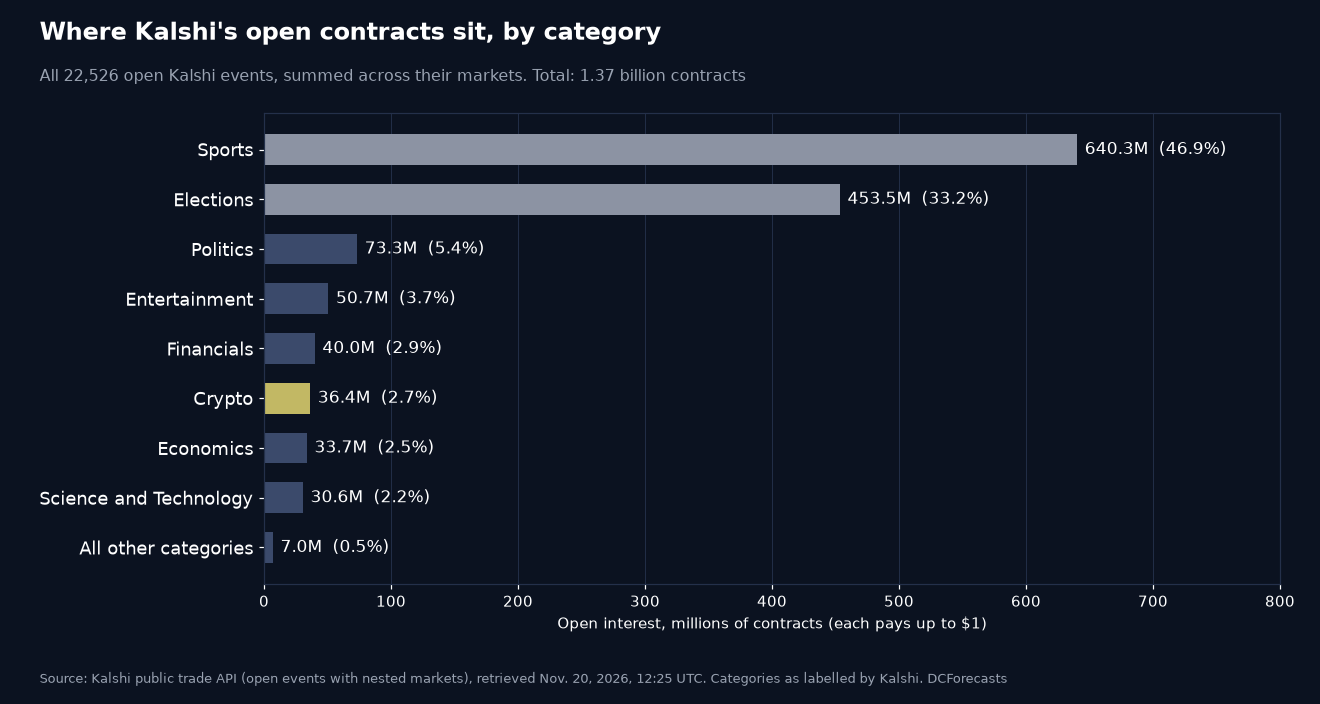
Kalshi’s “World” category held only three open events and about 132,000 contracts.
A keyword scan of all open event titles for war, terrorism, assassination, military and death terms returned 15 matches. None was a bet on how a war unfolds or on someone dying.
The matches were false positives: art auction lots, a cricket match featuring a team called the Warriors, and a question on renaming the Department of Defense. The largest, a market on whether President Trump announces his departure, is titled “(Excluding death).”
This is a snapshot of one venue’s open markets. It says nothing about contracts that have already closed, or about offshore platforms outside CFTC reach.
Still, we read it as a sign the bill codifies a line one of the biggest CFTC-regulated venues already appears to follow, rather than cutting into its core business.
Why Bitcoin Contracts Sit Outside the Fight
Kalshi’s crypto category holds 36.4 million contracts, or 2.7% of open interest.
Of that, 32.3 million contracts, or 88.8%, sit in Bitcoin series, based on the asset named in each series ticker. Ether accounts for 2.5 million and everything else for 1.5 million.
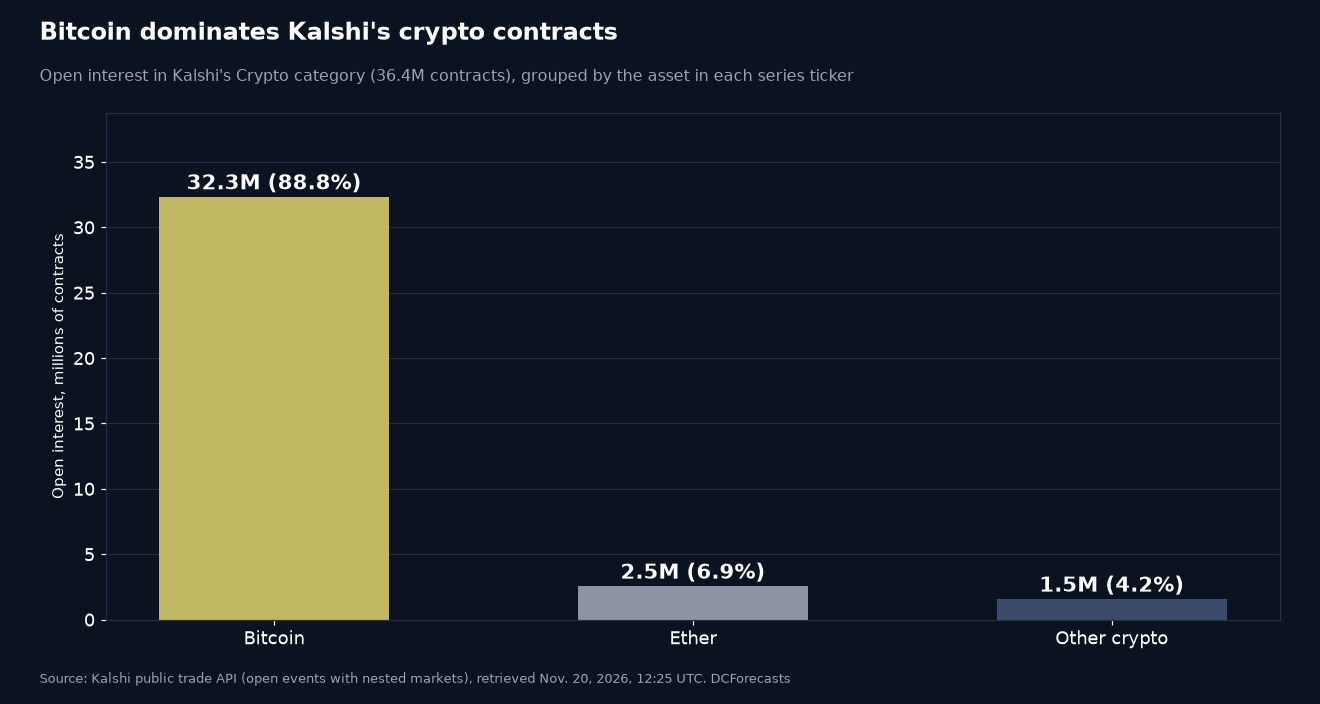
Those are contracts on where BTC trades by a given date or how high it climbs this year. None references war, terrorism or a death, so the Senate text does not reach them.
We believe that is the constructive takeaway for Bitcoin holders. Regulated prediction venues have become another place to express a view on BTC, and narrow, bipartisan guardrails make that venue easier to defend in Washington.
It fits a busy month for event contract rules, from the CFTC’s freeze on Kalshi’s Trump word bets to Polymarket US listing oil and gas contracts.
Can the House Finish the Job?
The DEATH BETS Act is not law yet. It needs House passage and the president’s signature.
A House version, H.R. 7942, was introduced on March 16 by Rep. Mike Levin (D-Calif.). It has three cosponsors: Reps. Seth Moulton (D-Mass.), Blake Moore (R-Utah) and Zach Nunn (R-Iowa).
That bill was referred on April 3 to the Subcommittee on Commodity Markets, Digital Assets, and Rural Development, and has not moved since.
Because the Senate amended its text, the House would need to take up the Senate-passed version for it to reach the White House unchanged.
Our watch list is short: whether the House Agriculture Committee schedules it, whether the CFTC uses its new rulemaking hook, and whether crypto keeps growing its slice of Kalshi’s open interest.
For now, the line Congress is drawing runs around war and death, not around markets on prices and policy. Bitcoin contracts sit comfortably on the permitted side of it.
DC Forecasts is a leader in many crypto news categories, striving for the highest journalistic standards and abiding by a strict set of editorial policies. If you are interested to offer your expertise or contribute to our news website, feel free to contact us at [email protected]











Discussion about this post