



America’s big-dollar payment rail is preparing for Fedwire Sunday hours, but a new Federal Reserve survey shows most banks are not yet planning to use the extra day for one of their core funding markets.
Only 8 of 91 banks, or 8.8%, said they plan to be operationally ready to trade in the fed funds market on Sundays and weekday holidays once the expansion arrives.
Another 45.1% said no, and 46.2% were unsure.
For Bitcoin investors, the contrast is hard to miss. The traditional system is planning, in careful steps, for a seven-day settlement calendar that Bitcoin has used since its 2009 launch.
The bigger question is how long the “closed on weekends” model can last as 24/7 trading spreads across finance.
What the Fed’s Survey Found
The Federal Reserve Board released the results of its September 2026 Senior Financial Officer Survey on Nov. 20.
The survey went to senior financial officers at 100 banks on Sept. 18, with replies due Sept. 28. In all, 91 banks answered: 56 domestic banks and 35 foreign banking organizations.
Together, the respondents held about three-fourths of all reserve balances in the U.S. banking system, so this is a meaningful sample of the institutions that move the most money.
Most of the survey covered reserve levels and money markets. Its final section asked how banks are preparing for weekend and holiday operations.

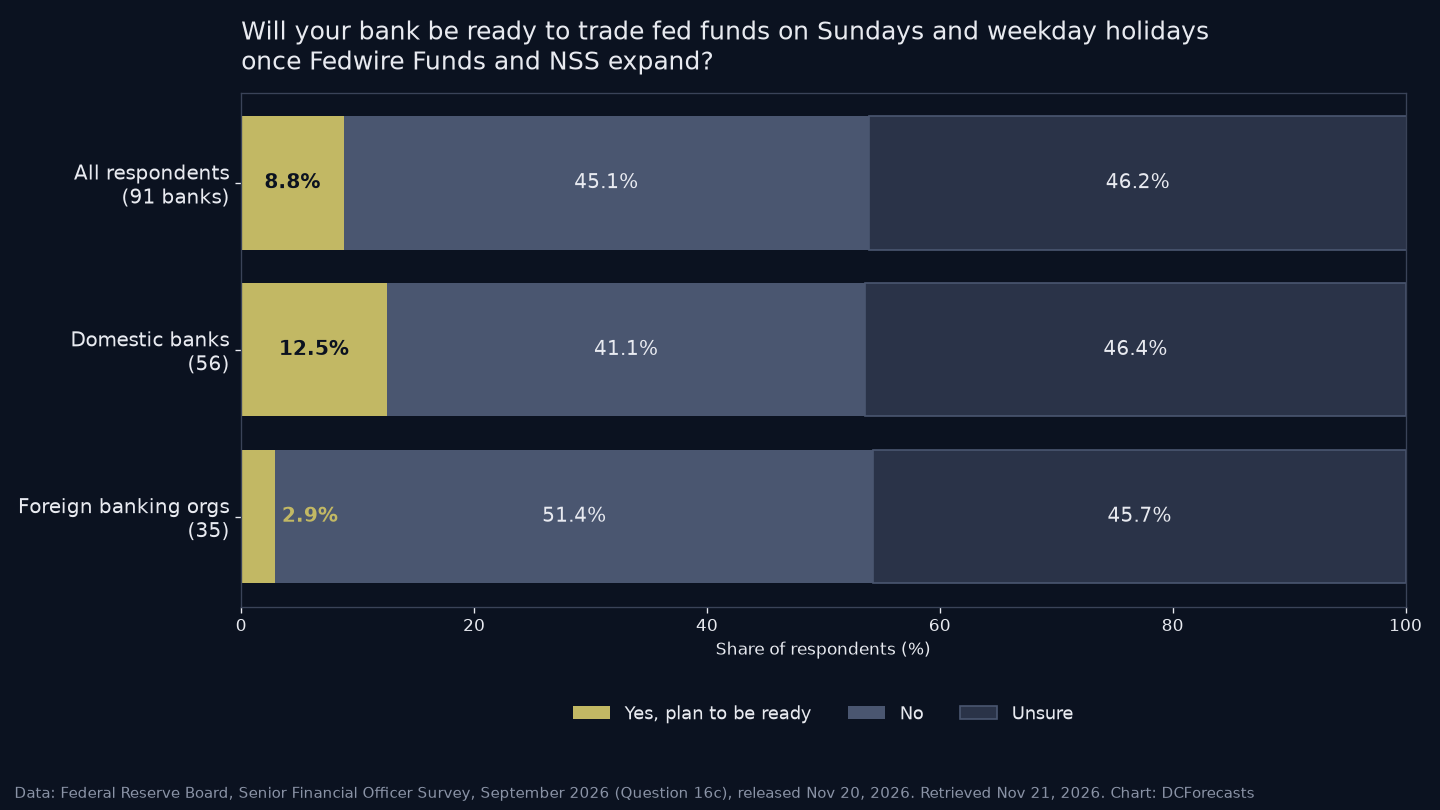
Domestic banks were more forward-leaning. Among them, 12.5% plan to be ready for Sunday fed funds trading, compared with just one foreign banking organization, or 2.9%.
Why Fedwire Sunday Hours Matter
The change behind these questions was set in motion more than a year ago.
On Oct. 9, 2025, the Fed announced that the Fedwire Funds Service and the National Settlement Service would expand from Monday through Friday to Sunday through Friday, including weekday holidays.
The Reserve Banks will implement the change no earlier than 2028. Fedwire Funds will keep its 22-hour operating day, and NSS will stay at 21.5 hours.
Saturday stays closed. The Board said it will monitor demand for a possible further move to seven days a week, which would require a new proposal and public comment.
That matters because Fedwire is where banks settle large-value dollar payments in central bank money. When it is shut, so are many of the funding channels that sit on top of it.
Banks Are Talking, but Few Are Staffing Up
The survey suggests preparation is still at an early stage.
About 68.1% of respondents said the industry’s move toward weekend and holiday operations has led to more management discussions. A third, 33.0%, are offering or planning to offer clients more weekend payment and liquidity tools.
Spending is following more slowly: 28.6% have raised or plan to raise technology budgets for weekend liquidity operations, and 24.2% have put more staff into planning.
Only three banks, or 3.3%, reported that more liquidity operations staff are actually working on weekends and holidays today.
The discount window is a bigger concern. Nearly two-thirds of domestic banks said it is important to be able to borrow from it on Sundays and weekday holidays, during at least some hours or during normal weekday hours.
Uncertainty runs through the answers. About 24.2% expect to temporarily raise reserves ahead of weekends and holidays, 34.1% do not, and 41.8% are unsure.
A Network That Never Closes
Bitcoin has no operating days to expand and no concept of weekend banking. Blocks keep arriving on Saturdays, Sundays and holidays, with no settlement window to open or close.
We counted daily blocks from Oct. 24 to Nov. 20 using mempool.space block data. The network produced 3,948 blocks over those 28 days, or about 141 a day.
The eight weekend days averaged roughly 144 blocks, slightly above the weekday average of about 140. The busiest day in the window was Sunday, Nov. 15, with 172 blocks.
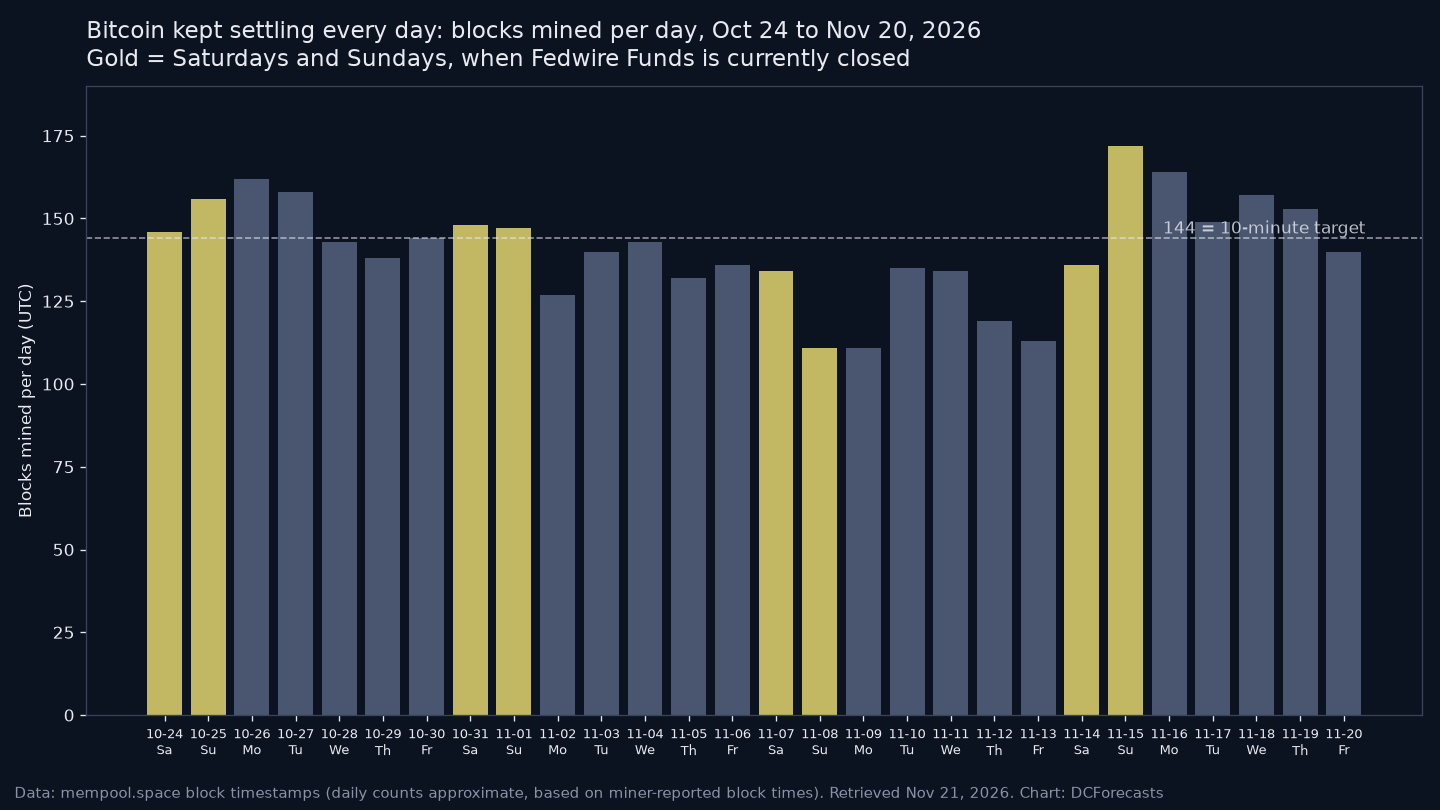
These counts are approximate, since block timestamps are set by miners. Still, the pattern is clear: weekends look like any other day on the Bitcoin network.
The Fed itself already runs one always-on rail. Its FedNow Service is designed for 24x7x365 processing, with a business day that includes weekends and holidays. FedNow, however, handles instant retail-style payments, not the large interbank flows that move through Fedwire.
Where 24/7 Trading Goes From Here
Regulators are clearly looking at the same trend. As we covered when the CFTC set the agenda for its Dec. 15 roundtable on 24/7 trading, weekend derivatives, tokenization and operational readiness are all on the table.
Tokenized assets are adding pressure too. We noted in our look at the IOSCO tokenization report that on-chain versions of traditional assets are growing quickly, and those markets do not stop on Friday afternoon.
We believe the Fed survey captures a system in transition. Banks see 24/7 trading coming, but their funding desks and back offices were built for a five-day week.
For Bitcoin, that is a quiet strength. Its settlement layer already works through every weekend and holiday, with no expansion plan, staffing decision or 2028 start date required.
If the weekend gap in traditional finance keeps narrowing, investors may start to see Bitcoin’s round-the-clock settlement less as a curiosity and more as the standard others are working toward.
DC Forecasts is a leader in many crypto news categories, striving for the highest journalistic standards and abiding by a strict set of editorial policies. If you are interested to offer your expertise or contribute to our news website, feel free to contact us at [email protected]












Discussion about this post