


Federal Reserve Governor Lisa Cook used a speech in Santiago, Chile, on Nov. 20 to make one point very clear: she does not think the Fed has done enough on inflation.
Inflation “is well above the Fed’s 2 percent target and has been for 67 months,” Cook said. She added that she is “skeptical that September’s single 1/4 point rate increase will be enough to change the path of inflation.”
The remarks land less than three weeks before the Fed’s Dec. 8-9 meeting, and on the same day Bitcoin traded as low as $57,655 on Coinbase, its weakest level since September 2024.
For Bitcoin investors, the most useful part of the speech is not the hawkish tone. It is the reason behind it: a dollar that has lost purchasing power faster than the Fed intended for nearly six straight years.
The bigger question is whether the December FOMC meeting brings another Fed rate hike, and how much of that risk markets have already absorbed.
What Did Lisa Cook Actually Say?
Cook delivered the keynote address at the 29th Annual Conference of the Central Bank of Chile. The policy section was blunt.
Based on data released last week, she estimated that the PCE price index rose 3.8% in the 12 months to October. Core PCE inflation, which strips out food and energy, was estimated at 3.2%.
“Thus far, there is little evidence inflation is declining,” Cook said. She pointed to brisk price increases across airfare, appliances, furniture, hotels and restaurants.
In her view, the economy gives the Fed little reason to hold back. Unemployment was 4.1% in October, payrolls rose by 165,000, and GDP grew at a 3.4% annual pace in the third quarter.

Her summary was simple: “waiting to act when a policy adjustment is required has a cost.”
Why Cook Broke With the Majority in October
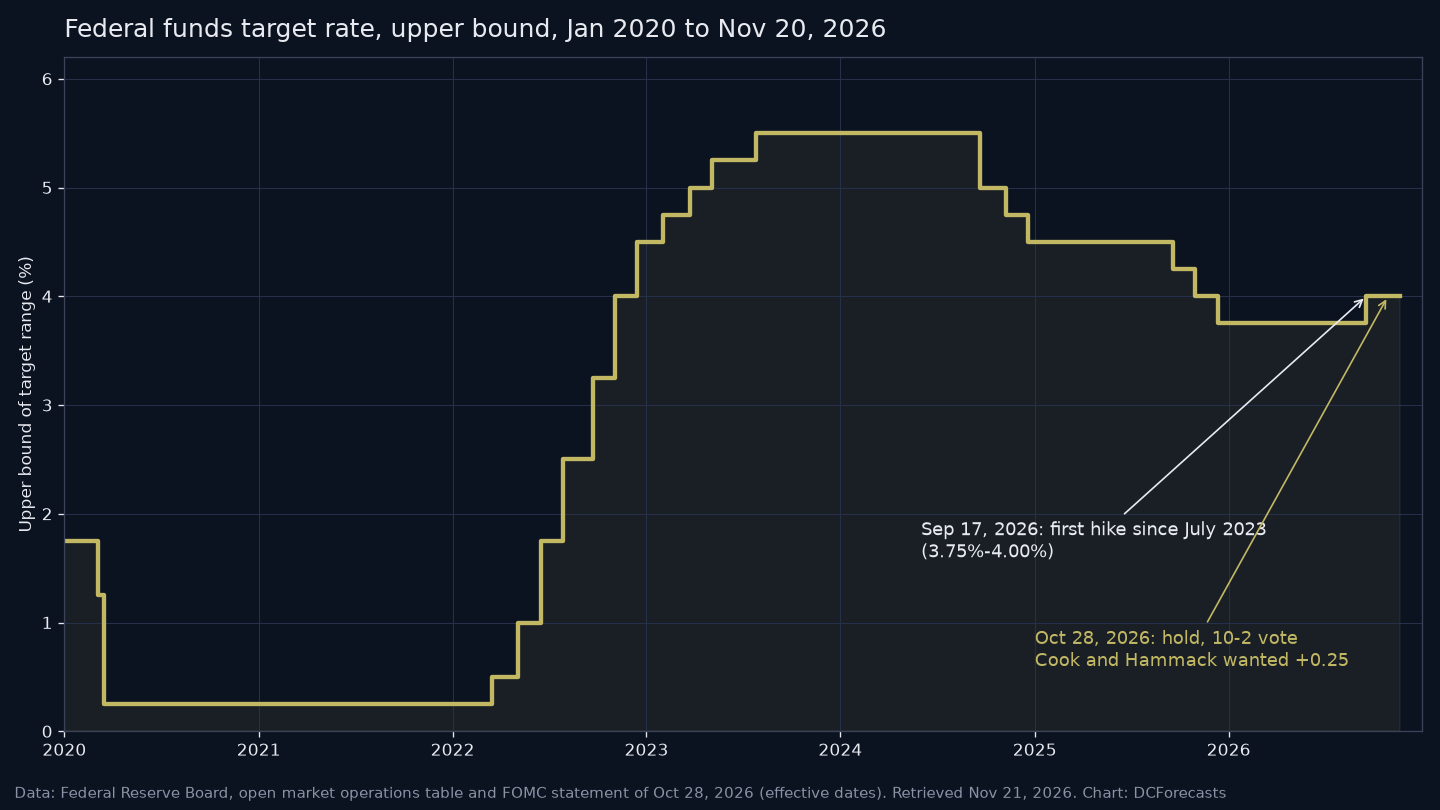
The Fed raised its target range to 3.75%-4.00% in September, its first increase since July 2023, according to the Fed’s record of rate changes. Cook supported that move.
At the Oct. 28 meeting, the Committee held rates steady by a 10-2 vote. The official statement shows Cook and Cleveland Fed President Beth Hammack dissented in favor of another quarter-point hike.
Cook gave two reasons. First, she sees financial conditions as too loose. “The current stance of policy does not appear to be curtailing the AI buildout, and equity prices continue to support consumer spending,” she said.
Second, she worries about expectations. Every extra month above target raises the risk that higher inflation gets built into prices and wages.
If the Fed falls behind, she warned, “additional and larger rate increases may be required later to catch up.”
Board governors vote at every meeting, so Cook’s view is more than commentary.
A 67-Month Inflation Streak in Context
The Fed’s target is set on PCE inflation, but consumer price data from the Bureau of Labor Statistics tells the same story.
Headline CPI was last at or below 2% year over year in February 2021, when it stood at about 1.7%. It peaked near 9.1% in June 2022, cooled to roughly 2.4% by January 2026, then climbed back to about 4.2% in May.
In September, headline CPI ran 3.7% above a year earlier and core CPI ran 2.6%.
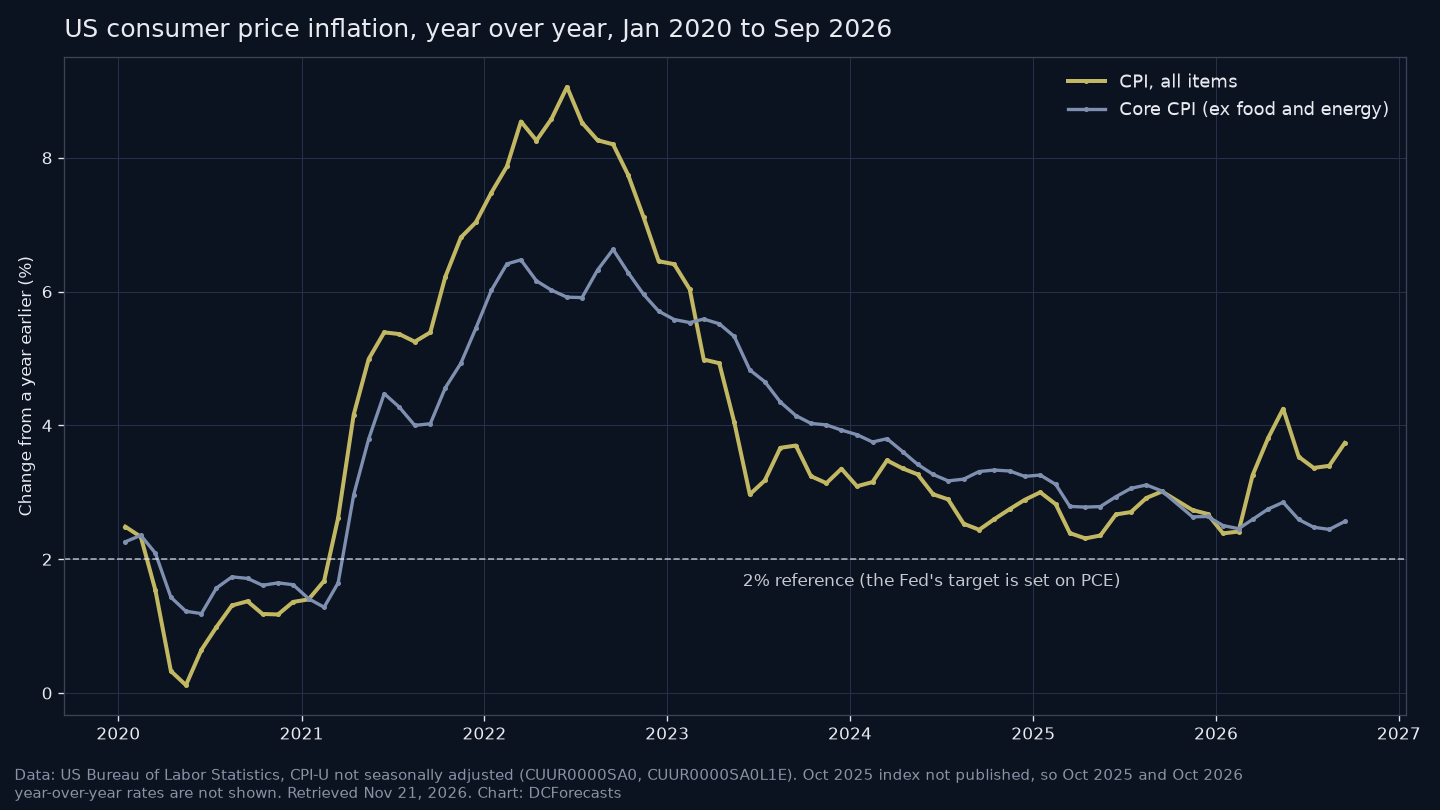
Cumulatively, the CPI index rose about 28% between February 2021 and October 2026, based on BLS data.
Cook is not alone in her concern. As we covered when the October FOMC minutes were released, nearly every official expects more hikes, and a couple discussed a larger one.
How Bitcoin Is Handling the Fed Rate Hike Debate
Bitcoin has felt the pressure. It traded near $58,830 on Coinbase early on Nov. 21, about 14% below its Nov. 14 opening price of roughly $68,240.
The Nov. 20 low of $57,655 was the lowest since Sept. 17, 2024. As we noted in our report on the cross-asset selloff, gold and the Nasdaq fell alongside it.
This has been a broad move into cash, not a verdict on Bitcoin’s network or adoption.
History also offers some perspective. Our review of past tightening cycles found that Bitcoin was higher a year later after 16 of the last 20 Fed rate hikes.
We believe that a large part of the hawkish case is already well known. Two dissents and hawkish minutes have been public for weeks, and markets have repriced sharply since.
That is not a guarantee of a bottom, but it suggests much of the bad news is already in the price.
Why a Long Inflation Streak Strengthens the Bitcoin Case
Cook’s speech is ultimately about trust in money. Prices have run above the Fed’s goal for 67 months, and officials are debating how hard to squeeze the economy to regain control.
Bitcoin’s monetary policy does not need a committee vote. Supply is capped at 21 million coins, and new issuance has been fixed at 3.125 BTC per block since the April 2024 halving.
In the short term, higher rates can weigh on every risk asset, Bitcoin included. Over longer periods, persistent inflation is one of the clearest arguments for a scarce, rules-based asset.
For the weeks ahead, we would watch four things: the next PCE release, Treasury yields, spot Bitcoin ETF flows and the Fed’s Dec. 9 decision.
If inflation finally starts to cool, the pressure for more hikes could ease quickly. And if it does not, Cook’s 67-month count will keep reminding investors why Bitcoin’s fixed supply was designed in the first place.
DC Forecasts is a leader in many crypto news categories, striving for the highest journalistic standards and abiding by a strict set of editorial policies. If you are interested to offer your expertise or contribute to our news website, feel free to contact us at [email protected]












Discussion about this post